
MLS: From World Cup Legacy to Major League Football
“Thanks world, we’ll take it from here.”
It’s a line delivered with a grin and a challenge, fronted by Lionel Messi, Son Heung-min, David Beckham and a cast of MLS faces in a slick new campaign aimed squarely at the millions of Americans who fell for football during the World Cup. The message is blunt: don’t switch off now. The real thing is on your doorstep.
The film rolls through World Cup heroes now based in the US, urging new fans to follow them back into the grind of the regular season. The league is even dangling free tickets to first-timers. This is not a soft sell. It’s an ambush.
“The World Cup has now exposed millions of people to Major League Soccer,” says MLS executive vice-president Dan Courtemanche, who has been around since before the first ball was kicked in 1996. “We’re going to continue to capitalise on that momentum.”
The question hangs over everything: could this be the moment MLS finally muscles its way into football’s elite?
From World Cup experiment to 30-club heavyweight
MLS itself is a World Cup legacy project. When the US bid to host the 1994 tournament, Fifa demanded a proper professional league. The country got the World Cup – and the obligation.
What followed was modest. Ten teams. No football-specific stadiums. A league that felt more like a promise than a product.
Thirty years on, the landscape is unrecognisable. MLS now boasts 30 clubs and almost as many purpose-built football venues. Concrete proof that this was more than a passing fad.
The latest World Cup on US soil pushed that story on again. Predictions of swathes of empty seats, priced out by sky-high tickets, never materialised. Stadiums were full, noise relentless, and the TV numbers forced even the sceptics to pay attention.
The USA’s last-16 defeat by Belgium delivered the most-watched football match ever on a single US network, drawing more than 33 million viewers on Fox. England’s last-16 win over Mexico went even bigger: a combined 45 million across Fox and Telemundo, the largest football audience in US history.
Those figures live in the same neighbourhood as the NFL, the sport that still owns the word “football” in America. They don’t yet touch the Super Bowl – the 2025 edition, with Kendrick Lamar on the half-time stage, reached 127.7 million viewers across English, Spanish and streaming – but the gap no longer feels impossible.
MLS, which has grown steadily since 1996, now talks openly about joining Europe’s elite.
“I think we’re looked at as the top, one of the top leagues commercially,” commissioner Don Garber said at a recent event on the league’s future and the World Cup legacy. “We’ve cracked that code. Now we’ve got to crack the rest of it.”
From “retirement league” to launchpad
On the pitch, the league has already edged into the global conversation. Forty-five MLS players went to the 2026 World Cup, including two in Argentina’s winning squad: Messi and Rodrigo de Paul.
For years, MLS was dismissed as a sun-drenched farewell tour for European icons. Beckham, then Zlatan Ibrahimovic, now Messi – the narrative wrote itself. Big names, big contracts, fading legs.
Courtemanche insists that picture is out of date. The average age of new international arrivals is now 23.8. These are players looking to climb, not coast. Many still see MLS as a stepping stone to Europe, but that, in itself, marks a shift. The league is part of the pathway, not an afterthought.
To tighten that link, MLS will switch to a summer-to-spring calendar in 2027, syncing more closely with Europe’s schedule and smoothing mid-season transfers in both directions. The league’s hierarchy has also pushed hard into youth development, building a structure they hope will eventually rival the best academies overseas.
Every MLS club now runs an academy. At an LA Galaxy viewing party for the USA’s win over Bosnia-Herzegovina, the future was easy to spot – and it wasn’t on the big screen. Dozens of children ignored the broadcast, locked instead in three frantic small-sided games nearby, only glancing up when the roar of a goal rolled through the crowd.
In a country where children’s lives are timetabled to the minute, these were rare, unscripted pick-up matches. The quality stood out. Some of those kids already wear MLS badges on their training tops.
One of them, eight-year-old Landon – named after US great Landon Donovan – darted between positions, happily swapping goalkeeper gloves for a striker’s role. His mother, coach Jen Wing, says her children have attended MLS camps and play for travel teams back home in New Jersey. Landon doesn’t hesitate when asked about his dream.
“LAFC,” he says.
The price of a dream
This is where the optimism hits a familiar American problem.
Critics argue MLS will never truly compete with Europe while the country clings to its “pay-to-play” culture. At the top, MLS academies mirror European models, training and developing players free of charge. The issue lies in the road that leads there.
To reach the level where an MLS academy even notices a teenager, families often shell out thousands of dollars on private coaching and travel teams. It’s a pattern repeated across US sport. Talent matters, but so does a family’s bank balance.
League officials insist the picture is changing. They point to evolving development leagues and scholarship schemes in every club, insisting the net is widening. Garber talks about an ongoing project, not a finished product, and about building players who can feed the men’s national team with more quality, more often.
“More and more to the men’s national team and just be better, bigger, stronger, faster,” he says, sketching out a future where MLS doesn’t just benefit from the USMNT’s profile, but helps define it.
Messi, movie stars and money
For now, one man still towers over everything.
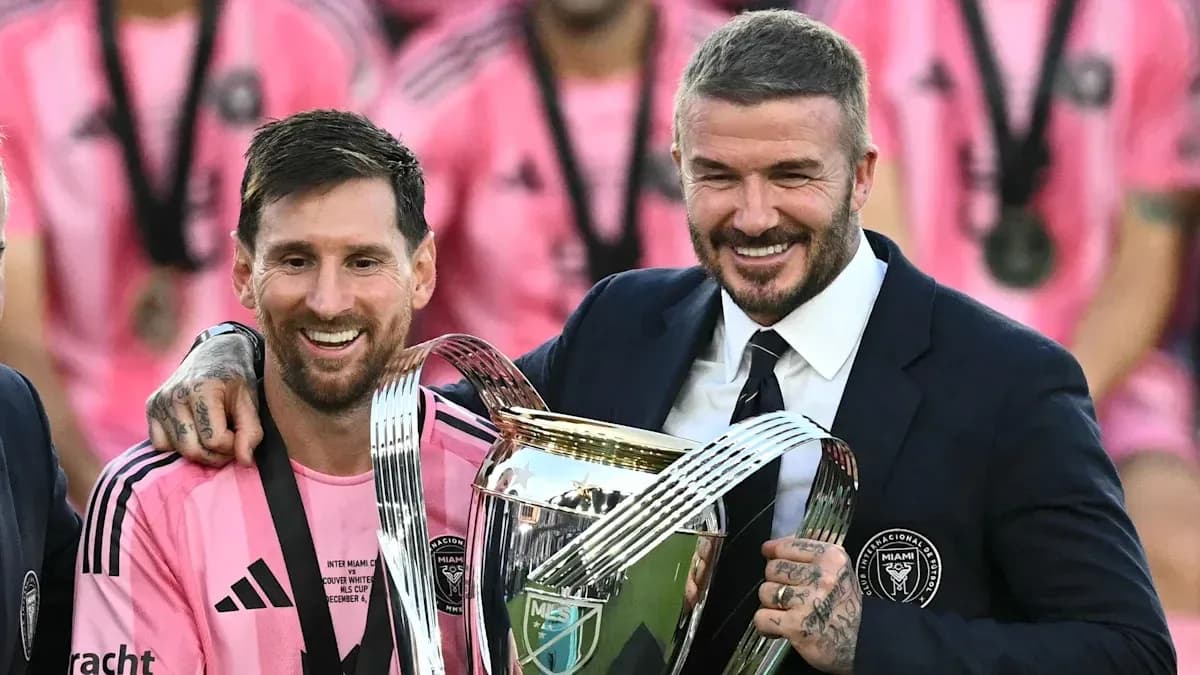
Messi is MLS’s greatest attraction, the gravitational force pulling in casual fans and hard-core obsessives alike. Wherever Inter Miami go, the circus follows. Ticket prices spike. Stadiums sell out. Neutral fans turn up in pink.
But the stardust doesn’t stop at the touchline. Ownership groups across the league read like red-carpet guest lists. Will Ferrell at LAFC. Reese Witherspoon in Nashville SC. Matthew McConaughey at Austin FC. Magic Johnson also tied to LAFC. MLS isn’t just selling sport; it’s selling a lifestyle.
The money has followed. When Drew Carey bought into Seattle Sounders in 2009, the expansion fee was $30m. The club is now valued at more than $900m. Beckham’s 2007 LA Galaxy contract famously included an option to buy an expansion team for $25m. He exercised it, created Inter Miami CF, and now sits on a franchise valued by experts at more than $1bn.
The league that once begged for relevance has become a serious investment play.
Friday night lights vs Saturday morning chairs
Yet the cultural headwind remains.
Even in the middle of a football frenzy, many in the game believe American football will always hold the country’s heart. The rituals run deep.
Brian Udovich watches the tug-of-war up close. His 12-year-old son, Croil, plays in an MLS Next Level league in Southern California, but Udovich has seen plenty of talented teenagers drift away from football and into Friday night lights.
On those nights, high school American football players step into giant stadiums, names on the scoreboard, marching bands blaring, cheerleaders on the sidelines. It’s spectacle, tradition, identity.
Soccer? That’s often Saturday morning, a few parents in folding chairs, coffee in hand. No bands. No lights. No mythology.
“It just means so much more to other cultures than us,” Udovich says, summing up a gap that can’t be closed by marketing alone.
Michael Bradley, now coaching New York Red Bulls, sees it differently. He accepts that American culture is its own beast and that the US doesn’t have the long, layered football history of Europe or South America. For years, that absence fed an inferiority complex – a nagging suspicion that the sport would never truly stick.
Bradley believes that era is over. He talks about pride, about a fanbase that no longer feels the need to apologise for loving the game.
“I think we can all unequivocally say in 2026, football is not going anywhere,” he told the BBC.
The World Cup has come and gone. The stadiums have emptied. The cameras have moved on.
Now MLS has to prove it can keep that promise.




