
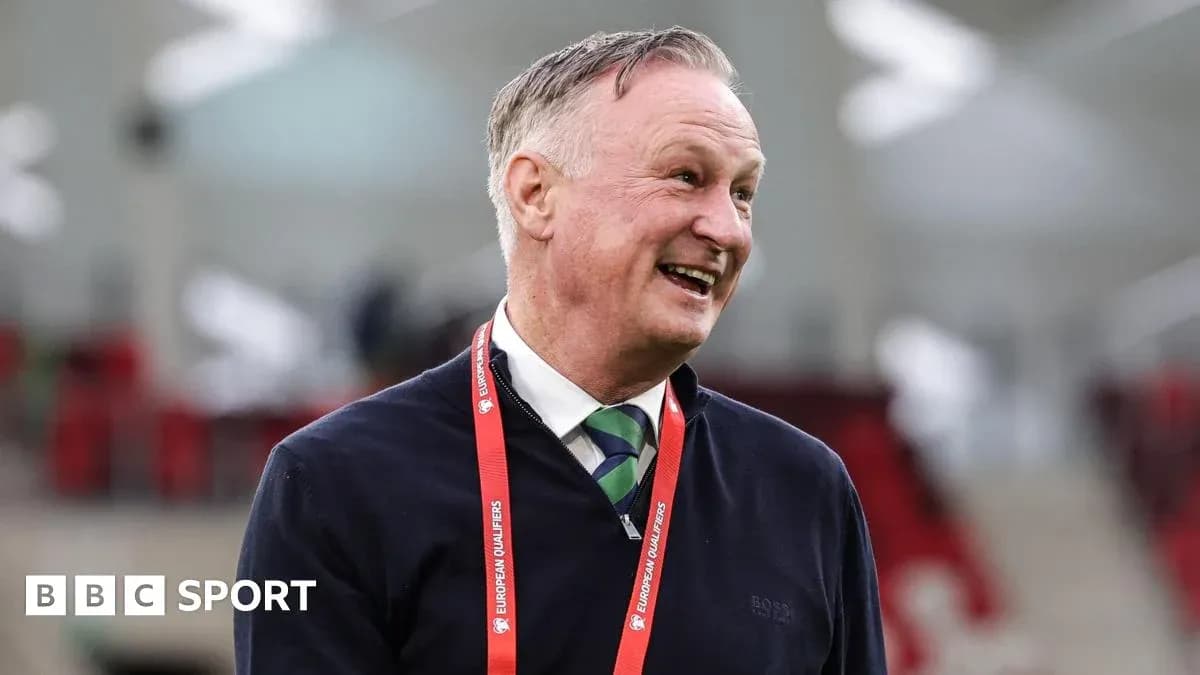
Michael O'Neill Commits to Northern Ireland Until 2032
Michael O’Neill has tied his future to Northern Ireland for the long haul, signing a four-year contract extension that will keep him in charge until 2032 and cementing his status as the defining managerial figure of the modern era.
The deal ends any lingering doubt over his direction after a turbulent few months in which he briefly straddled international duty and club football. Appointed interim Blackburn Rovers boss in February, O’Neill had been juggling Ewood Park with Windsor Park, a demanding double life that always felt temporary. Earlier this month, Blackburn confirmed he would not take the role on a permanent basis. The path back to full focus on Northern Ireland opened up immediately.
It suits him. And it suits them.
A Record-Breaking Reign
At 56, O’Neill already stands alone in the record books: 104 games in charge across two spells, more than any other Northern Ireland manager. His first tenure, beginning in 2011, dragged the team out of a long slumber and into Euro 2016, their first major tournament in three decades. That summer in France reshaped expectations. Northern Ireland stopped seeing qualification as a fantasy and started treating it as a target.
He left in 2019 to become permanent Stoke City boss, initially attempting to combine the club job with his Northern Ireland role before finally stepping away from the international scene. The separation never felt absolute. When Stoke parted company with him in 2022, the Irish FA moved quickly. O’Neill returned, older, more battle-scarred, but still convinced there was another chapter to write.
“This is a role that means a great deal to me,” he said after signing the new deal. The words were simple, but the message was clear: this is not a short-term patch-up job. It is a long-term project.
Rebuild After Heartbreak
The project has not been straightforward. His second spell has been defined less by nostalgia for 2016 and more by the grind of rebuilding. Northern Ireland failed to reach Euro 2024, a reminder that the margins at this level remain brutal. Then came the latest blow: a play-off defeat by Italy that crushed their hopes of reaching the 2026 World Cup.
That loss could have signalled the end of a cycle. Instead, it has become the starting point for the next one.
“I continue to believe strongly in the potential of this group of players and the direction we are moving in,” O’Neill said. “There is a lot of work ahead, but I am excited by the future.” It is not empty optimism. His squad looks very different from the one that went to France eight years ago.
Conor Bradley, Shea Charles and Isaac Price have moved from promising names on a teamsheet to central figures in a young, hungry side. O’Neill has leaned into the transition rather than resisting it, accepting the short-term pain that comes with blooding a new generation.
The results are starting to flicker into view. Northern Ireland topped League C3 of the 2024/25 Nations League, finishing with three wins, two draws and just one defeat. It was not headline-grabbing in the way Euro qualification would be, but it restored a sense of momentum and credibility.
Tests Ahead: Guinea, France and the Nations League
Now comes the next phase. The calendar is already loaded with tests that will reveal how far this group has come.
First up, an international friendly against Guinea on 4 June. On paper, it is a low-key assignment, a chance to experiment and fine-tune. Four days later, the tone changes completely: a trip to face France, one of the powerhouses of the international game and a brutal measuring stick for any evolving side.
Those matches are more than warm-ups. They are stepping stones into a Nations League campaign that could shape the mood around O’Neill’s extended reign. Northern Ireland have been drawn into Group B2 alongside Hungary, Georgia and Ukraine – a section with no easy nights and plenty of jeopardy.
Finishing top of League C3 showed they can handle expectation. Surviving, and thriving, at the higher level will demand another leap.
Eyes on 2028
Everything, though, keeps looping back to one date: Euro 2028.
The tournament, staged across the United Kingdom and the Republic of Ireland, offers Northern Ireland a rare chance to chase qualification for a major finals that will be played on familiar soil. For O’Neill, who once led his country into a European Championship abroad, the prospect of returning to the big stage within the British and Irish isles is a powerful lure.
He has now been in charge for a combined 11 years over his two spells. Few international managers anywhere in Europe can match that sort of longevity. It brings with it not just loyalty, but responsibility. The Irish FA have nailed their colours to O’Neill’s mast; the next four years will show whether the faith is repaid with another defining qualification campaign.
The rebuild is underway, the contract is signed, the young core is emerging. The question now is simple: can Michael O’Neill turn this second era into something that lives alongside – or even surpasses – the magic of 2016?




