Max Dowman shines while JJ Gabriel seeks exit from Manchester United
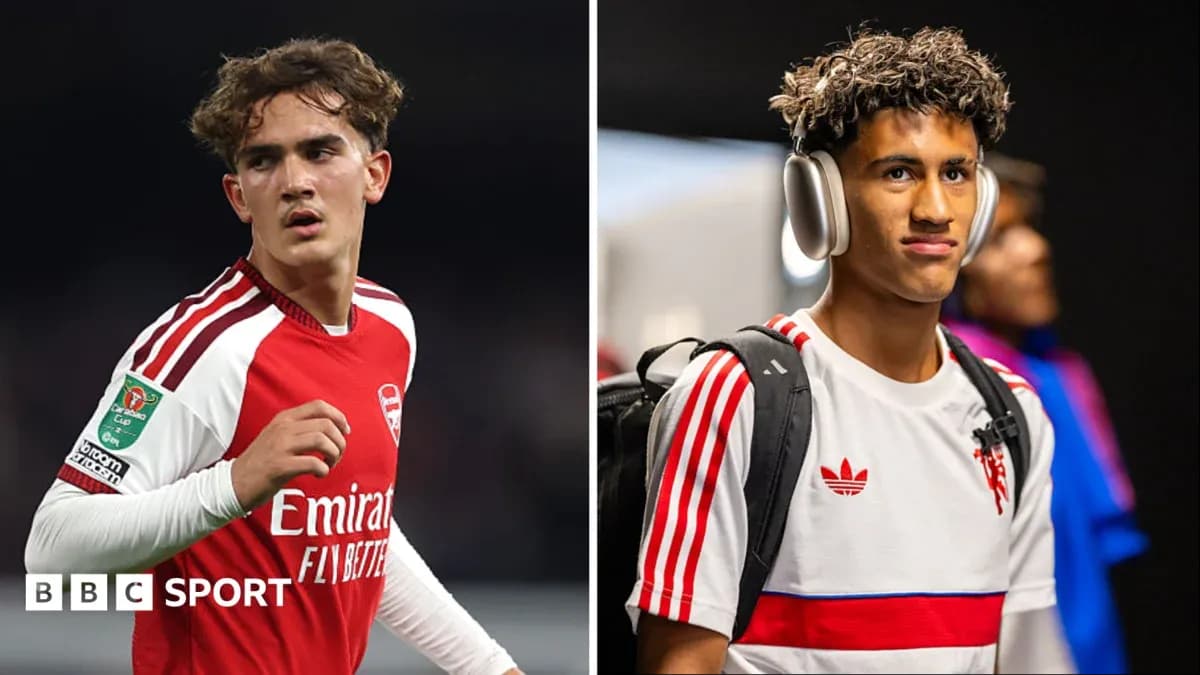
Max Dowman and JJ Gabriel are barely old enough to sit their GCSEs. Yet one is scoring twice in front of packed away ends, the other is asking to walk out of one of the biggest clubs in the world.
Two teenagers. Two very different headlines. One unforgiving system.
Dowman dazzles, Gabriel pushes for the exit
On Tuesday night at Portman Road, 16-year-old Arsenal winger Max Dowman stole the EFL Cup spotlight. Two goals in a 4-2 win over Ipswich Town, a performance that felt like a statement rather than a cameo.
Dowman is already used to rewriting records. Last season he became the second-youngest player in Premier League history and the youngest ever in the Champions League. Arsenal have not just dipped into their academy; they’ve hurled one of its brightest prospects straight into the deep end.
At Manchester United, the mood is very different around another prodigy. JJ Gabriel, just 15, has formally asked to leave the club. This after training with the first team in pre-season and being lined up for an official senior debut under Michael Carrick.
He has not played that game. He cannot yet. Gabriel only becomes eligible for a senior appearance this season because he turns 16 next month.
The contrast is stark. Dowman thriving in the limelight. Gabriel, equally highly rated, already trying to plot a new path.
Behind the headlines sits a strict framework that governs when and how these teenagers can actually play.
The age line: when a kid becomes a first-teamer
The Premier League does not allow clubs to throw in a 14-year-old on a whim. The minimum age for a senior appearance is tied to the season – or school year – in which a player turns 16.
In England and Wales, that means the player must be in Year 11. They can still technically be 15, as long as they hit 16 before the end of that school year.
Dowman is the textbook example. He made his Premier League debut at the start of last season aged 15, because he was due to turn 16 later in the campaign. Arsenal have done similar with Ethan Nwaneri and Jeremy Monga, both wingers who also debuted at 15 and turned 16 later that school year.
Gabriel did not have that option. United could not have used him in a senior match last season. Only now, with his 16th birthday approaching, would he be allowed to step onto a Premier League pitch.
The rules are tight, and they are only the start.
Inside the academy machine
Every professional academy in England sits within a four-tier system, from Category 1 down to Category 4. Category 1 clubs, the elite group, hold a powerful advantage: they can sign any player from lower-category clubs for a structured compensation fee.
It means the biggest clubs can reach down the pyramid and take the best teenagers, as long as they pay the set amounts.
Youth players do not become fully tied to a club until they sign a scholarship. Before that, registration offers some protection, but the bond is far looser. Once a scholarship is signed, the relationship changes. From that point, they can play first-team football, but they are still not professionals.
The ladder looks like this:
- Scholarship first.
- Then, in the season they turn 16, they can be offered a first professional contract.
- They cannot actually sign that professional deal until their 17th birthday.
Until then, they are paid on an apprenticeship model, with wages structured around training, education and development rather than full professional terms.
For some, that also means moving away from home. Clubs place teenagers in local accommodation – known as “digs” – with vetted families who work with the academy to provide day-to-day care. Others stay with their own families and receive money to cover living costs such as food and travel.
The football is serious. The lives are still very much those of schoolchildren.
School, GCSEs and a brutal statistic
The numbers are sobering. A 2024 study from the University of Essex found that only 4% of teenagers in professional academies end up playing top-flight football.
Four in every hundred.
Clubs know that reality, and the modern academy has shifted. Education is no longer a box-ticking exercise; it is a survival plan.
Some clubs build their own schools into academy training grounds. Others partner with local schools or work around a player’s existing education, tailoring timetables so that training and lessons can coexist.
The core subjects remain: English, maths, science. But the curriculum has broadened. Life skills. Media training. Financial education. Even driving lessons. The idea is simple: if the dream collapses, the teenager is not left with nothing.
Simon Ord, former head of education at Derby County and a long-time figure in youth development, is blunt about the responsibility clubs carry.
"We as clubs - with education, welfare - have got to make sure that those lads' academic potential is not hampered," he told BBC Sport. "It would be ethically immoral if we just said 'okay you know you stay with us for four, five, six years. You can do as little as you want education wise', then we can't guarantee a professional contract, and then where's the kid?"
Ord, who has also worked with England’s youth sides, says he deliberately limited how much school time players missed during their GCSE year. Not to hold them back, but to protect them.
"To keep them coming out of school at 16, during that really, really important year, it's wrong," he says.
Then there are the outliers. The Dowmans and Gabriels.
"Now there will be odd times, like the Max Dowmans and J.J. Gabriels of this world who are outliers, because they are top of the tree," Ord adds.
Dowman is his case study. "With Max Dowman, for instance. Max Dowman did his GCSEs and Arsenal have been absolutely brilliant amongst that, and he's come out with great grades. So you can do it."
The message is clear: even for the very best, the classroom cannot simply disappear.
Safeguarding: separate changing rooms, strict lines
For all the glamour of Premier League debuts, under-18s remain minors in the eyes of the law and the game treats them that way.
They are not allowed to change in the same dressing room as senior players. Instead, they use separate facilities, with their own designated shower areas. Those spaces must be monitored by an official chaperone – a player liaison officer, a safeguarding staff member, or, in lower divisions with fewer staff, another DBS-checked employee.
The separation extends beyond the changing room. Players under 18 are not permitted to wear shirts featuring gambling sponsors. With gambling companies no longer allowed as front-of-shirt sponsors in the Premier League, that issue has eased, but the rule still stands.
Clubs must also ensure that young players are kept away from alcohol when senior squads are drinking, including on team transport. Matchday protocols have been adapted too. Under-18s are exempt from the new 10-second substitution rule, which forces players to leave at the nearest point on the pitch. For safeguarding reasons, they must always exit at the halfway line by the dugouts.
Every detail is designed to protect them in an adult environment that moves at unforgiving speed.
The razor-thin line between dream and reality
For Dowman, the path currently looks golden: records broken, goals scored, GCSEs completed with strong grades, and a club praised for how it has handled his rise.
For Gabriel, the situation is more complicated. A teenager close to a first-team breakthrough, yet already asking to leave Manchester United. His request underlines how quickly plans can change, how fragile even the brightest pathway can feel inside the academy system.
Both stories sit on the same foundation: a structure that tries to balance ambition with protection, opportunity with education, dreams with cold statistics.
Only a tiny fraction will make it to the top. The question, for every Dowman, every Gabriel, and every club that shapes them, is brutally simple: when the final decision comes, will the boy be ready for a life that might not involve the Premier League at all?