
Lise Klaveness Challenges FIFA: A Voice for Change
In a sport still run largely by men in dark suits, Lise Klaveness has chosen a different role. She has become football’s inconvenient voice.
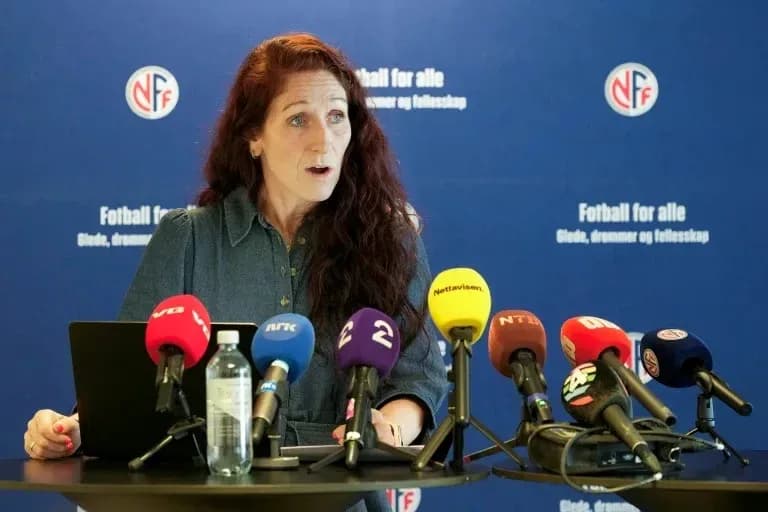
The president of the Norwegian Football Federation, a 45-year-old lawyer and former international with 73 caps, has spent the past few years doing what very few inside the game dare to do: publicly challenging FIFA, and more specifically, its president Gianni Infantino.
Now, with Infantino engulfed in fresh controversy over his failed attempt to open FIFA’s competitions to private investors, some inside the sport are whispering something once unthinkable.
What if she took his job?
From reform hopes to open revolt
When Infantino swept into power in 2016, he did so on a wave of promises. Reform. Transparency. Good governance. The end of the murky era that had brought down Sepp Blatter.
Klaveness remembers that moment clearly.
He was, she told AFP, a candidate elected on a reform platform built around proper governance. That optimism did not last. In her view, distance from political power gave way to dependence, then to retreat, all against a backdrop of growing influence from heads of state and powerful figures in World Cup host nations.
She did not keep those concerns to herself.
Barely a few months into her role as head of the Norwegian federation in 2022, she used the biggest stage available to her — the World Cup in Qatar — to fire her first public shot. Standing in Doha, with FIFA’s showpiece tournament in full glare, she lamented that human rights, equality and democracy, the values she considers the core interests of football, had not even made the “starting 11” when the World Cup was awarded.
The message cut through. It also marked her out.
Norway followed words with action. In 2023, the federation refused to back Infantino’s re-election, a symbolic but pointed gesture that signalled its disapproval of the direction in which he was taking world football.
Mina Finsted Berg, a sports commentator for Norwegian broadcaster TV2, saw what was happening. Klaveness, she said, became the first real standard-bearer for the wave of criticism now directed at Infantino’s leadership. A figure obsessed with rules being followed and decisions respected.
Inside FIFA, that kind of insistence is rarely welcomed.
Trump, Balogun and the investor battle
If Klaveness sounded alarmed before, the past few months have hardened her stance.
The flashpoints have piled up: FIFA’s decision to award a “Peace Prize” to US President Donald Trump, with whom Infantino has cultivated a conspicuously close relationship; the lifting of a suspension for US player Folarin Balogun at the 2026 World Cup after an intervention from Trump; and the explosive, swiftly rejected plan to bring private investors into FIFA competitions, including the World Cup.
For Klaveness and the Norwegian federation, these are not isolated missteps. They are symptoms of a deeper problem. Norway has now decided to take all three matters to FIFA’s Ethics Committee, an extraordinary move from a member association against the sitting president.
Then came Friday.
With Infantino’s investment plan shot down and his authority under scrutiny, Klaveness went a step further and called on him to resign. The gloves, if they were ever on, came off.
Her words land with extra weight because Norway is no longer a peripheral presence on the pitch. After years in the international wilderness, the national team produced a strong run at this year’s World Cup, reaching the quarter-finals before falling to England. Success on the field has amplified her voice off it.
Internationally, commentators have begun to describe her as a figure with a “strong moral compass” and, crucially, as a serious potential successor if Infantino were to step aside. For now, that remains hypothetical. Infantino is standing for a fourth and final term next March and is, at this stage, the only declared candidate.
Still, the idea is out there. And even Sepp Blatter, the man whose downfall paved the way for Infantino, has weighed in from the sidelines.
On X, the former FIFA president wrote that Klaveness was the only one who consistently took a clear stand and refused to drift with the mainstream. In his view, the time is right for a woman to lead FIFA.
Coming from Blatter, whose own tenure collapsed under a corruption scandal, the endorsement is as striking as it is ironic.
A reformer who resists the “Game of Thrones” narrative
Klaveness, though, has tried to push back against the storyline that casts her as a rival in a personal duel with Infantino.
She insists the crisis in world football cannot be reduced to a “Game of Thrones” power struggle at the top. For her, this is not about personalities, but about how the sport is run.
“It has never been a personal issue against Gianni Infantino,” she told AFP. The problems, she argues, go beyond the president himself.
She is well aware that her name is now circulating as a possible successor. She has “registered” it, as she put it, but when asked directly whether she would be a candidate, she brushed the question away.
“We’re not there yet.”
Behind that answer lies a political reality that is far more complicated than any moral argument.
The ballot box and the glass ceiling
Klaveness is not naïve about her standing in the global game. To some outside Europe, she is seen as radical. Too outspoken. Too willing to confront power in public rather than quietly behind closed doors.
And then there is the obvious factor. She is a woman, operating in regions where that still counts heavily against any leadership bid.
Berg, the TV2 commentator, believes those two elements — her perceived radicalism and her gender — represent serious obstacles in many parts of the world.
The resistance is not confined to faraway confederations. Even within UEFA, where one might expect her to find the most natural support, the path has been rocky. In 2023, she failed in her attempt to win a seat on UEFA’s Executive Committee. She only joined in 2025, and then only because she was the sole candidate for the seat reserved for women.
For Erik Thorstvedt, the former Norway goalkeeper turned pundit, that struggle inside Europe itself raises a blunt question: if Klaveness finds it so hard to be elected at UEFA level, how could she possibly convince federations in Africa and South America?
It is a fair challenge. FIFA elections are not won in press conferences or ethics complaints. They are won in hotel corridors, regional congresses and private meetings, where alliances are forged and loyalties traded.
Klaveness knows this. She has chosen, so far, to fight on a different terrain — that of principle and public accountability.
Infantino, for now, remains firmly in place, the only name on the ballot for next March. Yet the landscape around him is shifting. The investment plan debacle, the Trump controversies, the ethics complaints from a member association — all of it feeds into a growing sense that FIFA’s direction is once again under scrutiny.
And somewhere in Oslo, the federation president who refuses to stay quiet keeps pushing, one speech, one intervention, one complaint at a time.
Whether that makes her unelectable or inevitable is the question football’s power brokers will have to answer.




