Levski Sofia vs AEK Athens FC: Tactical Battle Ends in 0-0 Draw
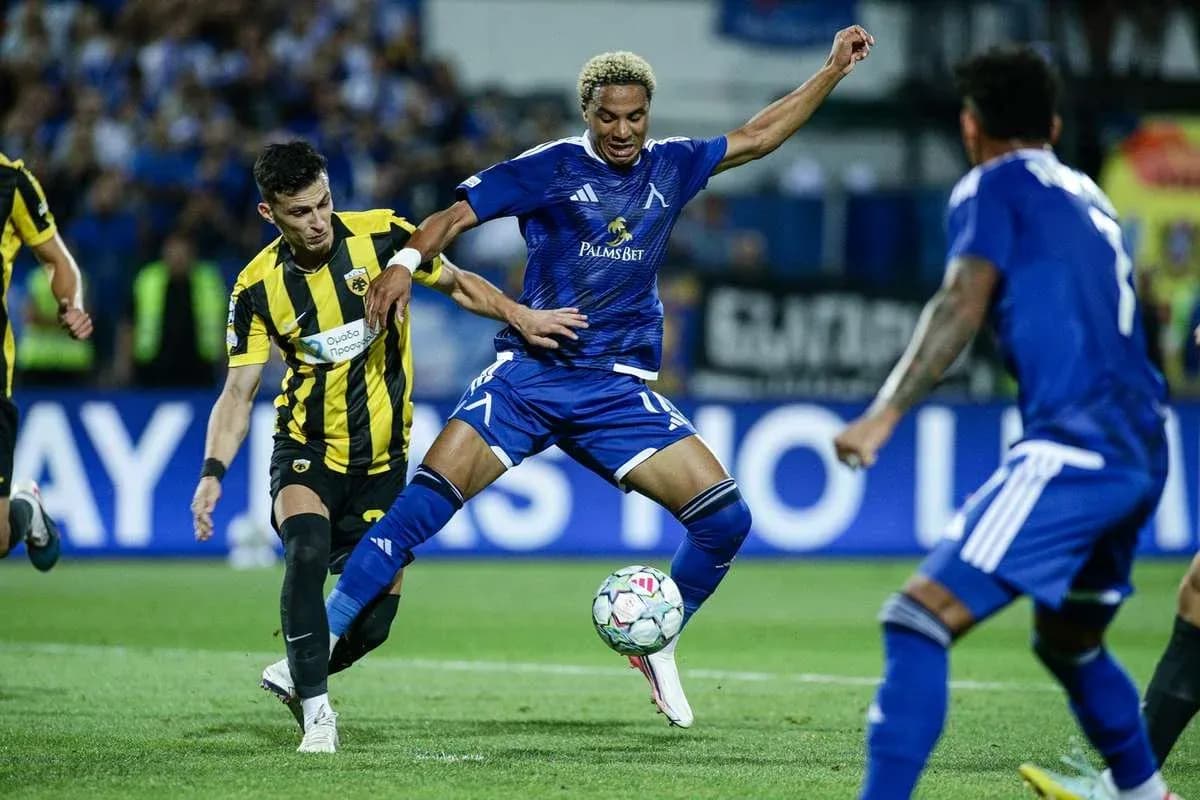
Levski Sofia and AEK Athens FC produced a tight, tactical 0-0 in the UEFA Champions League Play-offs at Georgi Asparuhov Stadium, a match defined more by structure and risk management than by clear scoring chances. Both sides finished with identical clean sheets but arrived there via contrasting approaches: Levski leaning on controlled possession and gradual territorial gains, AEK on compactness, duels and vertical threat.
Levski Sofia's Approach
Julio Velazquez set Levski up in a 4-2-3-1 that clearly aimed to control rhythm. Their 52% possession, 485 total passes and an 88% pass completion underline a plan built on circulation and patient progression. The double pivot of M. Moubarik and Maicon was central: with 4-2-3-1 spacing, they were the primary connectors between the back four and the advanced line of A. Oko-Flex, Serginho and Everton Bala behind Reinaldo. The distribution numbers suggest Levski were comfortable building from the back, using short passing to pull AEK’s 4-4-2 out of shape.
Yet the shot profile exposes the limits of that control. Levski generated 15 total shots but only 3 on goal, with 6 attempts inside the box and 4 blocked. The volume indicates they reached the final third often enough, but AEK’s defensive line, anchored by H. Moukoudi and F. Relvas, consistently got bodies in front of efforts or forced them from less optimal positions. The 9 shots from outside the box show that when Levski did manage to work shooting opportunities, they were frequently pushed to range rather than breaking the last line.
AEK Athens FC's Strategy
AEK Athens FC, under Marko Nikolic, operated from a 4-4-2 that was notably more direct and physically assertive. They had slightly less of the ball (48% possession, 453 passes at 87% accuracy) but were far more aggressive without it: 17 fouls to Levski’s 8 reflect a clear intent to disrupt rhythm, especially in midfield where R. Marin and K. Kairinen were tasked with closing down Levski’s pivots. This trade-off—more fouls for more control of central zones—limited Levski’s ability to play between the lines despite their passing superiority.
In attack, AEK were more selective. They produced 12 total shots, 5 inside the box and 7 from distance, but only 1 on target. The relatively low shots-on-goal figure suggests that while they reached promising areas, the final action—either shot selection or execution—was lacking. The 2 blocked shots show Levski’s back four, with N. Serafimov and K. Dimitrov centrally, reading danger well and stepping out to confront shooters.
Goalkeeper Performances
The goalkeepers were rarely overworked but still shaped the risk calculus. S. Vutsov (Levski Sofia) made 1 save, consistent with AEK’s single shot on target, reflecting a defensive structure that limited clear looks rather than a performance reliant on repeated interventions. At the other end, T. Strakosha (AEK Athens FC) recorded 3 saves, matching Levski’s 3 shots on goal and underlining that, when Levski did break through, AEK’s last line was reliable.
Substitutions and Tactical Adjustments
Substitutions from both coaches were more about energy and balance than radical tactical shifts. At 57', Nikolic refreshed his 4-4-2 front and right side: P. Mantalos (IN) came on for L. Majer (OUT), and B. Varga (IN) came on for L. Jovic (OUT). Mantalos’ introduction typically offers more ball security and creative passing from midfield, hinting at a desire to improve AEK’s ability to retain possession and launch more structured counters. Varga, as a fresh forward, added running in behind to stretch Levski’s back line and threaten in transition.
Velazquez responded later, with changes that subtly reconfigured the attacking structure while preserving the 4-2-3-1 base. At 67', J. Perea (IN) came on for A. Oko-Flex (OUT), likely adding more verticality and direct movement from the wide or central attacking band. The double change at 79'—M. Soula (IN) for Everton Bala (OUT) and A. Mitkov (IN) for Reinaldo (OUT)—suggests a late push for fresh legs in the advanced line, potentially with different profiles: Soula as a more direct runner and Mitkov offering different link-play options. These moves pointed to Levski trying to convert territorial control into higher-quality chances in the final phase.
AEK’s second wave of changes at 81'—M. Gacinovic (IN) for A. Koita (OUT) and O. Zubkov (IN) for Zini (OUT)—reinforced their hybrid identity: maintaining defensive work rate on the flanks while adding ball-carrying and transitional threat. Gacinovic is typically strong between the lines and in pressing triggers, while Zubkov provides pace and directness. This kept AEK dangerous enough in transition to prevent Levski from committing reckless numbers forward.
Levski’s late defensive and midfield adjustments—S. Hevertton (IN) for A. Neves (OUT) at 88' and S. Stoyanchov (IN) for Maicon (OUT) at 89'—hint at a dual objective: preserve the clean sheet while maintaining legs in midfield for one last push. Refreshing a full-back and a central midfielder that late often signals a desire to avoid concentration drops and to sustain pressing intensity against counters.
Set Pieces and Conclusion
Set pieces and wide areas were underused levers for both teams. Levski managed just 1 corner to AEK’s 2, a low count that reflects how often attacks were resolved before reaching the byline. With both sides defending crosses reasonably well and neither forcing repeated corners, much of the game stayed in central channels where compact 4-2-3-1 and 4-4-2 blocks naturally compress space.
In the end, the 0-0 is a logical expression of the numbers and the tactical choices. Levski Sofia controlled more of the ball and moved it cleanly but struggled to convert that into high-quality, on-target chances against a disciplined AEK block. AEK Athens FC accepted less possession, leaned into physical duels and fouls to manage space, and looked for selective moments to break, but their finishing and final-third clarity were insufficient to truly test S. Vutsov. Both coaches will see a structurally sound performance; the second leg will demand more risk if either side is to tilt a finely poised tie.