
Korea's World Cup Journey: Hope Amidst Doubt
Thirty days from a World Cup, most nations are swept up in anticipation. In Korea, the mood is closer to dread.
The Taegeuk Warriors are heading to their 11th straight finals, ranked 25th in the world and dropped into what looks, on paper, like a forgiving Group A. Yet the country’s relationship with its team has rarely felt this strained.
A coach under siege, a crowd turning away
The tension began with the decision that still hangs over everything: the appointment of Hong Myung-bo in the summer of 2024.
It was controversial. It was unpopular. And the backlash has not eased.
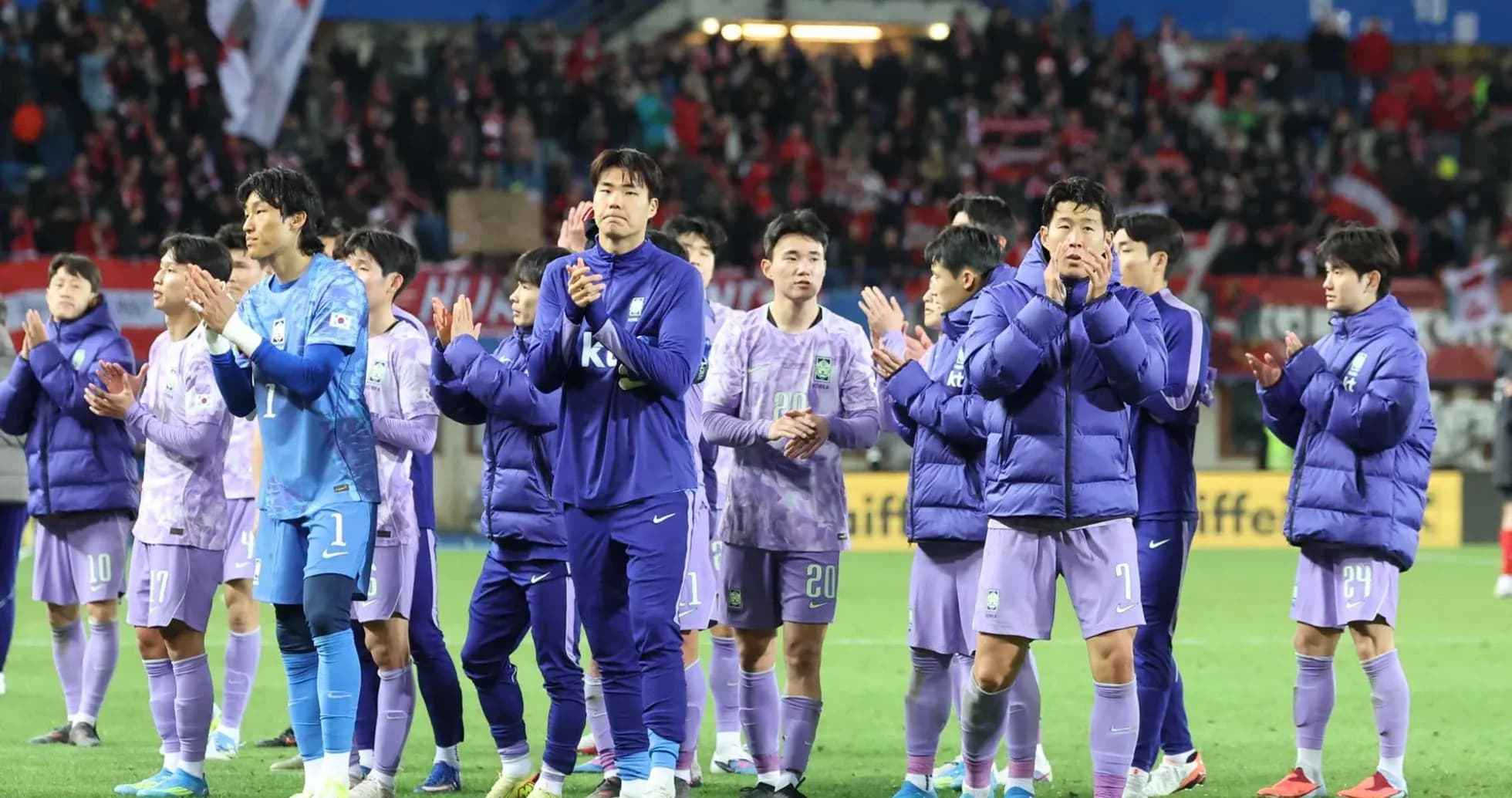
Korean fans, who usually pack stadiums and belt out anthems without hesitation, turned on their own. They booed Hong relentlessly. They held up banners demanding the resignation of Korea Football Association President Chung Mong-gyu. The noise was not just about tactics; it was about trust.
Then came the more damning verdict in modern football: empty seats.
On Oct. 14, only 22,206 fans showed up at the 66,000-seat Seoul World Cup Stadium for a friendly against Paraguay — the lowest attendance for a men’s international in a decade. Against Ghana on Nov. 18 at the same ground, the number rose to 33,256, still a stark contrast to the usual heaving stands.
Korea won both games, either side of another victory over Bolivia in Daejeon in front of around 33,000. The results looked respectable. The performances did not. The crowd knew it.
Then the World Cup year started, and the doubts hardened into alarm. A 4-0 hammering by Ivory Coast on March 28. A 1-0 defeat to Austria three days later. Both away, both friendlies, but both deeply unsettling for a team that wants to believe it can trouble the world’s best.
Confidence, among fans and pundits alike, has rarely been lower.
A soft group, a hard conversation
Strip away the noise and the numbers still offer Korea a route forward.
World No. 25 Korea have landed in a group that many observers quietly circle as one of the more manageable: 15th-ranked Mexico, 41st-ranked Czechia and 60th-ranked South Africa. No Brazil. No France. No Argentina.
The schedule helps, too. Korea open against Czechia at 8 p.m. on June 11 in Guadalajara (11 a.m. June 12 in Korea), then face Mexico at 7 p.m. on June 18, again in Guadalajara (10 a.m. June 19 in Korea), before finishing the group against South Africa at 7 p.m. on June 24 in Monterrey (10 a.m. June 25 in Korea).
All three matches on Mexican soil. Two in the same city. Less travel, fewer logistical headaches, more time to prepare between games. In a World Cup stretched across Mexico, Canada and the United States, that is no small advantage.
This edition is the biggest yet: 48 nations, up from 32, with a round of 32 ushering in the knockouts. The top two from each of the 12 groups go through, joined by the eight best third-placed teams. The door is wider than ever.
That is why, despite the grumbling and the jeers, many experts still say Korea should escape the group. What happens after that is where the arguments begin.
Away from home, Korea have only twice reached the knockout stage: in South Africa in 2010 and in Qatar in 2022. History says progress is possible, but not guaranteed.
The optimist: “Round of 16 at least”
Television analyst Kim Dae-gil sits on the more hopeful side of the debate.
“I think Korea will get to at least the round of 16,” he said. For him, the draw is a gift Korea cannot afford to waste. “Just looking at the group stage opponents, Korea won’t have to expend as much energy as in some previous tournaments. We can beat Czechia and South Africa six times out of 10. And if we qualify for the knockouts as the top seed or No. 2 seed, then we will meet a beatable opponent in the round of 32.”
His confidence leans heavily on two men: captain Son Heung-min of Los Angeles Football Club and Paris Saint-Germain playmaker Lee Kang-in.
Kim sees them as pure “game changers,” players who can conjure chances from nothing, who can tilt matches that are drifting away. In tight World Cup contests, that kind of talent often makes the difference.
But even he cannot ignore the problem beneath the star power.
“The gap between the starters and backups is substantial,” he warned. If Korea are to dream beyond the round of 16, they will need more than just Son and Lee. They will need a supporting cast that can step in without the level dropping off a cliff.
“It is imperative for the likes of Son Heung-min to stay healthy,” Kim added. One injury, and the entire structure starts to shake.
The realists: injuries, form and a fragile core
Two other analysts, Seo Hyung-wook and Park Chan-ha, look at the same squad and see a much tighter ceiling.
Seo has already revised his expectations downward. He initially penciled Korea in for the round of 16. An ankle injury to midfielder Hwang In-beom forced him to rethink.
Hwang, a clever two-way presence, knits Korea’s midfield together. He is currently rehabbing a right ankle injury suffered in March while playing for Feyenoord, working with the national team’s medical staff in a race against time.
Seo does not sugarcoat Hwang’s importance. He is “as irreplaceable as anyone on the team.” Lose him, or even have him at less than full strength, and the whole balance of the side changes.
“Other mainstays have not been playing well,” Seo said. Lee Kang-in and Bayern Munich defender Kim Min-jae have struggled for minutes at their clubs. That rust can be brutal on the World Cup stage, where the tempo never drops and mistakes are punished instantly.
Seo still sees a strength in the chemistry among the Europe-based core — Son, Lee, Kim and others who have shared countless camps and tournaments. They know each other’s runs, each other’s habits. That familiarity can carry a team through difficult spells.
“The problem is there just aren’t many of them,” he said. Depth again. Quality again. The same refrain.
“At this moment, I don’t think you could say anyone can play at a world-class level at the World Cup,” Seo added. A harsh verdict, but one that reflects the current form chart more than the players’ reputations.
His prediction now: an exit in the round of 32.
Park Chan-ha agrees.
A team that struggles to create
Park’s concerns are more tactical than medical.
“Hong Myung-bo’s team has some talented players,” he said. “And yet, they often have trouble creating scoring chances.”
That line will sting inside the camp, because it cuts to the heart of how this side plays. Korea, in Park’s view, rely too much on individual brilliance, on Son or Lee or another attacker wriggling free and making something happen out of a half-chance.
“The team relies on players’ individual skills to try to capitalize on those few opportunities, but you can only do so much of that at the World Cup,” he warned. Against Ivory Coast and Austria in March, Park saw the flaws laid bare: sterile possession, few clear openings, and opponents who punished lapses without mercy.
If Hwang In-beom cannot play, or if his ankle limits his range and intensity, Park believes those issues will only grow. The midfield will lack control. The forwards will become isolated. The burden on Son and Lee will become unsustainable.
Park’s forecast mirrors Seo’s: Korea to fall in the round of 32.
The match that could define everything
Where all three analysts converge is on the importance of the opening game. They just differ on what comes next.
“I think the first match against Czechia will be the most important one,” Park said. “This is the one Korea must win, and they will be in trouble if they don’t get it done. Czechia are not an offensive-minded team, and Korea may have difficulty breaking through their defense.”
Seo backs that view. For him, history is clear.
“In our World Cup history, the outcome of the first match often determined the fate for the rest of the tournament,” he said. With Mexico waiting in the second game, he sees little margin for error. “Mexico will be a tough test in the second match, and if we don’t win the first match, we will be in big trouble.”
Kim Dae-gil, the more optimistic voice, flips the emphasis.
He believes Korea and Mexico will duel for top spot and that the clash with El Tri will carry the heaviest weight. “I think Korea and Mexico will battle for the top spot in the group,” he said, suggesting that how Korea handle that second match could shape not just their progress, but their route through the knockouts.
A month to change the mood
So Korea stand here: a favorable group, a forgiving travel schedule, a bigger World Cup with more room to advance — and a fan base that has turned from unquestioning support to open revolt.
The talent is there in flashes: Son’s ruthlessness, Lee’s vision, Kim Min-jae’s authority at the back, Hwang In-beom’s intelligence between the lines. The question is whether Hong Myung-bo can turn those pieces into something cohesive, something convincing, in the space of a few weeks.
If he does, the boos may fade, the empty seats may fill, and a soft-looking Group A could become the launchpad for another deep run.
If he does not, Korea may discover that in a World Cup expanded for opportunity, an early exit stings even more.




