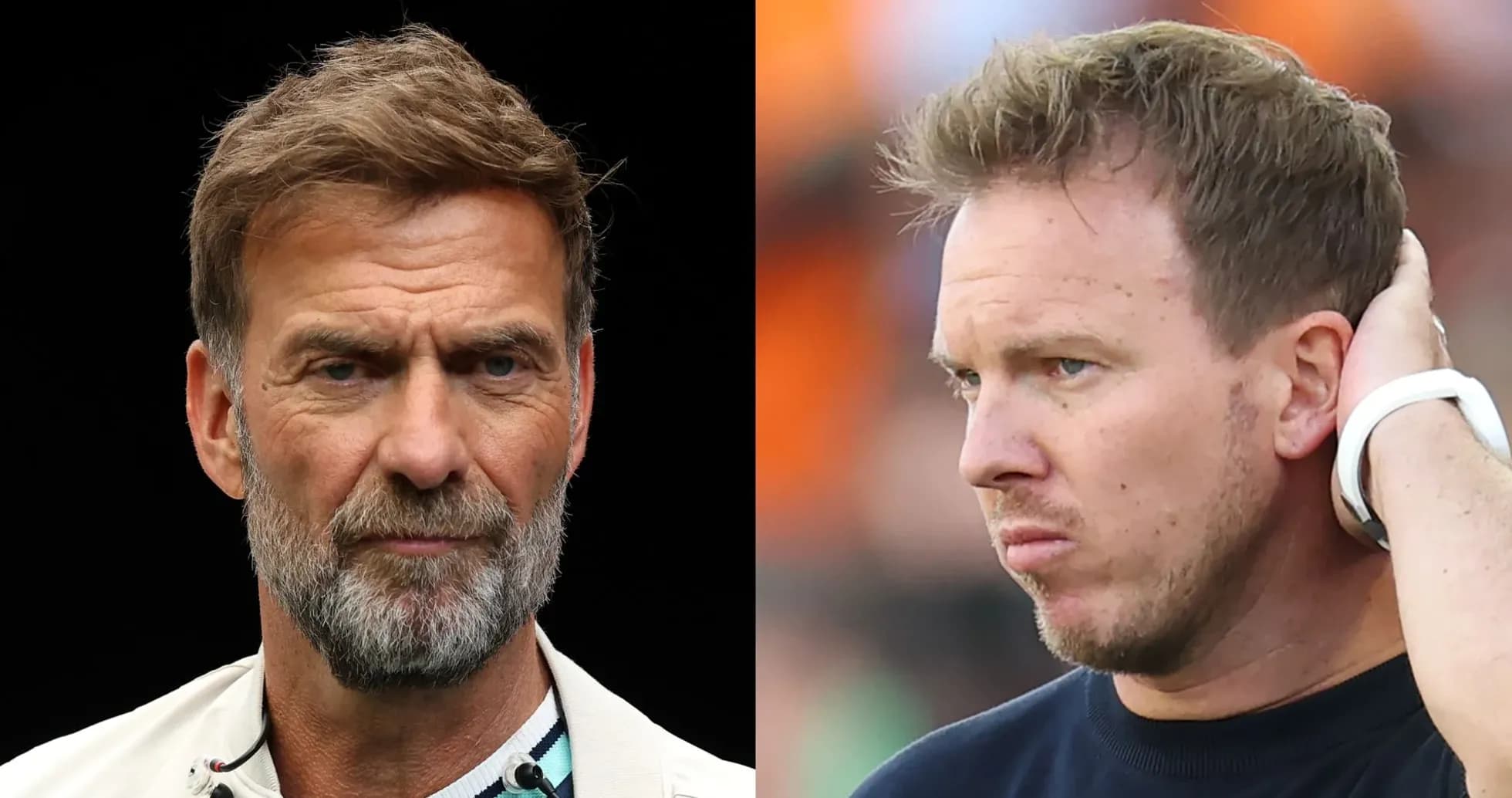
Jürgen Klopp Addresses Nagelsmann Relationship as Germany Coach
Jürgen Klopp walked into his first major press conference as Germany head coach with the usual grin, the usual energy – and one old issue he wanted to clear up immediately.
Not tactics. Not selections. Julian Nagelsmann.
Klopp closes the Nagelsmann chapter
Klopp was asked about his relationship with his predecessor after the World Cup and did not dodge the subject. He made it plain: there has been no contact between the two since the tournament, but there is no feud, no cold war, just a lingering regret over one careless word.
"I've had no contact since the World Cup. I respect Julian Nagelsmann enormously," he said, as quoted by Sky Sport. "The day with the 'still' comment was one of the worst days of my life. I could have done without it, but it happened now. I wish Julian nothing but the best."
That “still” has been following him ever since.
During Germany’s opening game against Curacao at the World Cup, Klopp was working as a TV pundit. In a throwaway line that landed like a grenade back home, he remarked: "Luckily, Julian Nagelsmann is still picking the team." One word, “still”, sparked a wave of debate in Germany about whether he was undermining the then national coach.
Klopp knew instantly he had stepped on a landmine.
After the game he addressed it head-on. "I’ve already found the most hated word of the year: ‘Still’," he admitted. "I could have punched myself in the face for that, but it was already too late and I was on TV. It just slipped out so casually and has absolutely no relevance."
He didn’t leave it there. Live on air, with Nagelsmann listening, Klopp issued a direct apology, a rare moment of raw self-criticism from one of the game’s most charismatic figures.
"There's one more thing I have to say… we still need to make time for this. We’re also informally part of the team, we’re absolutely on your side," he told Nagelsmann. "What I’ve realized is: I’ll be 59 the day after tomorrow and I’m still an idiot. We are completely on your side, whatever you do. Nothing was intended to come of it to disrupt the process here."
The incident has lingered in the background of German football’s national-team narrative. Klopp’s words now, as Bundestrainer, were an attempt to shut that door and step fully into his new role.
A new era, a demanding brief
The apology, though, is only a small part of the story. Klopp’s real task begins on the training pitches and in the stands of Europe’s stadiums.
His immediate priority, he stressed, is not a grand tactical manifesto but human connection. Building trust. Building a group.
Klopp takes over with Germany still reeling from their shock elimination in the round of 32 at the 2026 World Cup, a tournament that underlined just how far the four-time world champions have slipped from the sport’s top tier. His mandate is clear: drag Germany back among the world’s leading nations.
"I don't know what my daily routine will be like yet; I'm almost glad it doesn't start tomorrow," he admitted at Friday's press conference. The honesty was typical, but behind it sat a clear plan.
He will be based in Wiesbaden and expects to be in Frankfurt often, close to the DFB’s headquarters and the heart of the national setup. Yet his job will stretch far beyond Germany’s borders.
"I'll watch games in every country our players are in," he said. "I think it's more important to have more contact with the players than just watching them play. I'll try to get in touch with the players quickly."
That sentence cuts to the core of Klopp’s footballing philosophy. For him, systems and structures only work when the relationships are strong. The Germany job, with players scattered across Europe’s top leagues, will test that belief like never before.
The cameras caught the familiar Klopp: animated, reflective, occasionally self-mocking. The stakes, though, are different now. No longer the outsider inspiring club fanbases, he is the figurehead of a football nation demanding a return to the top.
The word “still” once dropped him into an unwanted storm. The next word that will define him is far simpler: “again”. Can he make Germany feared again?