Hellas Verona Faces Como: A Season of Struggles and Contrasts
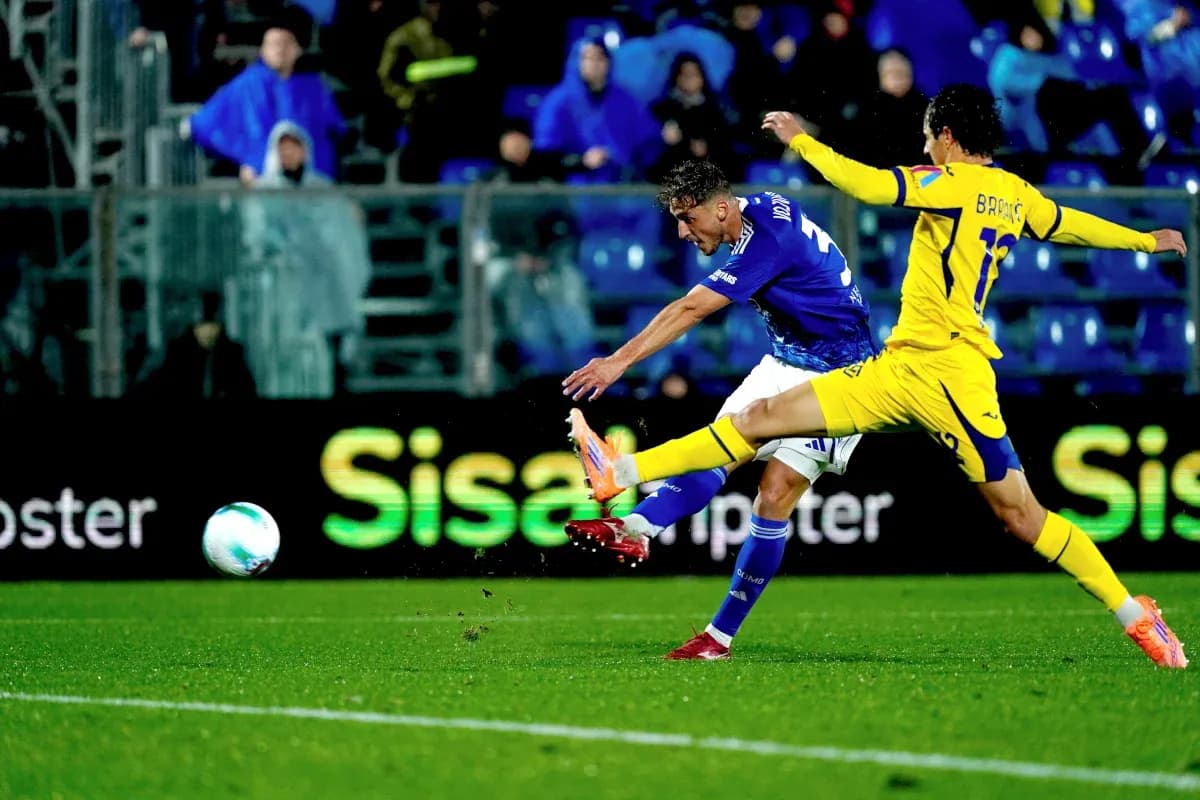
The afternoon at Stadio Marcantonio Bentegodi ended with a familiar chill for Hellas Verona. Under the grey Verona sky, a season’s worth of struggle condensed into 90 minutes, as Paolo Sammarco’s side fell 0–1 to a slick, controlled Como outfit that played like a team heading for Europe rather than merely visiting a relegation battleground.
I. The Big Picture – Two Different Seasons on the Same Pitch
Following this result, the league table underlines the gulf. Verona sit 19th in Serie A with 20 points from 36 matches, locked in the relegation zone with a goal difference of -34, the mathematical echo of a campaign defined by fragility: 24 goals scored and 58 conceded overall. At home they have only 1 win from 18, with 12 goals for and 26 against; Bentegodi has not been a fortress, but a stage for narrow margins and recurring disappointment.
Como, by contrast, leave Verona in 6th place on 65 points, very much in the mix for European football. Their overall goal difference of 32 comes from 60 goals scored and 28 conceded – the profile of a side that attacks with purpose and defends with structure. On their travels they have 9 wins from 18, with 26 goals scored and just 13 conceded away, an away record that quietly screams authority.
The formations told the story even before kick-off. Verona lined up in a 3-5-1-1, Sammarco leaning into density and protection, with L. Montipo behind a back three of V. Nelsson, A. Edmundsson and N. Valentini. The wing lanes were entrusted to M. Frese and R. Belghali, while the central band of J. Akpa Akpro, R. Gagliardini and A. Bernede tried to stitch together resilience and progression. T. Suslov floated as a second striker behind K. Bowie, the lone reference point.
Cesc Fabregas answered with Como’s now-familiar 4-2-3-1, a system that has underpinned 32 of their league lineups this season. J. Butez anchored a back four of M. Vojvoda, Diego Carlos, M. O. Kempf and A. Valle. In front of them, the double pivot of M. Perrone and L. Da Cunha provided the platform for the creative trio A. Diao, N. Paz and Jesús Rodríguez behind the league’s third-ranked scorer, T. Douvikas.
II. Tactical Voids – Who Was Missing, and What That Meant
Verona’s bench and absentees list read like a cautionary tale. A. Bella-Kotchap, D. Mosquera, C. Niasse, G. Orban, D. Oyegoke and S. Serdar were all ruled out, thinning Sammarco’s options both in the back line and in transitions. The absence of Orban in particular stripped Verona of a direct, vertical outlet in attack; his 7 league goals and willingness to run channels would have been a different kind of problem for Como’s centre-backs.
Those missing names forced Verona into a more cautious 3-5-1-1, leaning heavily on the work rate of Akpa Akpro and Gagliardini, both already among Serie A’s most card-prone midfielders. Across the season, Verona’s yellow-card distribution shows a particular spike between 46-60 minutes (22.62%) and 31-45 minutes (21.43%), underlining how often their midfield is forced into reactive defending once the game speeds up.
Como were not untouched. J. Addai was out with an Achilles tendon injury, while Jacobo Ramón Naveros – one of Serie A’s most combative defenders and a league leader for yellow cards and red cards – missed out due to suspension for yellow accumulation. His absence removed a physically dominant, front-foot defender, but Fabregas compensated by trusting the experienced pairing of Diego Carlos and Kempf, supported by the positional discipline of Perrone.
III. Key Matchups – Hunter vs Shield, and the Battle for the Middle
The “Hunter vs Shield” duel was always going to centre on T. Douvikas against Verona’s battered defensive record. Douvikas, with 13 league goals and 44 shots (27 on target), arrived as a striker comfortable working between lines, drifting wide or attacking the box late. Verona, heading into this game, were conceding 1.4 goals per match at home and 1.6 overall, with only 3 clean sheets at Bentegodi all season. The script was clear: if Como could supply their No. 11 with consistent service, Verona’s back three would be stretched.
That service channel was embodied by N. Paz. With 12 goals and 6 assists, plus 51 key passes and 125 dribble attempts, he is the creative engine of this Como side. His penalty record this season – 0 scored and 2 missed from the spot – is a rare blemish in an otherwise outstanding campaign, but in open play his influence is relentless. Against Verona’s trio in midfield, he repeatedly sought pockets between the lines, forcing Gagliardini to step out and opening seams behind.
The “Engine Room” clash pitted Verona’s destroyers against Como’s metronomes. Gagliardini, with 71 tackles, 13 blocked shots and 54 interceptions this season, and Akpa Akpro, with 39 tackles and 7 blocked shots, were tasked with breaking Como’s rhythm. On the other side, M. Perrone and L. Da Cunha offered a different profile: Perrone’s 2060 passes at 91% accuracy and 55 tackles made him the pivot around which Como’s circulation turned, while Da Cunha balanced progression with coverage.
Out wide, M. Frese – himself among the league’s most-booked defenders with 8 yellows – had to manage the dual threat of A. Diao’s runs and Jesús Rodríguez’s underlaps. Rodríguez, one of Serie A’s top assist providers with 7, is also a red-card risk, but his 33 key passes and 96 dribble attempts speak to a winger unafraid to take on his man. Verona’s wing-backs, Frese and Belghali, were pinned deeper than Sammarco would have liked, limiting their ability to support Suslov and Bowie.
IV. Statistical Prognosis – Why 0–1 Felt Almost Inevitable
Strip away the emotion and the numbers are unforgiving. Heading into this game, Verona were scoring 0.7 goals per match at home and failing to score in 10 of 18 home fixtures. Como, on their travels, were conceding only 0.7 goals per match, with 9 away clean sheets. When a team that rarely scores hosts a side that rarely concedes, the margin for error is almost nonexistent.
Conversely, Como’s away attack, averaging 1.4 goals per match, was always likely to find at least one moment against a Verona defence that has already allowed 26 goals at home. Even without explicit xG values, the expected pattern was clear: Como to control territory and shot quality through Paz, Perrone and Rodríguez; Verona to rely on low-percentage counters via Suslov and Bowie.
Discipline tilted the balance further. Verona’s season-long yellow-card peaks in the middle phases of each half contrasted with Como’s tendency to accumulate cards late, with 19.48% of their yellows and 100% of their reds arriving between 76-90 minutes. That suggested a game in which Verona would be stretched earlier, conceding territory and fouls in dangerous zones, while Como could afford to manage risk until the closing stages.
In the end, the 0–1 scoreline felt less like a shock and more like the logical outcome of two trajectories: Verona, a side whose structural issues in both boxes have persisted all season, and Como, a team whose blend of defensive solidity and creative punch – even with a key defender suspended and a creator carrying penalty scars – continues to translate into narrow, controlled wins on their travels.