
Hearts' Title Chase: From Euphoria to Disbelief
Tynecastle did not know whether to roar, sing or simply stare at the nearest phone screen. For eight surreal minutes, with Falkirk long since beaten and the final whistle blown, Hearts stood on the brink of a title party that would have shaken Gorgie to its foundations. Avoid a three-goal defeat at Celtic Park on Saturday and the league was theirs. That was the script.
Then came Motherwell. Then came the whistle. Then came Celtic’s 96th-minute penalty.
What had felt like the start of a week-long celebration turned, in an instant, into something far more fraught. The mood flipped from euphoria to disbelief, then to anger. Derek McInnes did not bother to hide any of it.
The Hearts manager called the Celtic award “disgusting”. He said he did not need to ask who the stoppage-time penalty was for when he heard the minute it had been given. His frustration with Scottish refereeing, already simmering after a curious non-penalty call at Fir Park on Saturday, boiled over as the title equation shifted again.
“We’re up against everybody,” he snapped, before also acknowledging Celtic’s blistering recent run. It was the sound of a manager who knows how far his team have come, and how thin the margins now are.
From three-goal cushion to single point. Game 38 of 38 will now send Hearts to Celtic Park needing a draw to end a championship drought stretching back to 1960. One point to smash four decades of Old Firm dominance. One point to complete a story that, last summer, would have sounded like fantasy.
And yet, as the dust settled at Tynecastle, nobody in maroon looked remotely like they were living a dream. The stands that had vibrated with noise before kick-off now held something tighter, more anxious. Relief at another commanding home win sat awkwardly beside the knowledge that the hardest part still lies ahead.
The atmosphere will be one of the great losses when this season finally ends. Again, Tynecastle crackled from the first whistle. Again, the home crowd came ready to drag their team over the line. Falkirk, though, were not there to play the patsy.
Within five minutes, Calvin Miller had the ball in the Hearts net, only for an offside flag to rescue the hosts. The Hearts back line were more relaxed about the call than the replay merited. It was tight. It was also a warning. Falkirk had started with purpose and ambition.
Then word filtered through from Lanarkshire. Motherwell had scored against Celtic. Tynecastle erupted as if Hearts themselves had taken the lead. Nobody in this part of Edinburgh truly expected a favour from a Celtic side on a run of five straight league wins, but hope, once lit, is hard to extinguish.
On the pitch, though, Hearts still had a game to grab hold of. For the opening quarter of an hour they had not found their rhythm. Passes went astray, Falkirk snapped into challenges, and the noise in the stands felt more driven by events 40 miles away than anything happening in front of them.
Lawrence Shankland almost changed that on his own. The captain, so often the man for the decisive moment this season, saw a deflected effort drop tamely into the arms of Nicky Hogarth after slick buildup play from Alexandros Kyziridis and Cláudio Braga. It was not a goal, but it was a spark. Hearts finally settled.
The breakthrough came from an unlikely source. Frankie Kent, a squad man for much of this campaign, only started because of the serious injury Craig Halkett suffered at the weekend. From a Kyziridis corner swung in from the right, Kent rose unchallenged and powered a header beyond Hogarth. A stand-in centre-half, delivering like a seasoned centre-forward. It summed up the collective nature of this Hearts run.
Tynecastle exhaled. Then it inhaled again, sharply. A bogus message rippled around the stands: Motherwell 2-0 Celtic. It was wrong, but the reaction on the pitch was very real. Hearts did not wait for confirmation. They made their own momentum.
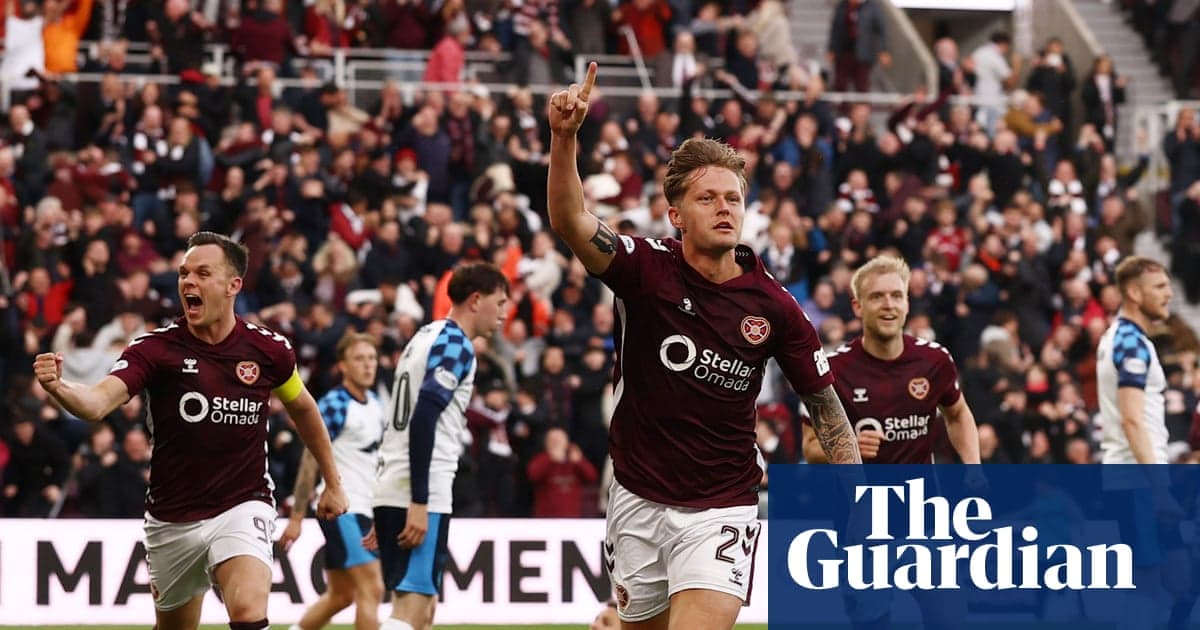
Cammy Devlin, the tireless heartbeat of McInnes’s midfield, suddenly found himself in unfamiliar territory – 12 yards out, ball breaking kindly, Falkirk stretched. His shot took a deflection off Coll Donaldson and flew in. Devlin wheeled away, Tynecastle roared again, and for a moment it looked and felt exactly like a title procession.
Hearts attacked with the swagger of champions-elect. Every forward move carried menace. Every set piece seemed to bring panic in the Falkirk box. Yet the stadium’s attention kept drifting back to Motherwell. Phones came out, heads turned, conversations broke out in the rows behind the dugout. When Celtic’s equaliser came, the noise in Edinburgh changed. Not silence. Something more jagged.
McInnes’s team still had a job of their own to finish. The second half brought a simpler target: protect an unbeaten home league season. They did that with authority. Falkirk had their moments – Ben Broggio sliced wide from a promising position – but Hearts controlled territory, tempo and, crucially, their nerves.
On the touchline, McInnes began to think ahead. Changes arrived with Saturday clearly in mind. Legs were saved, risks avoided. The manager has long insisted this title race would go to the wire. As Celtic moved 2-1 ahead at Fir Park, his prediction looked bang on.
Then another twist. In Edinburgh, with the clock ticking into the 80s, word came that Liam Gordon – once of Hearts’ youth ranks – had levelled for Motherwell. The roar that followed Blair Spittal’s exquisite third for Hearts felt like a release of something deeper than mere joy at a fine goal. The midfielder curled his finish with the composure of a man playing in August, not on the brink of history in May.
Was this it? Was fate, at last, smiling on Gorgie Road?
Not quite. Not yet. The late penalty at Motherwell, the one that sent McInnes into open fury, dragged the story back into dangerous territory. It stripped away Hearts’ margin for error and left them staring at the most daunting of final-day assignments: a trip to Celtic Park, title on the line, needing something, anything, to complete the job.
Hearts will go there with their destiny still in their own hands. They will go there having captured attention far beyond Scotland with a title charge that has torn up the old assumptions about who can win this league. They will also go there knowing that, after all of this, to fall short now would be a wound that lingers for years.
One point. Just one. Simple on paper, brutal in reality. On Saturday, in Glasgow, we discover whether this extraordinary season becomes legend or just another hard lesson in how unforgiving the summit of Scottish football can be.




