
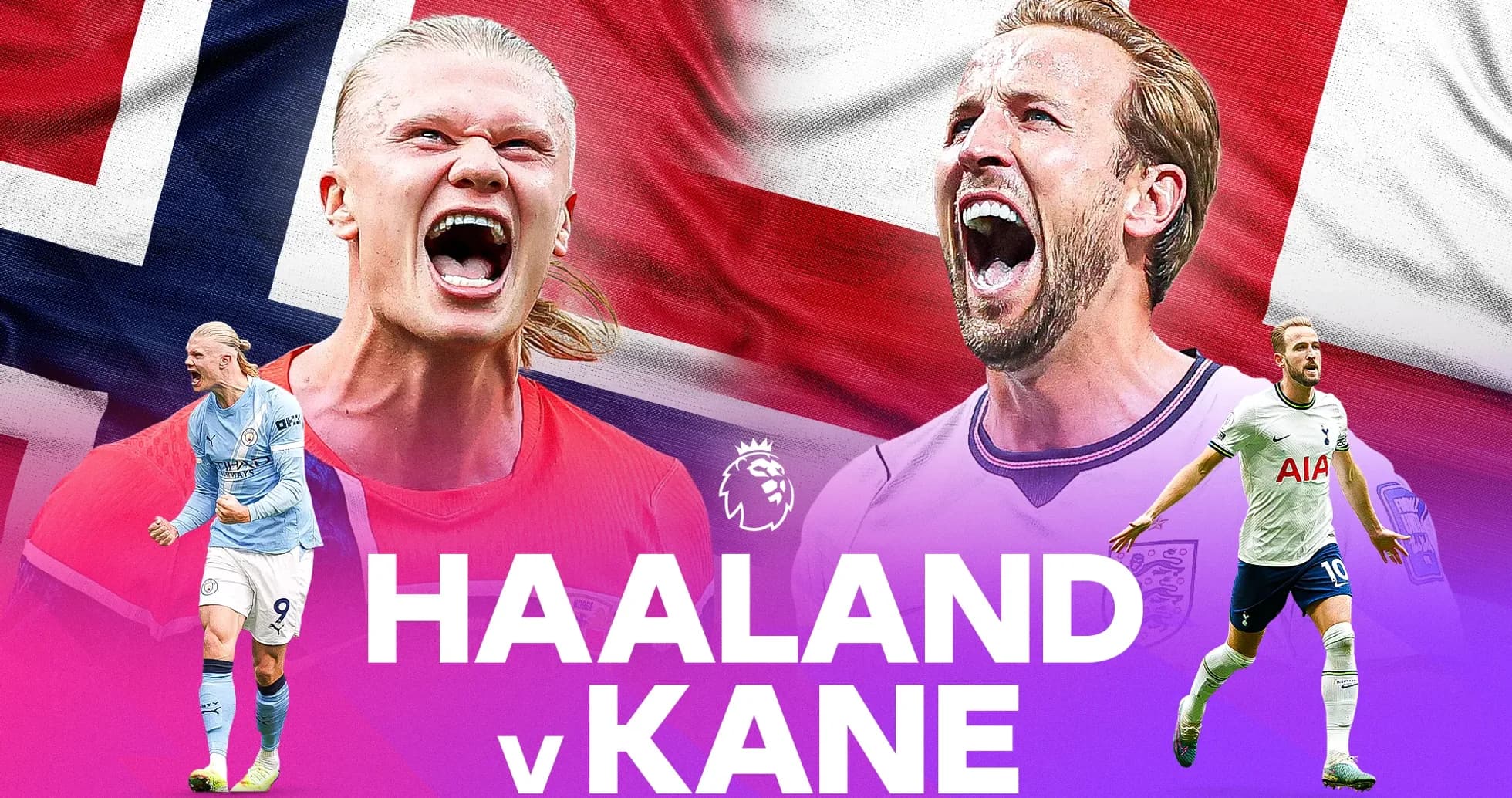
Harry Kane vs Erling Haaland: A Striker Showdown
Harry Kane and Erling Haaland are chasing the same prizes, rewriting the same record books, and yet they could hardly be more different.
Two No 9s. Two eras. Two completely contrasting interpretations of what a modern striker should be.
Haaland is the executioner. A cold, relentless finisher whose game condenses into one brutal act: the shot. He lurks, he waits, and then he strikes with a ruthlessness that has turned penalty areas into his private hunting ground.
Kane is the conductor. Creator, link-man, and finisher rolled into one. He wore the number 10 shirt at Tottenham Hotspur for a reason: he has always seen himself as the pulse of the team, not just the final touch.
On Saturday, those philosophies collide when England face Norway in the 2026 FIFA World Cup quarter-final. For once, this rivalry will not run in parallel. It will run straight at each other.
A rivalry built on numbers
Strip away the emotion and what remains is staggering data.
In Premier League terms, Haaland’s goalscoring rate is from another planet. He has 112 goals, already 25th on the all-time list, and nobody in the competition’s history can match his 0.91 goals per 90 minutes. Nobody.
Kane’s case is built on volume and longevity. With 213 Premier League goals, he sits second only to Alan Shearer’s 260. He is just 47 short of the all-time record, and at his historic rate of roughly 25 league goals a season, he would need only around 18 more months back in England to stand alone at the top.
Haaland, though, has only had four Premier League seasons. Kane enjoyed nine as a first-team regular at Spurs. Time matters here.
Run the numbers forward and the picture changes. At 0.91 goals per 90, Haaland needs 113 more Premier League matches – around four seasons at his current 33-games-a-year rhythm – to score the 102 goals required to overhaul Kane and move into second on the all-time list. With eight years left on his current contract, he has more than enough runway not only to pass Kane but to catch Shearer. After those 113 games, he would need roughly another 52 matches to find the extra 47 goals that would take him past 260.
Give it time, and the machine from Norway is on course to become the most prolific scorer the Premier League has ever seen.
For now, though, Kane still leads the race that has already been run.
Peaks, records and the art of domination
Their stories in England began very differently.
Kane’s rise was gradual. He was 21 when he finally exploded under Mauricio Pochettino in 2014/15. From there, he became a metronome of elite output.
Haaland arrived like a thunderclap. In his debut Premier League season, 2022/23, he smashed the single-season goals record with 36. That year, Kane – in his final campaign at Spurs – scored 30 league goals, the second time he had hit that mark in the competition.
Look at their best seasons and Kane’s consistency jumps out. The top five Premier League scoring campaigns between them read:
- Haaland – 36 goals (2022/23)
- Kane – 30 goals (2022/23)
- Kane – 30 goals (2017/18)
- Kane – 29 goals (2016/17)
- Haaland – 27 goals (2025/26)
Haaland has the highest single-season peak, but Kane appears more often in that elite bracket. Again, the context matters: Haaland simply hasn’t had as many seasons to stack.
When it comes to records, they trade blows.
Haaland owns the fastest to 100 Premier League goals, the most goals in a single season, and the best per-90 scoring rate the division has ever seen. Kane counters with the most goals for a single Premier League club – 213 for Spurs – and the most goals in London derbies, with 51.
Personal awards? The margins are slim.
Haaland already has five Golden Boots: three from the Premier League and two from the UEFA Champions League, plus three major Player of the Year titles – one each from the Premier League, the Bundesliga and UEFA. Kane’s honours list is longer, but spread across more years and more competitions: nine Golden Boots (three in the Premier League, three in the Bundesliga, one in the Champions League, one at the World Cup and one at the Euros), along with a Bundesliga Player of the Year award. Kane also has two European Golden Shoes to Haaland’s one.
The Norwegian, seven years younger, is still accelerating into his prime. The Englishman is squeezing everything out of his.
Trophies and context
Football, though, is not an individual sport dressed up as a team game. Medals matter.
On that front, Haaland has the heavier cabinet. He has three league titles – two in the Premier League and one in the Austrian Bundesliga – plus a Champions League crown. He has also lifted five domestic cups: two FA Cups, one EFL Cup, one DFB-Pokal and one Austrian Cup.
Kane’s team honours arrived later. He has two Bundesliga titles and one DFB-Pokal. That’s it.
Some will look at that and say the argument is over. Others will point to Kane’s numbers in teams that often fell short of title-winning level and argue that his output, in a less dominant environment, is even more remarkable.
The move to Bayern Munich has sharpened that debate.
Kane in Germany, Haaland for Norway
Since crossing to the Bundesliga, Kane has entered a scoring realm usually reserved for Lionel Messi and Cristiano Ronaldo.
He has 98 goals in 94 Bundesliga matches. Those are not just good numbers; they are absurd. They prompt a tantalising hypothetical: what would his Premier League tally look like if he had spent his prime years at a side like Pep Guardiola’s Manchester City?
Haaland, though, has his own version of that question at international level.
Playing for Norway, he operates outside the elite tier of national teams. Yet his record is outrageous: 62 goals from 54 caps, scoring in each of his last 14 internationals. That equates to 1.26 goals per 90 minutes for his country.
Kane’s England record is, in its own right, historic. He has 85 goals from 119 caps, at 0.83 goals per 90, and stands as his country’s all-time leading scorer. Still, Haaland’s international ratio is on another level.
So where does the balance land?
Kane leads many metrics because he has been at this longer. Haaland has more trophies because he has spent more time at clubs and in environments built to collect them. The ledger, in July 2026, is finely poised.
The decisive season – for now
One detail tips the scales.
In 2025/26, Kane outscored every player in Europe in all club competitions. He finished with 61 goals. Kylian Mbappe was next on 42. Haaland, by his own high standards, trailed with 38.
That single season matters. Not just for numbers, but for status.
Right now, Kane stands as the best striker in the world. Haaland is the looming threat, the heir apparent, the forward whose trajectory points towards the record books and beyond.
On Saturday in the World Cup quarter-final, they finally share the same pitch with everything on the line. One man trying to confirm his supremacy. The other desperate to accelerate the changing of the guard.




