Hapoel Beer Sheva Dominates Crvena Zvezda in UEFA Champions League
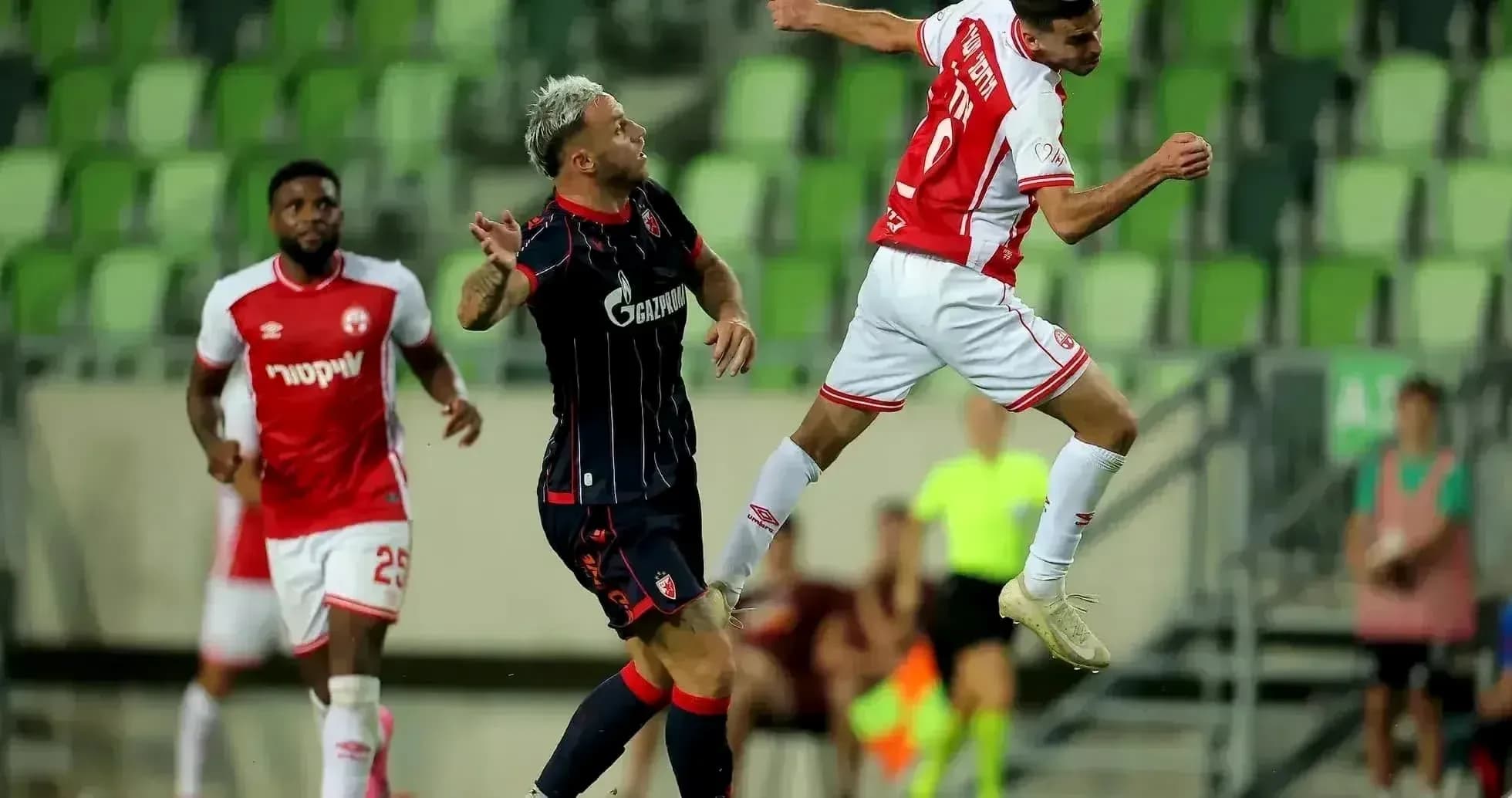
FK Crvena Zvezda’s 0-2 home defeat to Hapoel Beer Sheva at Stadium Rajko Mitić in the UEFA Champions League 3rd Qualifying Round was defined by an extreme territorial imbalance and two well-constructed second-half attacks from the visitors. With Hapoel Beer Sheva recording 96% possession against just 4% for Crvena Zvezda, the match became a prolonged defensive exercise for Dejan Stankovic’s side, further complicated by two red cards. Ran Kozuch’s 4-3-3 controlled rhythm, space and transitions, turning overwhelming ball control into a steady stream of chances and, ultimately, a decisive two-goal cushion.
Hapoel Beer Sheva's Strategy
Hapoel Beer Sheva set up in a 4-3-3 that functioned as a patient positional play structure. The back four of G. Mizrahi, Miguel Vitor, I. Rotman and P. Amador formed a wide base, with Lucas Ventura and N. Yehoshua supporting E. Peretz to create constant three-man chains in midfield. Against Crvena Zvezda’s 4-2-3-1, that gave the visitors a permanent 3v2 or 4v2 in central areas against R. Krunic and T. Elsnik. With 96% possession, Beer Sheva were able to recycle the ball at will, stretching the hosts laterally and forcing the defensive block deeper with each circulation.
Crvena Zvezda's Formation
Crvena Zvezda’s nominal 4-2-3-1, with Matheus in goal behind a back four of Seol Young-Woo, D. Luckassen, S. Erakovic and N. Tiknizyan, never really functioned as an attacking platform. The double pivot of Elsnik and Krunic was pinned back so close to the centre-backs that the line of three – O. Bukari, V. Kostov and Bruno Duarte – plus J. Enem up front, were starved of usable possession. The 4% ball share is the clearest tactical indicator: Zvezda were almost exclusively in a low block, forced to defend deep and narrow, with virtually no opportunity to press in advanced zones or to build structured attacks.
Shot Profile
The shot profile underlines that dynamic. Crvena Zvezda managed only 2 shots on goal, 7 off target and had 2 efforts blocked. With so little possession and no recorded total passes data, their attacks were necessarily direct and rushed: long clearances or isolated counters rather than constructed patterns. The absence of offsides (0) further suggests they rarely managed to push the line high enough or combine in behind; there were simply not enough phases in the final third for runs to be timed beyond the last defender.
By contrast, Hapoel Beer Sheva’s 6 shots on goal and 2 off target from a similar number of corners (3, same as Zvezda) show a side that converted territorial control into consistent final-third presence. Their 1 blocked shot indicates that many of their attempts were worked into clearer lanes rather than speculative efforts through traffic. The two goals – both “Normal Goal” events – were the logical outcome of sustained pressure rather than isolated breaks, with the front three of J. East, I. Zlatanovic and Z. Ahmed supported aggressively by Peretz and the advanced midfield line.
Discipline and Game State
Discipline and game state compounded Crvena Zvezda’s problems. The hosts committed 10 fouls to Hapoel Beer Sheva’s 5, a reflection of constant defensive firefighting. The first red card at 57' for D. Stankovic removed leadership and likely tactical flexibility from the touchline just as adjustments were most needed. Later, M. Abu Fani’s red card for “Roughing” at 90+2' meant Zvezda finished with nine men, but more importantly it encapsulated a match in which the home side were consistently reacting late to movements around them, often arriving second in duels.
Hapoel Beer Sheva’s two yellow cards – I. Rotman for “Holding” at 22' and Lucas Ventura for “Roughing” at 63' – were isolated incidents rather than part of a broader pattern of defensive strain. With 96% possession, their fouls tended to occur in counter-press situations rather than in deep defensive emergency. The visitors’ ability to control the tempo meant they could commit tactical fouls selectively without being drawn into chaotic exchanges.
Substitutions
Substitutions from Crvena Zvezda underline a search for solutions that never really altered the tactical picture. At 46', M. Arnautovic (IN) came on for J. Enem (OUT) and M. Abu Fani (IN) came on for T. Elsnik (OUT), signalling a desire to refresh the forward line and add energy in midfield. Later, M. Ivanic (IN) for V. Kostov (OUT) at 62', M. Cham (IN) for O. Bukari (OUT) at 73', and A. Katai (IN) for N. Tiknizyan (OUT) at 80' suggested a move towards more creativity and perhaps a back-three variant. Yet with so little of the ball, these profile changes could not manifest in sustained attacking patterns.
Kozuch’s changes were more about energy management within a functioning system. H. Kanaan (IN) for G. Mizrahi (OUT) and M. Abu Rumi (IN) for N. Yehoshua (OUT) at 66' refreshed the right side and midfield legs without altering the 4-3-3 structure. Later, D. T. Diop (IN) for I. Zlatanovic (OUT) at 76', O. Davidzada (IN) for P. Amador (OUT) at 90+2', and A. Ohana (IN) for J. East (OUT) at 90+2' maintained the pressing intensity and defensive security as Beer Sheva protected their 2-0 lead. The fact that they could rotate within the same tactical framework, while Zvezda chased the game with increasingly improvised changes, is a key strategic contrast.
Set Pieces
Set pieces offered no rescue for the hosts. Both sides had 3 corner kicks, but with Hapoel Beer Sheva dominating possession, their corners were the product of sustained pressure rather than rare forays. Zvezda’s corners, by contrast, were isolated events in an otherwise one-way territorial flow, and with no goals or major chances recorded from them, they failed to change the momentum.
Without goalkeeper saves or xG data, the clearest verdict comes from possession, shots and discipline: Hapoel Beer Sheva imposed a controlled, ball-dominant 4-3-3 that suffocated FK Crvena Zvezda’s 4-2-3-1, forced them into a low block and reactive fouling, and then capitalized with two well-timed second-half goals. In a tie of this magnitude, such an extreme 96%-4% possession split is not just a statistic; it is a tactical verdict in itself.