Haaland vs Kane: World Cup Semifinal Showdown in Miami
Miami will drip with heat and storylines on Saturday night. England, serial quarterfinalists, stand one win from yet another World Cup semifinal. Norway, back on this stage for the first time since 1998, are trying to stretch a fairytale into something historic.
The setting is brutal: 33C, thick humidity, a 5pm local kick-off, and the threat of thunderstorms. The football should be even more unforgiving.
Haaland vs Kane: Golden Boot, golden stakes
Two of the planet’s most ruthless finishers walk into the same furnace, both chasing a World Cup and the Golden Boot.
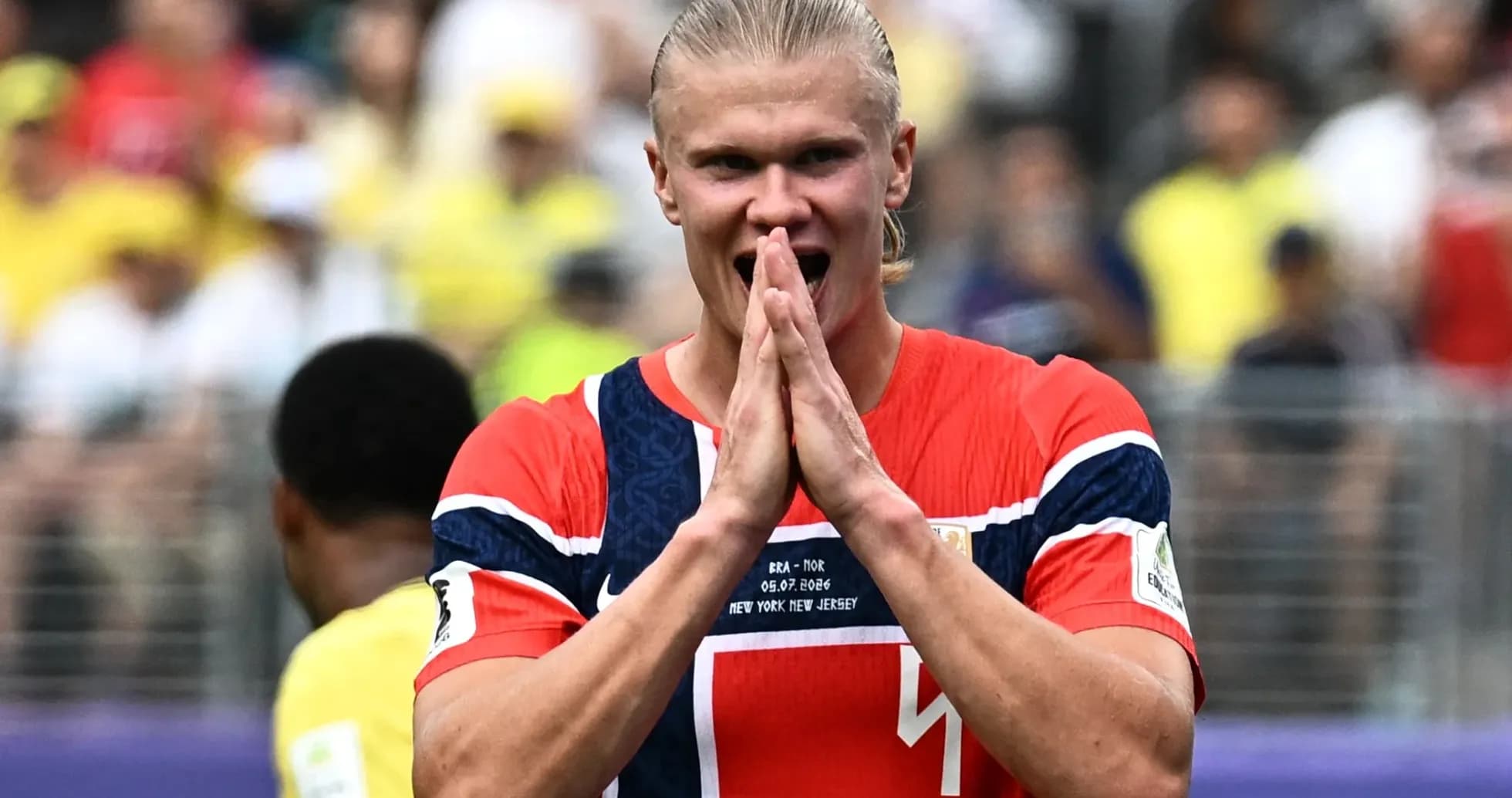
Erling Haaland arrives as the tournament’s force of nature. Left out against France with qualification already sealed, he responded by deciding both knockout ties since. He struck the winner against Ivory Coast, then bullied Brazil with both goals in a 2-1 victory that stunned the five-time champions.
Seven goals in four appearances. Fourteen straight games scoring for Norway, 27 in that run. A scarcely believable 62 goals in 54 caps. He trails only Kylian Mbappé and Lionel Messi in the Golden Boot race and stands one ahead of Harry Kane.
Kane’s path has been steadier, but no less decisive. Two goals to open against Croatia, another to secure top spot against Panama. Two more in the late turnaround against DR Congo in the Round of 32, and then the penalty that settled a wild 3-2 epic against Mexico. Six goals, all at pivotal moments, from a 32-year-old who knows this stage and its scars.
They mirror each other in more ways than that: three Premier League Golden Boots apiece, both having thrived in Germany, both used to carrying the weight of nations and superclubs. Yet they’ve only shared a pitch twice, back in 2022/23. Tottenham vs Manchester City. One win each, one goal each. Perfectly poised.
Now they collide with more on the line than three points. A World Cup semifinal. A Golden Boot. And the right, for at least a few months, to claim they are the most devastating No 9 on Earth.
Can England build a Haaland-proof wall?
Stopping Haaland has become football’s toughest exam. England might just have an unlikely answer.
Dan Burn.
The 6ft 7in Newcastle defender was the curveball in Thomas Tuchel’s World Cup squad, a late bloomer who only made his England debut just before turning 33 and whose four starts came against Andorra and Albania in qualifying. On paper, he looked like depth. On Sunday night against Mexico, he looked like a plan.
Thrown on for the final 15 minutes with England down to 10 men and clinging to a 3-2 lead, Burn turned the box into his own private no-fly zone. Cross after cross met his forehead. Blocks, clearances, sheer stubborn resistance as England dug in through 12 minutes of added time.
He is not as quick as Haaland. He is nine years older. But he is taller, stronger in the air, and the history between them is not nothing. Since Haaland arrived at Manchester City in 2022, the pair have shared more than 10 hours on the pitch across eight matches in all competitions. Haaland has scored once in that time, in their very first meeting in August 2022.
For a striker who averages a goal every 73 minutes for his country, that is a rare chokehold.
Burn is not alone in that category. Ezri Konsa has faced Haaland for 406 minutes across five games and also conceded just one goal, again in their first encounter back in September 2022. Given Haaland has plundered 112 goals in 132 Premier League games over four seasons, with three Golden Boots, those numbers matter to Tuchel.
The contrast with others is stark. Marc Guehi conceded seven goals to Haaland in five meetings before joining him at City. John Stones, Haaland’s club teammate, has never faced him in anger at all.
Tuchel must decide whether to lean into the data and the bruises Burn and Konsa have collected over years of grappling with Haaland in England. If he does, England’s back line might look more like a specialist task force than a traditional defence.
Odegaard vs Rice: the brains of the operation
If Haaland is the hammer, Martin Odegaard is the hand that guides it.
Norway’s captain delivered a midfield masterclass against Brazil. He carried the ball forward 61 times, completed 101 of his 109 passes, and dictated a game in which the Selecao were reduced to a mere 33.6 percent possession – their lowest ever in a World Cup match.
Norway suffocated Brazil with the ball. Odegaard was the metronome and the scalpel.
England know that feeling from the other side. Against Mexico, reduced to 10 men and pinned back, they recorded their lowest share of possession since such records began. If they are to reach a first World Cup semifinal since 2018 – and only their third since 1966 – they cannot afford a repeat. They have to disrupt Odegaard’s rhythm at source.
Declan Rice should understand that job better than anyone alive. He and Odegaard have shared the Arsenal midfield 117 times over the past three seasons, driving the club to a long-awaited Premier League title and a Champions League final. Rice knows Odegaard’s habits, his preferred angles, where he wants the ball and when he speeds the game up.
But Rice is not at full tilt. Neural pain has nagged at his lower back and hamstring for months. He still logged 3,094 Premier League minutes this season, with England partner Elliot Anderson playing even more. Odegaard, by contrast, clocked just 1,369 league minutes. The Norwegian arrives fresher, lighter, perhaps sharper.
If Rice can still close space, still win those half-seconds in transition, England can drag the game away from Odegaard’s comfort zone. If he cannot, Norway’s captain will happily turn this into another exercise in control.
The Miami test: who survives the furnace?
Tactics will matter. So will lungs.
Neither England nor Norway are built for tropical evenings, but their routes to Miami have not been equal. Norway have already felt the heat. They opened in Boston against Iraq, then moved to New York/New Jersey for the win over Senegal. Back to Boston for the rotated defeat to France. Dallas brought their only enclosed game, a win over Ivory Coast, before another hot, humid test in New York/New Jersey to beat Brazil.
England’s path has been kinder. Croatia in the closed Dallas stadium. Ghana in a rainy Boston. Panama in a wet New York/New Jersey. DR Congo in the air-conditioned comfort of Atlanta. Mexico in Mexico City, cooler than expected despite the thunderstorm that delayed kick-off by an hour.
The two hottest group games of the tournament so far both came in Miami. Uruguay vs Cape Verde and Uruguay vs Saudi Arabia turned the pitch into an oven. Saturday should be similar: 33C, 58 percent humidity, storms lurking.
This could become a game of who fades slowest rather than who starts fastest. Those final 20 minutes, with legs heavy and shirts soaked, may decide who walks back into the same stadium on Wednesday for a semifinal.
Norway’s left vs England’s right: a live wire of a duel
One flank, one decision, and possibly one tournament on the line.
Reece James is the only recognised right-back in England’s squad. He has missed the last three matches after a hamstring injury against Ghana. Tino Livramento never made it to kick-off, ruled out with a calf problem on the eve of the tournament.
Since James limped off, Tuchel has stitched together solutions. Djed Spence has played there. Ezri Konsa has filled in. John Stones and Jarell Quansah have both been shunted wide. Rice even finished the DR Congo game at right-back. Now Quansah is suspended after his red card against Mexico, and England are waiting on James’ fitness like a weather report.
If James makes it, England gain an elite one‑on‑one defender and a natural outlet on that side. If he does not, Konsa is the favourite to reprise the role he handled with such discipline in the Mexico rearguard.
Whoever starts will be busy.
Antonio Nusa offers one kind of problem. A quick, elusive winger coming off the left, he cuts inside onto his right and can finish with whip and precision – as Ivory Coast discovered when he bent a superb strike into the top corner in the Round of 32. He drifts, he darts, he teases.
And yet it was his replacement who turned Norway’s last game on its head. At half-time against Brazil, Stale Solbakken sent on Andreas Schjelderup. The 22-year-old produced his standout performance of the tournament. First, a measured cross for Haaland to rise and head in the opener. Later, the calm square pass that allowed Haaland to step onto the ball at the edge of the box and lash in the second.
Schjelderup carries less chaos than Nusa, but more end product right now. He times his runs, chooses his moments, and his delivery has already cut open one giant.
England’s right-back – whoever it is – will not just be defending the touchline. They will be trying to stop the supply line to the most lethal striker in the competition, while also deciding when to risk stepping out to help Rice and the midfield.
One misjudged step, one tired sprint in the Miami heat, and the ball could be on Haaland’s head again.
So it comes to this. A nation used to quarterfinal heartbreak against a nation unused to being here at all. Haaland and Kane chasing goals and legacy, Odegaard and Rice wrestling for control, two benches juggling cramp, fatigue and the threat of lightning in the sky.
The winner walks back into the same stadium on Wednesday with a World Cup semifinal to play. The loser leaves Miami with sweat, regrets, and the nagging thought that this, in this heat, was their moment.