Gnabry's Rise and Musiala's Challenge in Bayern's No. 10 Race
Serge Gnabry turned 30 in July 2025 and walked back into a Bayern Munich dressing room that, for the first time in a long while, truly needed him. A few months earlier, he had looked more like a name for the sales list than a pillar of Vincent Kompany’s project. By the end of pre-season, he was something else entirely: the default answer to a problem Bayern hadn’t properly solved.
Not because he had produced some once-in-a-lifetime pre-season. Because there was barely anyone else.
In Kompany’s 4-2-3-1, three attacking spots were untouchable. Harry Kane, Michael Olise and Luis Diaz were locked in as the front three. That left one role, the No. 10, and one serious candidate: Gnabry.
Jamal Musiala was out for months after his fibula fracture. Lennart Karl, hugely gifted, was still supposed to be a slow-burn story, not a headline act. Nicolas Jackson only arrived on Deadline Day at the start of September and then needed time – plenty of it – to adjust.
So the choice in the big games was blunt: Gnabry or nobody.
Kompany backed him. In the majority of Bayern’s biggest fixtures, Gnabry started, even as Karl accelerated his development and Jackson was handed chances he largely failed to seize. When Musiala finally returned in January, he had to fight his way back into a hierarchy that had quietly shifted in his absence.
Now, that hierarchy is gone. The fight is wide open.
A New Four-Way Fight Behind Bayern’s Superstars
The spine of Bayern’s attack is clear: Kane, Olise, Diaz. Everything else is up for grabs.
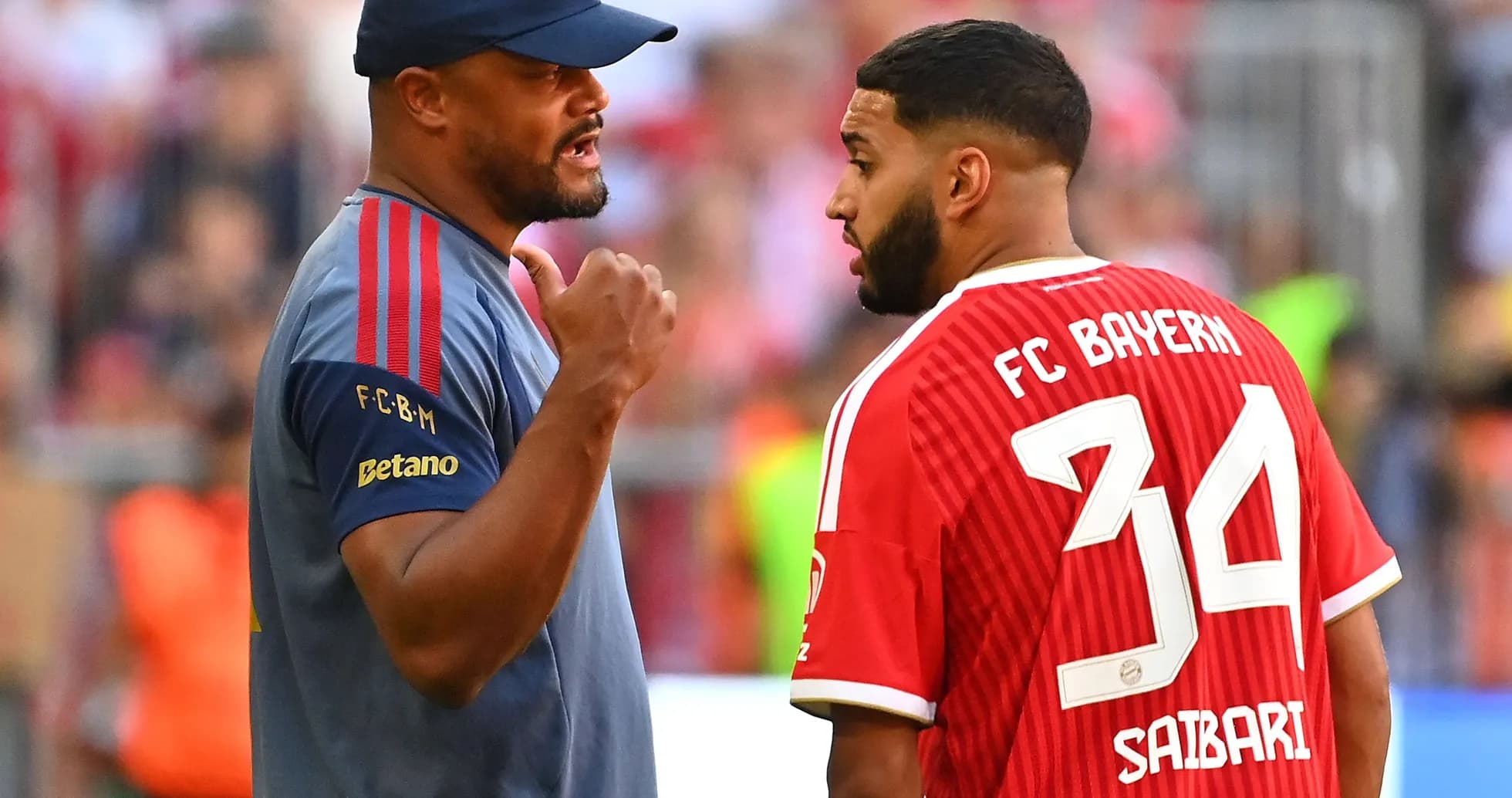
Behind them, a four-man contest is taking shape for that fourth attacking slot. Musiala, Gnabry, Karl and new €50 million signing Ismael Saibari all have realistic claims on serious minutes. With a crammed schedule on multiple fronts, Kompany will have no choice but to rotate heavily.
The real question is simpler: who plays when it really matters?
Musiala was supposed to be the answer. He wears the No. 10 shirt. He is one of the club’s top earners. Internally and externally, he was framed as the face of Bayern’s future, a player to build around, not rotate.
Right now, that vision feels distant.
Since his January comeback, Musiala has not hit his previous level. The World Cup left its mark, and after that disappointing tournament he had a metal plate removed from his foot. Physically and mentally, he has been chasing his old rhythm.
Then came the worrying scenes in pre-season. Twice, in friendlies against RB Leipzig and 1. FC Heidenheim, he collapsed. The diagnosis: absence epilepsy. A serious issue, but one that does not automatically close the door on a professional career.
Neurologist Dr Regina Becker underlined that in an interview with SPOX, stressing that playing at the top level is fundamentally possible with the condition.
Musiala has no intention of stepping away. In a widely discussed Instagram statement, he wrote that, in close and regular consultation with specialists, it was his personal wish to face the challenge and, with medical clearance, continue to live his everyday life and pursue his passion for football.
He wants to play. Bayern want him available. The question is how quickly he can become the decisive force he was meant to be.
Saibari Arrives Sharp, Gnabry and Karl Race the Clock
While Musiala grapples with form and fitness, two of his direct competitors have been on their own recovery paths.
Gnabry, now 31, and Karl, just 18, both missed the World Cup with muscle injuries. Their summers were quieter, spent largely away from the group, working individually on comebacks rather than chasing minutes in high-profile games. Only now are they being eased back into full team training.
The timeline is encouraging. Both could feature as early as the Super Cup against Borussia Dortmund on Saturday. If not then, they are expected to be fully available by the Bundesliga opener against VfB Stuttgart the following Friday at the latest.
Saibari, though, has stolen an early march.
Fresh from an impressive World Cup with Morocco, the 25-year-old also had to pause with a torn muscle fibre. That delay has now passed. He is up to full speed, has looked sharp in his first two friendlies and already has an assist to his name from the 3-1 win over Leipzig.
Right now, he is the fittest of the four contenders. That alone gives him a crucial edge heading into the opening weeks. When Kompany looks at his board for the first competitive line-ups of the season, Saibari’s name is the one with the fewest question marks beside it.
Youth Glimpses, But a Deeper Squad Changes the Odds
While the established names were missing, others stepped into the spotlight.
Loan returnee Arijon Ibrahimovic, 20, and academy prospects Tim Binder, 19, and Maycon Cardozo, 17, all used pre-season to make noise. Their energy and fearlessness gave Kompany options he might not have expected so soon. Karl’s rapid rise last year, from academy hopeful to genuine first-team factor, offers a clear template.
This time, though, the path looks steeper.
Bayern’s attacking pool is deeper, more experienced, and more expensive than it was 12 months ago. Saibari has arrived for big money. Gnabry has reasserted himself. Musiala is fighting to reclaim his status. Karl is no longer a surprise, but a known quantity.
The door from the academy to the Allianz Arena pitch is still there. It is just more crowded.
Somewhere in that congestion, Kompany must find his No. 10 for the biggest nights. Does he trust the old hand in Gnabry, the prodigy in Musiala, the rising Karl or the sharp, all-action Saibari?
The answer will shape Bayern’s season – and perhaps decide who truly owns that space behind Harry Kane.