Gianni Infantino's Fall from Grace: From King of Football to Isolated President
Gianni Infantino sat alongside Donald Trump at MetLife Stadium less than a fortnight ago, bathed in the glare of the World Cup final and the cameras that came with it. The US president has called him the “King of Football”, and for a while the FIFA boss wore the crown with ease.
There were boos when the pair walked the turf to hand Spain and Argentina their medals on July 19, but they were a faint soundtrack to a triumphant night. The 104th and final match of the biggest World Cup in history looked like the closing scene of a flawless campaign: record revenues, record audiences, and a president cruising towards a coronation re-election in March.
That glittering tableau now feels like a relic.
In less than two weeks, Infantino has gone from untouchable to embattled, his authority shredded by a revolt that has shaken global football’s governing body to its core.
From World Cup king to isolated president
The turning point was not a refereeing scandal, a VAR controversy or a political storm over a host nation. It was a business plan.
Infantino’s decision to invite private investors, fronted by Joshua Kushner, to buy into the future profits of the World Cup and all FIFA events detonated a backlash few in Zurich appeared to anticipate.
The project, packaged under the name FIFA Forward Enterprise (FFE), would have carved out the most lucrative parts of FIFA’s operations – World Cups, other tournaments, broadcasting rights, sponsorship, ticketing and hospitality – into a new subsidiary. Investors were asked to pay $4.2bn for roughly 20 percent of FFE, implying a $20bn valuation.
The anchor investor: Thrive Eternal, a vehicle launched by Kushner, whose brother Jared is Donald Trump’s son-in-law.
For Infantino, it was pitched as a way to lock in long-term money and turbocharge development funding. For much of the football world, it was something else entirely: the moment the World Cup itself, the sport’s ultimate prize, stepped towards being a financial product rather than a shared global spectacle.
The resistance was instant and ferocious.
A deal too far
FIFA’s 211 member associations, technically the owners of the organisation under Swiss law, were presented with a tempting offer. Each federation was told it could receive $20m from the new structure, double the $10m already due to them over the next four-year cycle, funded by FIFA’s record $15bn revenue from 2023-26.
Under FFE projections, that $20m would rise to $22m per federation through 2034 and $24m to 2038. For small associations in places like Andorra, Montserrat or Papua New Guinea, those are transformational sums. For established powers such as England, Spain or France, they are less persuasive than control, calendar stability and competitive integrity.
The deadline to accept the offer was set for September 19. On paper, Infantino looked strong. He left New York last week with letters of support from around 200 federations, an emphatic show of confidence ahead of next March’s election.
Then the mood turned.
What began as unease hardened into open revolt. Senior staff claimed they had been misled. European federations threatened boycotts. Political leaders weighed in. Fans, already suspicious of creeping commercialisation, saw a red line being crossed.
By Friday, Infantino had no choice but to retreat.
“Having listened carefully to all the views, it has become clear that the project has created divisions of a nature that, regardless of the level of support, are no longer in the interest of the objective set out in the first place,” he said in a statement announcing the plan’s abandonment.
The project was dead. The damage, though, was only beginning.
Allies vanish, critics step forward
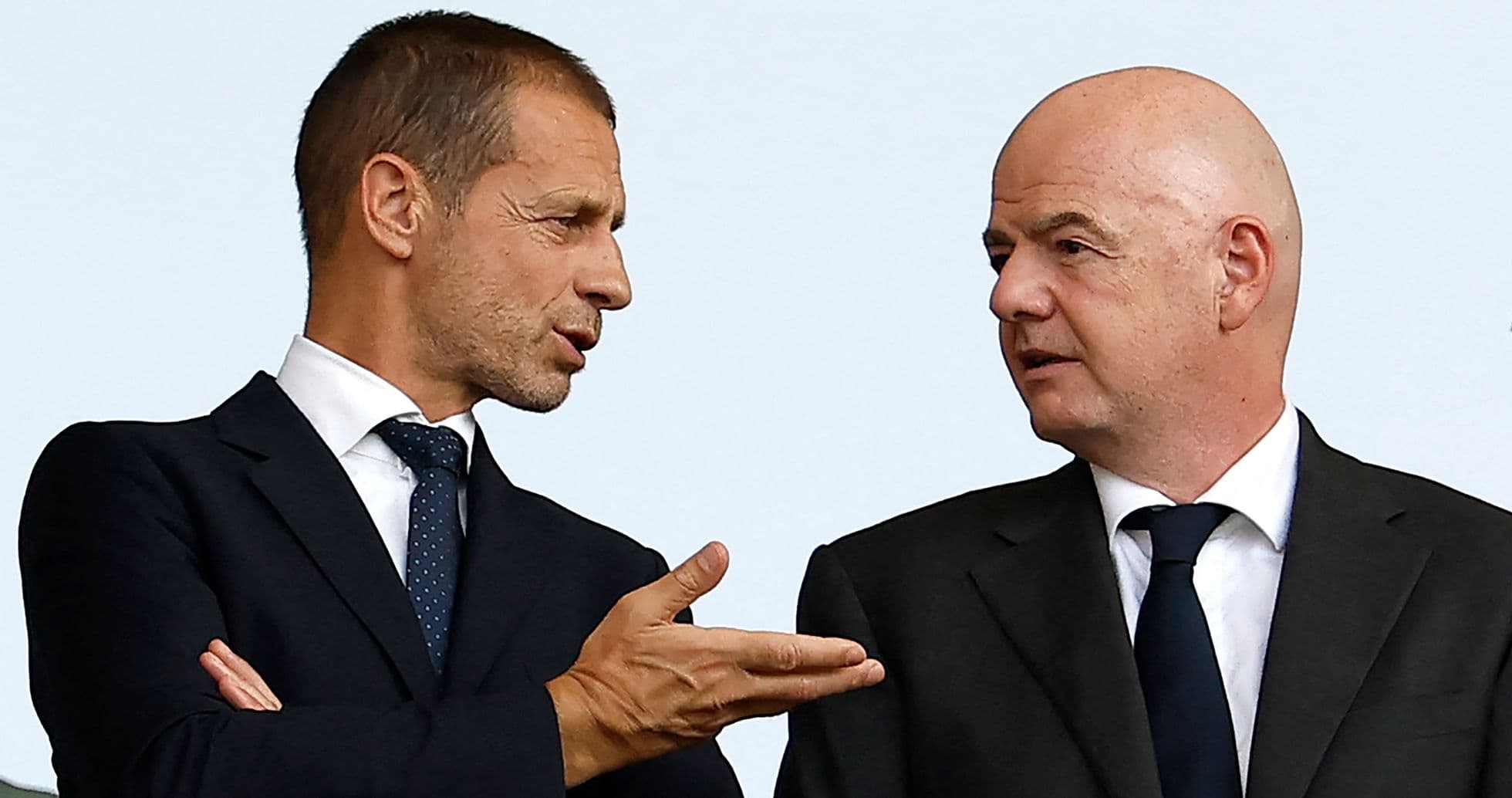
The list of opponents read like a who’s who of the game’s power structure. Some FIFA vice presidents. Senior executives. Every European federation. The confederations of Asia and North America. The global body representing domestic leagues. Even Britain’s prime minister.
In short: almost everyone that mattered.
Inside FIFA, the pushback became personal. Carlos Cordeiro, Infantino’s senior adviser and a former Goldman Sachs banker, resigned, calling the deal “bad”. Kevin Lamour, the organisation’s chief operating officer, issued a stinging public defence of staff that stopped just short of inviting Infantino to sack him.
Then came the decisive blow. UEFA announced on Thursday that its members would boycott all FIFA competitions unless the investment plan was scrapped.
That threat cut straight to FIFA’s financial heart. European teams dominate the men’s World Cup and the Club World Cup, the two tournaments that underpin FIFA’s revenue. Without them, the governing body’s business model collapses.
European officials feared that private investors, once embedded, would push relentlessly for more matches, expanded tournaments and new competitions to maximise returns. That, they argued, would wreck an already overloaded calendar, drain attention and money from club competitions such as the UEFA Champions League, and drive elite players beyond their physical limits.
The fixture list is already bursting. Broadcast and sponsorship markets are not infinite. Something, they warned, would break.
The fury was not only about the content of the plan, but the way it had been driven. Many inside and outside FIFA believe Infantino spent the last year crafting the project in a tight circle, consulting few, while spending conspicuous time in Trump’s orbit. Trump himself said on Friday he had not spoken to Infantino about selling stakes in the World Cup.
For a president who built his power base on promising transparency and collective decision-making after the scandals of the Blatter era, the optics were brutal.
Who still stands with Infantino?
Infantino’s traditional bastions of support have not yet turned on him, but they have not rushed to his defence either.
Africa, with 54 of the 211 votes and long the cornerstone of his electoral strength, stayed notably neutral, weighing the promise of “game-changing” money against the uproar elsewhere. For many African federations, the sums on offer would reshape domestic football; for their leaders, the political cost of backing a toxic plan was harder to calculate.
In South America, CONMEBOL said on Friday it had received the proposal and would study it “with the rigour it demands”. Its president, Alejandro Dominguez of Paraguay, is also a FIFA vice president and has his own stake in Infantino’s future. He is counting on the FIFA chief to expand the 2030 World Cup to 64 teams, which would give minority co-hosts Argentina, Paraguay and Uruguay more matches. Under the current 104-game format, each of those three is due just one game, with the rest staged in Spain, Portugal and Morocco.
That kind of horse-trading has long defined FIFA politics. This time, though, the storm is bigger than a few extra fixtures.
Infantino had been re-elected unopposed in 2019 in Paris and again in 2023 in Kigali, Rwanda. The statutes allow him one more four-year term. Until this week, another walkover in Rabat on March 19, 2026, looked almost inevitable.
Now, nothing about that vote looks certain.
Power, money and a future beyond 2031
Behind the FFE proposal lay a deeper question: what happens to Infantino after 2031?
FIFA’s term limits mean he must step down then. The new subsidiary, with its commissioner-style leadership role and control over the money-making side of the game, appeared to offer a path for him to stay at the centre of world football in a different guise, likely on a salary far beyond his current package of more than $6m per year.
By trying to secure that future, he may have jeopardised the present.
The presidential election rules are simple. In a contested vote, a candidate needs 106 ballots to secure a majority. Continental blocs rarely vote as a single unit, but a coalition of most of Europe’s 55 associations, CONCACAF’s 35 and Asia’s 46 would form a formidable base for any challenger.
Names are already circulating. Nasser Al-Khelaifi, the Paris Saint-Germain president with deep ties to Qatar and European football. Victor Montagliani, the Canadian FIFA vice president and CONCACAF boss. Sheikh Salman bin Ebrahim Al Khalifa of Bahrain, the long-serving AFC president who narrowly lost to Infantino in the 2016 FIFA election.
For years, such speculation felt like background noise – a reminder of discontent rather than a real threat. Infantino’s grip on power, cemented by development funds and political alliances, looked too strong.
This week has changed that calculation.
A presidency on the brink
The UEFA-led uprising killed the investment plan. It did not answer the bigger question.
Can Infantino credibly lead FIFA after his closest adviser has walked away, his chief operating officer has publicly challenged him, and his most powerful stakeholders have threatened to boycott his competitions?
The timeline is tight. November 18 is the deadline for presidential candidates to declare, four months before the vote in Morocco. In that window, federations will decide whether this crisis was a one-off misjudgment or the final straw after years of frustration with Infantino’s style and his repeated pushes for controversial reforms.
For now, the “King of Football” remains in his palace. The crown, though, no longer sits comfortably. And as potential rivals weigh their chances, the question hanging over Zurich is no longer who will buy into FIFA’s future profits, but who will be trusted to run the game at all.