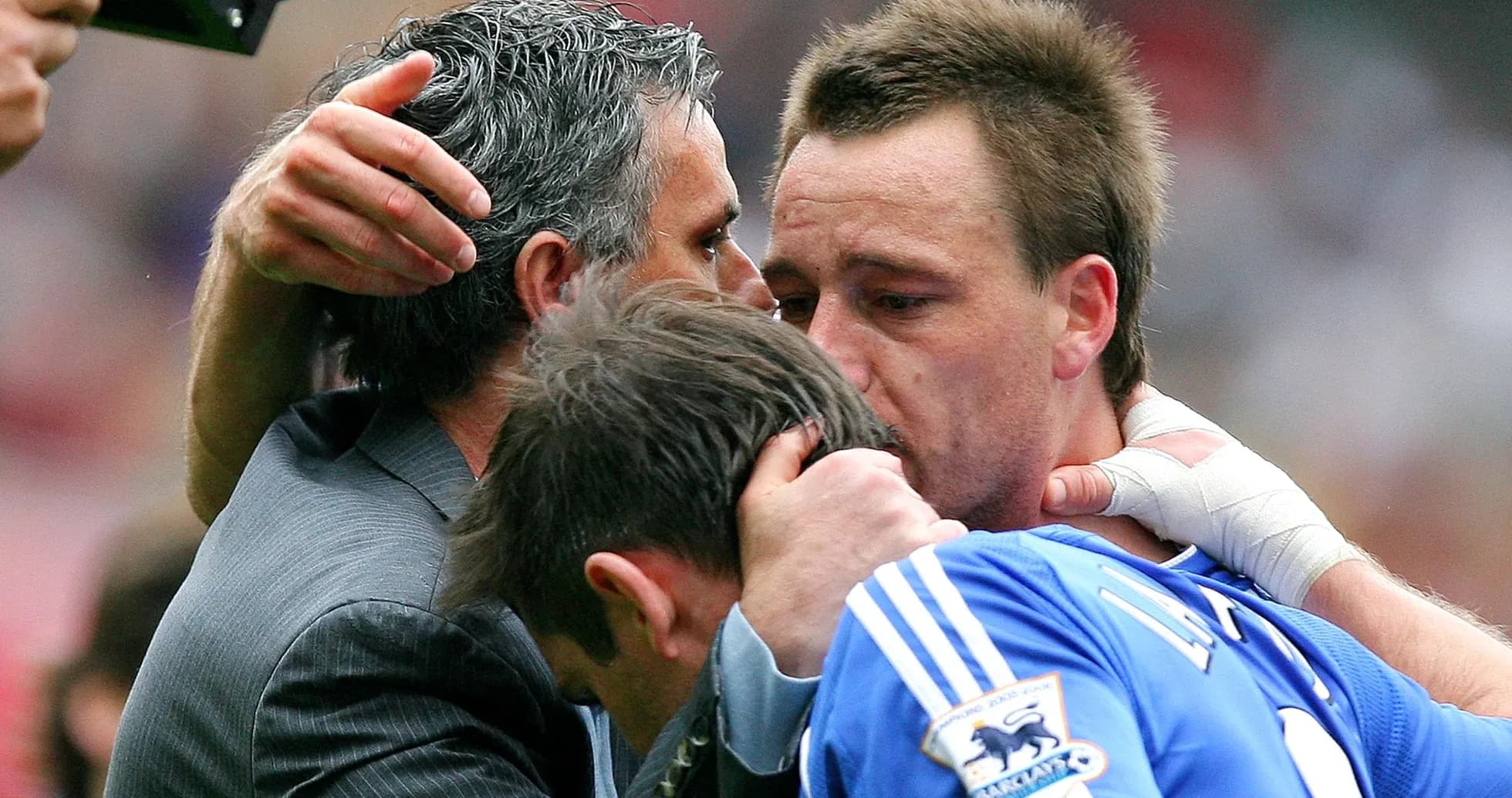
Frank Lampard and John Terry Reflect on Mourinho's Departure from Chelsea
Frank Lampard still remembers the way he walked in.
No entourage. No speech prepared. Just Jose Mourinho, stepping into the Chelsea dressing room and telling the players, face to face, that it was over.
"I remember him coming into the dressing room and he said to me that he’d been sacked," Lampard recalled. "I couldn’t think about how much this man had helped my career, how much I loved working with him. There were tears, which is not normal in the dressing room when a manager leaves."
Tears. From hardened professionals who had won titles, fought through injuries, and lived inside the ruthless churn of elite football. That day in 2007, after a 1-1 Champions League draw with Rosenborg, Chelsea’s era-defining partnership between Mourinho and Roman Abramovich finally broke – and the players felt it like a bereavement.
John Terry, the captain who came to embody Mourinho’s Chelsea, still carries the weight of that night.
"I would leave that pitch in a coffin for him," Terry said. "You’ve got grown men, tears running down their face, not really understanding why. And even still today I’m like, that’s my fault.
"When we drew the Champions League game, my man scored. If I didn’t let that person score, would he have lasted another couple of years? Who knows? I still feel kind of responsible for that, if that makes sense. It’s just disappointing how it all ended, if I’m honest. I absolutely loved him and adored him and was more upset than anyone, to be honest."
For Terry, that Rosenborg equaliser is not just a conceded goal; it is a sliding-doors moment. For Lampard, the memory is the sight of a manager he revered, telling them it was finished. For Mourinho, the story runs deeper than one result.
The Portuguese coach has long framed his first Chelsea exit not as a simple footballing decision, but as the consequence of a shifting power structure at Stamford Bridge. What began as a tight, clearly defined working triangle – Mourinho, chief executive Peter Kenyon and owner Roman Abramovich – slowly turned into something more crowded, and more complicated.
"In my work, the triangle: Jose, Peter Kenyon, Roman was invaded by strangers," Mourinho revealed. "In the beginning, you play at Stamford Bridge, you look to the box, Roman, his wife, with one or two persons of his confidence. A few seasons later: former players, agents. These kinds of people, they know where the money is."
That image is stark. The owner’s box, once a small inner circle, gradually filling with new faces, new voices, new agendas. Mourinho, so used to absolute authority in the dressing room, suddenly found the perimeter of his influence under pressure from the outside.
The tension did not come only from the boardroom or the stands. It seeped into the day-to-day, into the odd requests and subtle signs that the relationship between owner and manager was changing.
Mourinho recalled one moment that, for him, crystallised that shift. It was not about a transfer, a team selection, or a tactical disagreement. It was about a phone call and a demand that cut across his sense of professional duty.
"I think Roman changed," Mourinho said. "For example, one day Peter came to me quite embarrassed and he told me, 'Jose, I have to tell you something. The boss is in Sardinia with these boats, and the people that work in these boats they play football against guys from the hotel, and they are losing. Can you go there to win a game for him?'
"'No, Peter, I have training today. I have to prepare for tomorrow; I cannot go'. And he was not happy with that."
It is a surreal story on the surface – a billionaire owner wanting his world-class manager to fly out and win a kickabout on a luxury boat in Sardinia. Underneath it, Mourinho saw something else: a clash between his obsession with preparation and an owner’s growing desire for access, control, and perhaps a different kind of loyalty.
From that triangle at the heart of Chelsea’s rise, to the tears in a dressing room stunned by his departure, the threads are clear. The players remember the emotion. Mourinho remembers the intrusion. The result against Rosenborg may sit on the record as a 1-1 draw, but for those inside the club, it marked the moment when a dynasty began to unravel.
The trophies remain in the cabinet. The bonds, even now, remain raw. The question that lingers is the one Terry still asks himself: if that one goal had been stopped, would the story of Mourinho and Chelsea have run very differently?