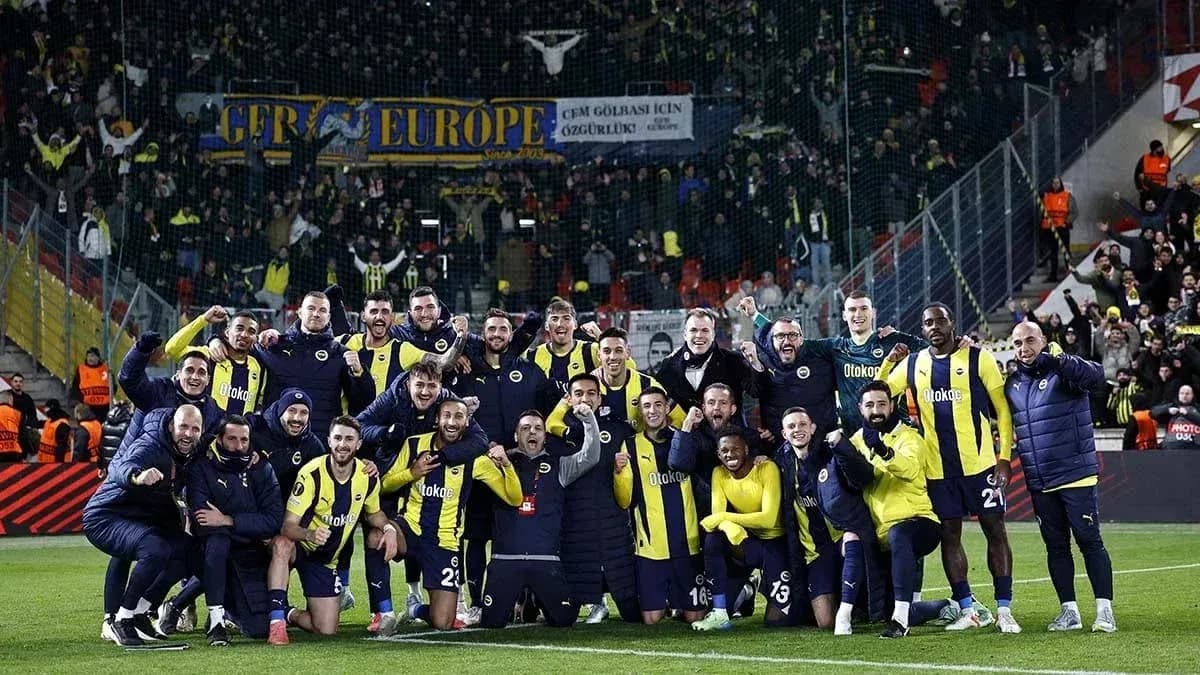
Fenerbahçe vs Lyon: Tactical Analysis of UEFA Champions League Play-offs Draw
Fenerbahçe and Lyon produced a tactically tight 1-1 draw at Chobani Stadium in the UEFA Champions League Play-offs, a match defined more by structure and control than chaos. Both sides mirrored each other in a 4-2-3-1, and the statistics underline how evenly balanced the contest was: 12 shots apiece, 52–48 possession in favour of Fenerbahçe, and 13 fouls each. The first half belonged more to Lyon in terms of incision, rewarded by L. Openda’s opener, while Fenerbahçe’s adjustments after the interval, capped by M. Greenwood’s equaliser, shifted the territorial and chance-creation balance without breaking the deadlock.
In goal, Ederson (Fenerbahçe) and D. Greif (Lyon) were central to keeping the scoreline level, each registering 4 goalkeeper saves. That parity in end-product, however, came from different defensive dynamics. Fenerbahçe allowed 12 shots but blocked only 2; their back four of N. Semedo, M. Skriniar, N. Ake and A. Brown tended to defend deeper and narrower, relying on compactness in the box rather than aggressive front-foot blocking. Lyon, by contrast, posted 5 blocked shots, reflecting a more proactive, step-out defending from the line of A. Maitland-Niles, R. Kluivert, M. Niakhate and Abner Vinicius, especially when Fenerbahçe worked the ball into the half-spaces for M. Greenwood and K. Akturkoglu.
Fenerbahçe's Structure
Fenerbahçe’s 4-2-3-1 was built on the double pivot of N. Kanté and M. Guendouzi, who gave Ismail Kartal a stable platform to dominate possession and circulation. Their passing figures – 453 total passes, 389 accurate at 86% – show a team comfortable progressing methodically. With 7 of their 12 shots coming inside the box, Fenerbahçe’s structure succeeded in moving the ball into advanced central zones, often via Talisca between the lines and Greenwood drifting in from the right. However, the shot map profile (5 on goal from 12 total) suggests that while they reached good zones, Lyon’s last-ditch interventions and Greif’s positioning limited the quality of final contacts.
Lyon's Approach
Lyon’s double pivot of T. Tessmann and T. Morton, supported by C. Tolisso higher up, underpinned a more vertical interpretation of the same 4-2-3-1. Their 433 passes (375 accurate, 87%) with slightly less possession indicate a side content to concede some territory but attack more directly once they recovered the ball. With 7 shots from outside the box and only 5 inside, Lyon’s threat profile skewed more towards medium- and long-range efforts, consistent with using Openda’s runs to stretch the line and then exploiting second balls or lay-offs for late-arriving midfielders.
Set-Play Dynamics
Set-play and territorial patterns also reveal the balance of control. Fenerbahçe earned 3 corner kicks to Lyon’s 0, a clear sign of their sustained pressure phases, particularly after Greenwood’s equaliser. They also drew Lyon into 3 offsides, evidence of a high line or at least a coordinated step from Skriniar and Ake when Lyon tried to release Openda early. Lyon, with just 1 offside and no corners, were more reliant on transitions and open-play combinations than on piling up territorial pressure.
Discipline
Discipline was symmetrical in volume but not in distribution. Both teams committed 13 fouls, yet Fenerbahçe collected 2 yellow cards (N’Golo Kanté and Milan Škriniar, both for “Foul”) to Lyon’s single booking for Abner Vinícius (“Foul”). That pattern fits the game’s tactical story: as Fenerbahçe pushed harder in the second half and raised their defensive line to lock Lyon in, their centre-back and screening midfielder were more frequently exposed to transitional defending and had to break play with tactical infringements. Lyon’s lower card count, despite similar foul numbers, hints at more fouls in less dangerous zones or better timing in their challenges.
Substitutions
The substitution pattern from both benches was explicitly tactical. At 73', D. Nene (IN) came on for K. Akturkoglu (OUT) and M. Asensio (IN) came on for Talisca (OUT), signalling Kartal’s intent to refresh the attacking band behind the striker with more direct running (Nene) and refined delivery (Asensio). Shortly after, at 82', R. Lukaku (IN) came on for V. Muriqi (OUT), transforming the reference point up front. Lukaku’s presence likely encouraged more direct entries and combinations around the box, which align with Fenerbahçe’s higher volume of shots inside the area and Lyon’s elevated blocked-shot count in the closing stages.
Paulo Fonseca’s response at 75' saw C. Mata (IN) for R. Kluivert (OUT) and K. Boudache (IN) for E. Nuamah (OUT), moves that preserved the 4-2-3-1 but slightly rebalanced the right flank, likely with more defensive security at full-back and fresh energy in the wide attacking role. The later changes – M. Bidstrup (IN) for T. Morton (OUT) at 86' and M. Ouedraogo (IN) for M. Fofana (OUT) at 90+1' – were classic game-management decisions, reinforcing legs in midfield and on the flank to withstand Fenerbahçe’s late pressure and protect the 1-1.
Statistical Verdict
From a statistical verdict, this was a near-perfectly even tie. Both teams finished with 5 shots on goal from 12 attempts, each goalkeeper making 4 saves. Fenerbahçe’s slight edge in possession (52%) and passing volume did translate into more box entries and corner kicks, but Lyon compensated with a higher number of blocked shots and a more efficient foul-to-card ratio. With expected goals and goals prevented not specified, the raw shot and save data suggest that neither side created a volume of clear-cut chances sufficient to tilt the contest decisively. As a first-leg style Play-offs encounter, the 1-1 feels like a fair tactical equilibrium: Fenerbahçe’s structured possession and territorial control matched by Lyon’s compact block, transition threat, and disciplined defensive execution.