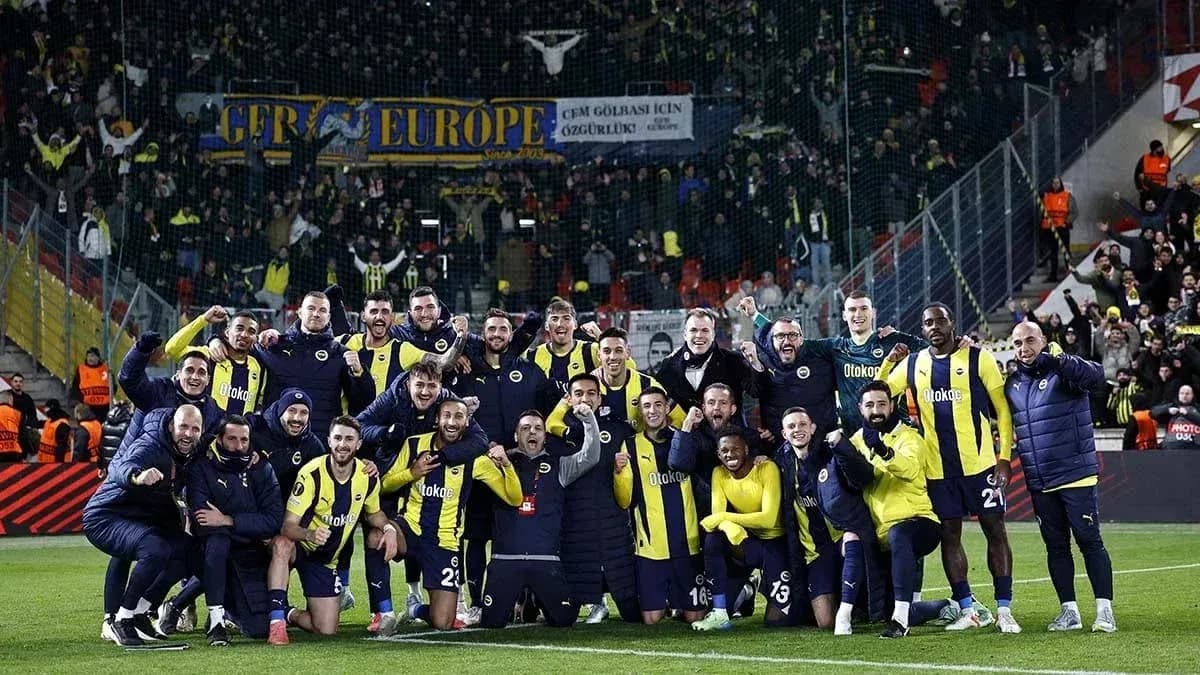
Fenerbahçe Dominates Sturm Graz in 2–0 UEFA Champions League Win
Fenerbahçe’s 2–0 win over Sturm Graz at Chobani Stadium was a textbook example of territorial domination built on structure and control. Ismail Kartal’s 4-2-3-1 suffocated the visitors from the first whistle, turning 72% possession into constant pressure and 10 shots on goal, while Fabio Ingolitsch’s 4-4-2 was pinned deep, reduced to just 5 total shots and 1 on target. The Turkish side’s double pivot dictated tempo, the three attacking midfielders created overloads between the lines, and the lone striker stretched the back line to open lanes for late runners. Sturm Graz, by contrast, spent long spells in a low block, defending their box and relying on direct balls to the front two, but could neither progress through Fenerbahçe’s press nor protect their own penalty area consistently.
Tactical Structure
Kartal’s structure was clear: a 4-2-3-1 with M. Gunok behind a back four of N. Semedo, M. Skriniar, N. Ake and J. Oosterwolde, shielded by M. Guendouzi and N. Kante. Ahead of them, M. Greenwood, M. Asensio and K. Akturkoglu operated as a fluid band behind Talisca. In possession, the full-backs pushed high to create width, with Kante anchoring transitions and Guendouzi stepping into higher half-spaces to support circulation. The front four constantly rotated, with Talisca dropping off the last line and Greenwood and Akturkoglu attacking the channels, forcing Sturm’s back four to make difficult tracking decisions.
First Goal
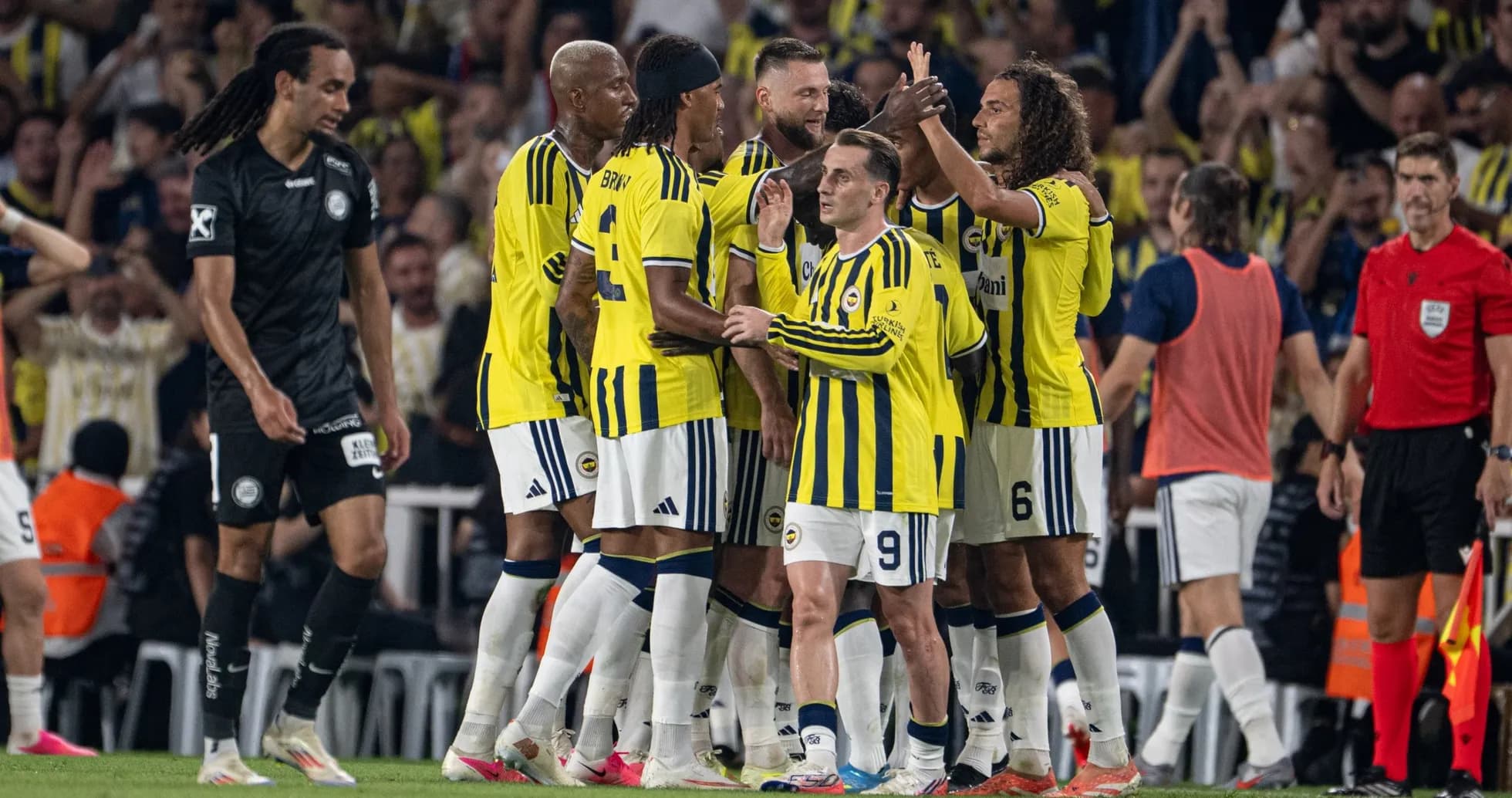
The early 1–0, scored by Talisca from an assist by K. Akturkoglu on 9 minutes, came directly from this positional superiority: Fenerbahçe’s high occupation of Sturm’s defensive third created gaps between centre-backs and full-backs, and the visitors’ midfield could not screen passes into the attacking midfield line. Once ahead, Fenerbahçe doubled down on ball retention rather than risk exchanges in transition. Their 578 total passes, 520 accurate at 90%, underline how they controlled rhythm, recycling through the centre-backs and double pivot to drag Sturm’s 4-4-2 shape side to side until an opening appeared.
Second Goal
The second goal, M. Greenwood finishing from an M. Asensio assist at 45’, reflected the quality of their wide and half-space play. Asensio, nominally central, frequently drifted into the right half-space, combining with Semedo and Greenwood to overload Sturm’s left side. With Sturm’s wide midfielder forced back into the defensive line, their central midfielders were repeatedly outnumbered 3v2 by Guendouzi, Kante and Asensio. Greenwood’s timing between lines and into the box was excellent, and Fenerbahçe’s 12 shots inside the box show how often they broke into prime finishing zones.
Defensive Strategy
Out of possession, Fenerbahçe pressed intelligently rather than recklessly. The front four screened central access, with Talisca and Asensio often curving runs to block passes into J. Gorenc Stankovic and L. Weinhandl. Behind them, Kante’s reading of second balls prevented Sturm from building sustained attacks off clearances. Fenerbahçe committed only 10 fouls, a low number given their territorial dominance, suggesting they defended more through positioning and counter-pressing than last-ditch interventions.
Sturm Graz's Struggles
Sturm Graz’s 4-4-2 struggled at every phase. Their back four of J. Heil, A. Vallci, J. Mitchell and E. Soglo was continually pushed back, and the midfield line of J. Hodl, L. Weinhandl, J. Gorenc Stankovic and S. Seidl rarely got high enough to support the forwards S. Wlodarczyk and S. Jatta. With just 222 total passes and 164 accurate (74%), they were forced into longer, lower-percentage balls. The front two were isolated; without consistent support from the wide midfielders, Sturm could not create overloads on either flank or hold the ball in Fenerbahçe’s half.
Attacking Output
Their attacking output – 5 total shots, 3 inside the box and only 1 on goal – reflects how rarely they broke Fenerbahçe’s last line with control. When they did reach the final third, Fenerbahçe’s centre-backs, particularly Skriniar and Ake, defended the box aggressively, supported by Kante dropping into the line. Sturm’s 3 blocked shots show they were often forced to shoot under pressure rather than from clean setups.
Substitutions
The substitutions did not alter the tactical story. For Fenerbahçe, the introduction of A. Brown for J. Oosterwolde at 30’ was a like-for-like adjustment at full-back, maintaining width and defensive balance. Later changes – Fred for Greenwood, I. Kahveci for Asensio, M. Muldur for Semedo, and O. Aydin for Akturkoglu – were about energy management and preserving structure, not changing shape. The 4-2-3-1 remained intact, with fresh legs sustaining the press and possession game.
Sturm’s triple change on 64’ – G. Mamageishvili for S. Seidl, R. Fosso for L. Weinhandl, and N. Weiper for S. Jatta – aimed to refresh the midfield and front line, but with Fenerbahçe still controlling the ball, these players spent most of their time chasing. Earlier, A. Kayombo had replaced S. Wlodarczyk at 46’, but with service so limited, the profile change up front had little impact. B. Beganovic for J. Hodl at 87’ came too late to influence the pattern.
Discipline and Control
Discipline further underlined Sturm’s reactive posture: they committed 19 fouls and collected 3 yellow cards, all for “Foul” or “Simulation”, as they repeatedly arrived late into duels or tried to relieve pressure through gamesmanship. Fenerbahçe, by contrast, received no cards, reflecting their control of tempo and duels.
Goalkeeping Performance
In goal, M. Gunok (Fenerbahçe) was largely a spectator, required to make only 1 save thanks to the protection in front of him. At the other end, D. Khudyakov (Sturm Graz) made 8 saves, a high number that prevented the scoreline from becoming heavier. Fenerbahçe’s 10 shots on goal versus Sturm’s 1, combined with their overwhelming possession and passing superiority, show a match where structure, spacing and technical quality converged to produce a dominant, controlled 2–0 home win in this UEFA Champions League 3rd Qualifying Round fixture.