Dinamo Zagreb vs Viking: Tactical Analysis of 2-2 UEFA Champions League Draw
Dinamo Zagreb and Viking shared a 2-2 draw at Stadion Maksimir in a UEFA Champions League Play-offs tie that was tactically defined by Dinamo’s territorial dominance against Viking’s ruthless efficiency in transition. The Croatian side led 2-0 after just 10 minutes but were pegged back before half-time, and despite heavy pressure after the break, they could not turn control into a winning goal. On the balance of play and statistics, Dinamo imposed their structure and tempo, while Viking maximised a compact 4-3-3 and direct attacking patterns to escape Zagreb with a valuable away draw.
I. Executive Summary
Dinamo Zagreb set up in a 4-1-4-1 under Mario Kovacevic, using J. Misic as the single pivot to connect a high-volume midfield line behind lone striker D. Beljo. With 60% possession, 544 passes and 23 total shots (17 inside the box), their plan clearly centred on sustained pressure, wide overloads and repeated entries into the penalty area. Viking, in Bjarte Aarsheim’s 4-3-3, accepted a lower block and counter-attacking role, completing 371 passes at 40% possession and taking just 6 shots, yet converting half of them into goals. The tactical story is one of Dinamo’s structure and volume versus Viking’s compactness and vertical punch.
II. Scoring Sequence & Disciplinary Log
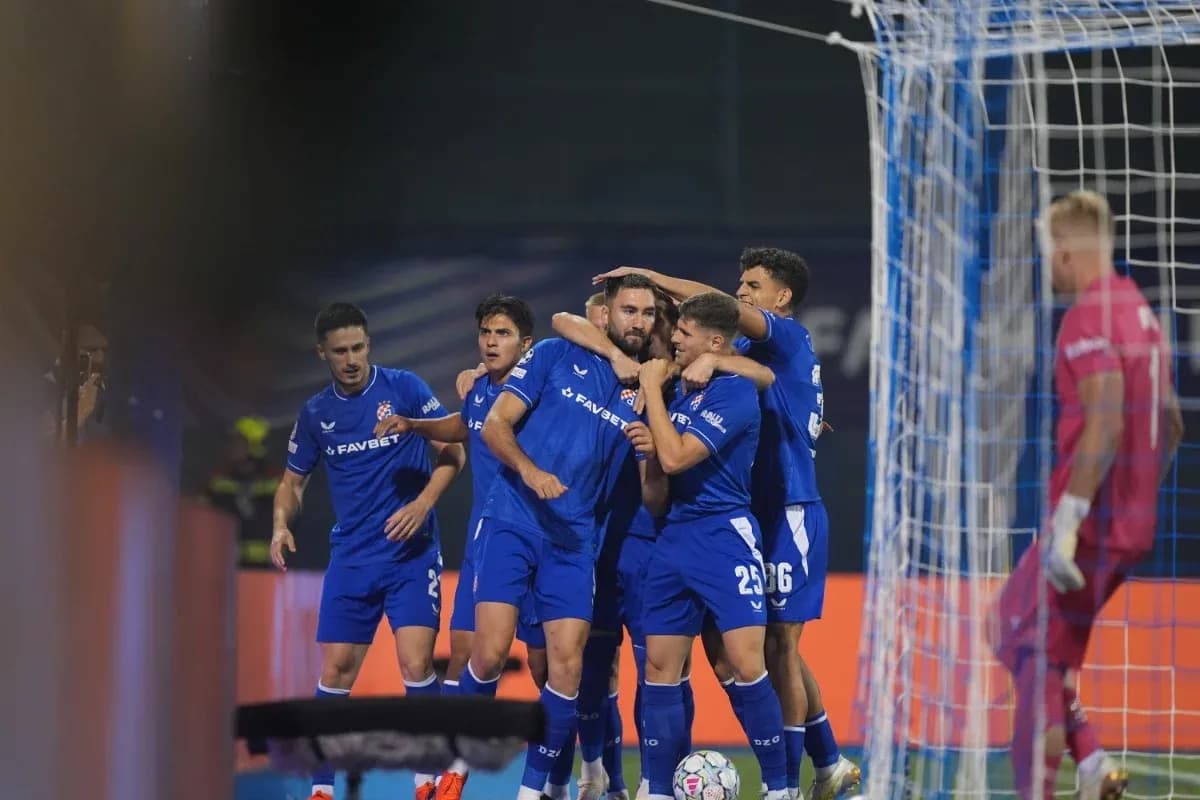
The game opened with Dinamo immediately exploiting their left side. On 6', D. Beljo (Dinamo Zagreb) finished a move created by overlapping full-back M. Perez Vinlof, whose delivery from the left was rewarded with the assist. Four minutes later, the structure of the 4-1-4-1 paid off again: on 10', M. Lisica (Dinamo Zagreb) arrived from midfield to score, assisted by Beljo, who had dropped off the front line to link play. At 2-0, Dinamo’s pressing and circulation looked in full control.
Viking responded by leaning into their 4-3-3 transitions. On 26', P. Christiansen (Viking) struck after a break orchestrated by T. Moi, whose assist underlined Viking’s plan to attack quickly through their wide forwards. The equaliser on 39' came in a similar pattern: Z. Tripic (Viking) scored, again assisted by T. Moi, punishing Dinamo’s high line and the space left behind their advanced full-backs. The half-time score of 2-2 reflected a contest where Dinamo had dominated territory but Viking had clinically exploited the few attacking moments they created.
Discipline remained relatively controlled but still influenced the rhythm. At 65', Joe Bell (Viking) received a yellow card — Foul — as he tried to disrupt Dinamo’s midfield circulation. Later, at 83', Moris Valinčić (Dinamo Zagreb) was booked — Foul — as Viking sought to escape pressure down the flank. In total, Dinamo Zagreb: 1 yellow, Viking: 1 yellow, Total: 2 cards.
III. Tactical Breakdown & Personnel
Dinamo’s 4-1-4-1 was designed for dominance of the ball and territory. With 544 passes at 81% accuracy (438 accurate), they built consistently through J. Misic as the pivot, using him as the fulcrum to switch play and keep Viking pinned back. The full-backs, especially M. Perez Vinlof, pushed high to create width, which was crucial for the opening goal. The advanced midfield line of M. Lisica, L. Stojkovic, M. Zajc and M. Orsic operated between the lines, flooding central and half-space zones and generating 17 shots inside the box — a clear indicator of Dinamo’s ability to penetrate Viking’s defensive block.
D. Beljo’s role as a lone forward was pivotal. He scored once and assisted once, but beyond the direct contributions, his dropping movements created central overloads that freed late runners like Lisica for the second goal. The flanks were used to stretch Viking’s back four, with crosses and cut-backs feeding a constant stream of attempts: 23 total shots, 7 of them blocked, and 4 on target. The volume suggests that Dinamo’s attacking mechanisms functioned, but the final execution and decision-making in the box lacked the precision to tilt the tie.
Defensively, Dinamo’s high line and aggressive full-back positioning created vulnerability. Viking’s two first-half goals came from exploiting the spaces behind and around the centre-backs, with Moi, Tripic and Christiansen combining quickly in transition. Although Dinamo committed only 12 fouls and picked up just one yellow, their rest defence structure — the positioning of defenders and pivot when attacking — was not sufficiently compact to prevent Viking’s direct breaks.
In goal, I. Nevistic (Dinamo Zagreb) was statistically underworked, making 1 save. The fact Viking still scored twice from only 3 shots on target underscores how efficiently the visitors converted their limited chances and how exposed Dinamo could be when their press was bypassed. On the other side, A. Ostbo (Viking) made 2 saves, but more importantly, benefited from the protective nature of Viking’s compact 4-3-3 block, which forced many of Dinamo’s 23 shots into blocked lanes or off target rather than clear one-on-ones.
Viking’s approach with 371 passes at 73% accuracy was pragmatic. The midfield trio of T. Moi, Joe Bell and K. Askildsen focused on screening central zones, denying Dinamo easy vertical passes into Beljo’s feet, and springing forward quickly when possession was won. The front three of Tripic, Christiansen and E. Austbo stayed high and narrow enough to threaten in behind, which was key to both goals. Their 6 total shots, 5 inside the box, show that when they did attack, they reached dangerous areas efficiently.
Substitutions reflected both coaches’ intentions. Aarsheim’s changes — notably S. Bjorshol and H. J. Haugen for H. Heggheim and K. Haugen, and later J. Hansen and R. Postema for Tripic and Christiansen — were about refreshing legs in wide and forward areas to maintain counter-attacking threat and defensive discipline. Kovacevic’s introduction of L. Kacavenda, R. Mudrazija, A. Hoxha, N. Galesic and S. Prevljak aimed to add creativity and fresh energy to sustain pressure, but Viking’s block held.
IV. The Statistical Verdict
The raw numbers reinforce the tactical narrative. Dinamo Zagreb’s 60% possession, 544 passes and 23 shots (17 inside the box, 7 blocked) point to a side that controlled the match and created repeated attacking situations. Their 4 shots on target from that volume, however, indicate a lack of clarity in final actions and shot selection against a compact block. Viking, with 40% possession, 371 passes and only 6 shots, produced 3 on target and 2 goals — a striking efficiency that matched their counter-attacking game plan.
Both sides committed a similar number of fouls (Dinamo 12, Viking 10), and each received one yellow card, suggesting that while the match was competitive, it was not overly disrupted by rough play. From a defensive perspective, A. Ostbo (Viking) with 2 saves and I. Nevistic (Dinamo Zagreb) with 1 save underline that much of the defending happened before the ball reached the goalkeepers: Viking through their compact 4-3-3 block, Dinamo through territorial control that limited Viking’s total attempts.
In tactical terms, Dinamo’s structure and volume would usually be enough to win a home Play-offs tie, but Viking’s sharpness in transition and clinical finishing ensured the contest remains finely balanced heading into the return leg.