Chaos in Leeuwarden: Feyenoord Match Marred by Fan Violence
The scoreboard in Leeuwarden read 5-2 to Feyenoord. Nobody was talking about the football.
Once again, the Eredivisie weekend was dragged off the pitch and into the stands, this time at the Kooi Stadion, where a storm of red flares and fireworks from the away end halted play and left supporters injured and a league under fire.
Chaos in the 12th minute
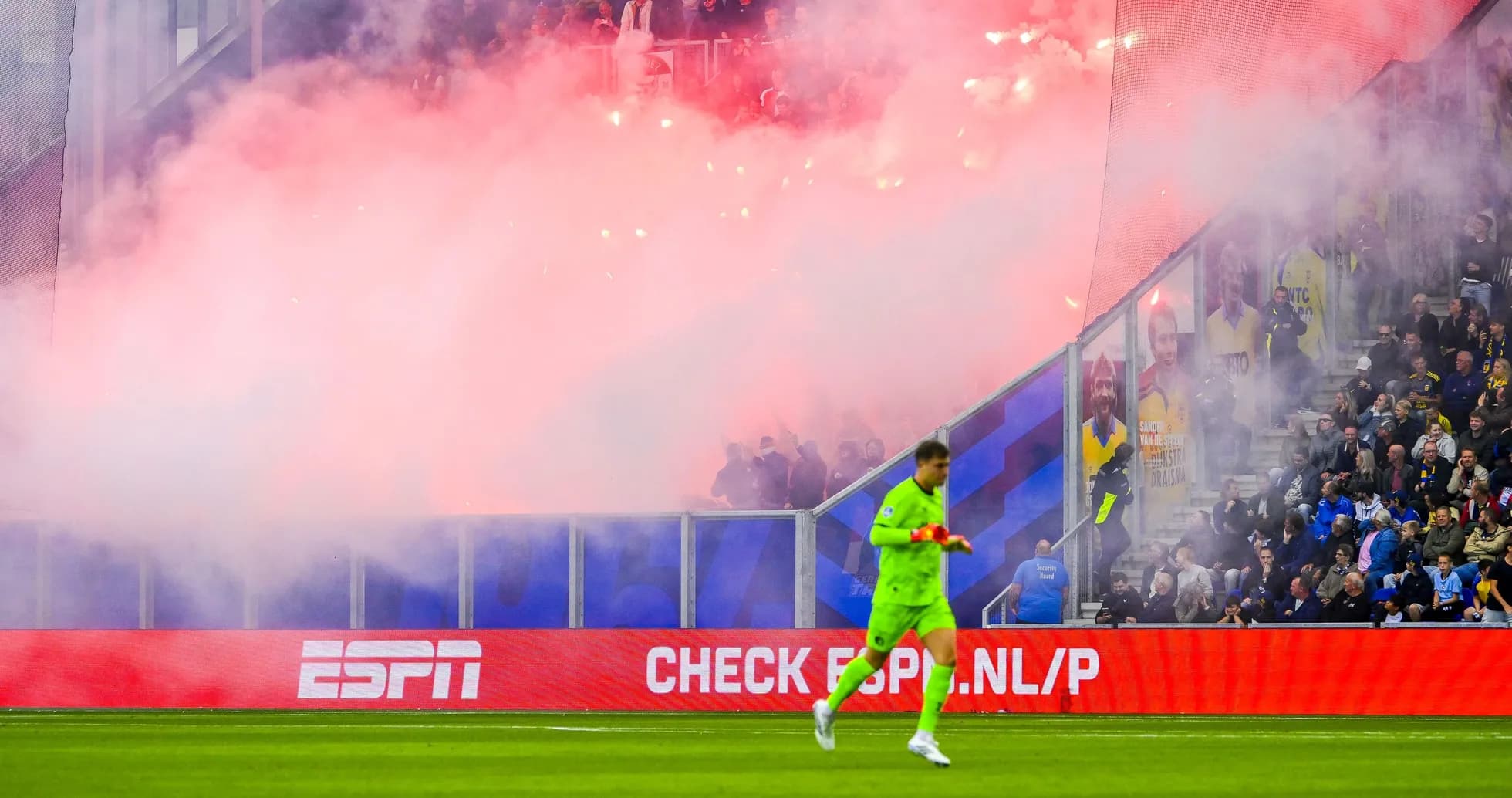
It started early. In the 12th minute, with the game still settling, the away section erupted. Feyenoord fans lit a barrage of red flares and hurled fireworks onto the pitch and toward the home support. Smoke poured across the stadium. Explosions cracked near the touchline.
One firework detonated just metres from Feyenoord goalkeeper Tjark Ernst. For a few seconds, the match teetered on the edge of something far worse.
Referee and players had no choice. They left the field as the chaos unfolded behind them. Play was suspended for around 10 minutes while officials and stewards tried to regain control and clear the pitch.
The match eventually restarted. The damage in the stands did not reset so easily.
Injuries in the home end
SC Cambuur later confirmed the scale of the fallout. In a detailed medical update, the club reported that five home supporters had been injured in the incident. The list of harm was stark: burns, hearing damage, eye injuries.
These were not near-misses or abstract risks. Projectiles had been fired directly into sections packed with Cambuur fans, many of whom had turned up to celebrate their club’s return to the top flight after three seasons away. They left with more than just a heavy defeat.
The football carried on. The sense of safety did not.
Feyenoord win, but leave with shame
On the pitch, Feyenoord cruised to a dominant 5-2 victory. In the dressing room and boardroom, nobody felt like celebrating.
Head coach Giovanni van Bronckhorst moved quickly after the final whistle, offering an immediate apology to the Cambuur hierarchy on behalf of the Rotterdam club. Feyenoord then released a formal statement, stressing it “firmly distances itself from the unacceptable events” and promising internal action.
The club has already set a plan in motion: request and review all available camera footage, identify those responsible, and act. The language from Rotterdam was clear. The behaviour was “life-threatening.” It cannot be allowed to blend into the background noise of another matchday.
General manager Robert Eenhoorn cut a visibly shaken figure as he addressed the media. For him, the scoreline barely registered.
“I cannot be happy,” he admitted. “Frustration prevails too much for that. This problem obviously does not only affect Feyenoord and is unfortunately something we have been unable to put a stop to for decades. We will therefore have to sit down again with all stakeholders, clubs, the KNVB and the authorities to look for a solution together.”
The victory, on a day like this, felt hollow.
Cambuur demand answers
For Cambuur, the anger was raw. A club that has fought its way back into the Eredivisie now finds itself asking why its own stadium could not guarantee basic safety for its supporters.
The administration promised a full investigation, working alongside local police and government officials. The wording of their official communication left no room for ambiguity.
“It should be clear that setting off and firing fireworks is completely unacceptable and has no place in a football stadium whatsoever,” the club stated.
They want to know how this was allowed to happen. Who brought in the pyrotechnics. Who failed to stop them. And what will be done to ensure their supporters never sit in those seats with that same sense of vulnerability again.
Political pressure and a familiar pattern
The incident has not stayed within football’s walls. Leeuwarden mayor Foort van Oosten condemned the events in the strongest terms and vowed a thorough investigation into how such a large quantity of pyrotechnics was smuggled into the Kooi Stadion.
His involvement underlines the scale of the problem. This is no longer just a matter for clubs and stewards. It is a public safety issue.
Dutch football has seen this script before. Recent seasons have brought a worrying rise in fan disorder, with flares and fireworks repeatedly used as weapons rather than spectacle. A high-profile match between Ajax and Groningen was abandoned last season after similar scenes.
Each time, the same questions return. Each time, the stakes seem to rise.
KNVB under the spotlight
This latest flashpoint has forced the KNVB to confront an uncomfortable gap in its own rulebook.
Under current regulations, the match would have been abandoned permanently if a player or match official had been struck. Five injured supporters, though, did not trigger the same response. The game went on.
Jan Bluyssen, the KNVB’s manager of professional football competition affairs, did not attempt to gloss over the optics.
“That doesn’t feel right,” he told Dutch news agency ANP.
That admission has sharpened the pressure on the governing body. It now faces urgent calls to introduce tougher penalties for clubs whose fans cause bodily harm and to rewrite protocols so supporter safety is treated as non-negotiable, not secondary to completing a fixture.
The KNVB has confirmed it will revisit its procedures for dealing with disorder, with a stated aim: make sure the safety of those in the stands comes before the final whistle.
The Eredivisie has seen enough smoke and sirens. The question now is whether this latest blast in Leeuwarden finally forces Dutch football to draw a hard line—or whether the next explosion is only a matter of time.