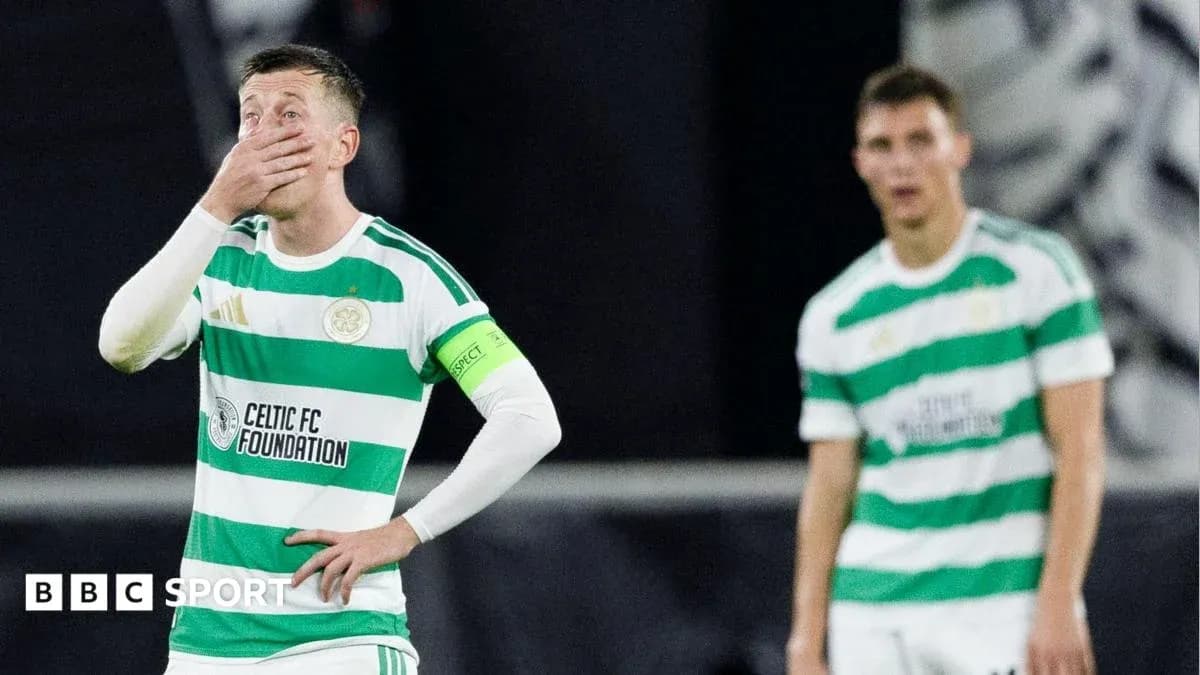
Celtic's European Collapse: A Captain's Fury
Callum McGregor has seen some things in Europe. This was the one that broke him.
When the Celtic captain walked through the mixed zone after the collapse against LASK, he didn’t bother with diplomacy. He called his own teammates “passive” and “scared”, then delivered the line that cut through the wreckage of a shambolic night: “Now we’ll see what people are made of.”
For once, the harshest verdict did not come from pundits or press. It came from the man who has carried this club through a decade of European trauma.
A captain at the end of his tether
McGregor has lived it all. The goalless 210 minutes against Kairat Almaty and the penalty shootout failure that followed. The 7-1 humiliation by Borussia Dortmund. The 6-0 against Atletico Madrid. The Champions League play-off exit to Midtjylland. The twin 4-1 defeats by Sparta Prague. The earlier eliminations against Ferencvaros, AEK Athens and Cluj. The 7-1 against PSG, the 7-0 against Barcelona.
He has medals, yes. But he has scars to match every one of them.
Even in that context, it was hard to remember him as furious as he was in Linz. He didn’t shout. He didn’t rant. He spoke quietly, and that made it worse. The rage was controlled, not theatrical. Rage at another exit. Rage that, with a 4-0 aggregate lead, Celtic folded at the first sign of serious pressure. Rage that professional pride vanished in real time.
He had started the night as the hero. A deflected strike, 4-0 on aggregate, and Celtic apparently cruising into the Champions League proper.
It felt like the tie had been punched out of LASK’s body. They had created chances in Glasgow, they carved out more in the opening minutes in Linz, and still they stared at a four-goal deficit. How many blows can a team absorb before they break?
Plenty, as it turned out. Especially when the opposition hold the door open for them.
From control to capitulation
Celtic invited chaos. Seven days earlier we praised their swagger, their goals, their ambition. We assumed there was steel behind the style. That illusion lasted 32 minutes of the second leg.
Benjamin Nygren’s slack, unforgivable pass handed LASK their first goal of the night. Suddenly 4-1 on aggregate did not feel safe. It felt fragile. It felt familiar.
Three minutes into the second half, the tremors became a quake. Auston Trusty was shrugged aside, bullied off the ball, and LASK made it 4-2. The American was targeted relentlessly. He was not alone in struggling, but he was a glaring weak point and the Austrians pounced on him.
Ten minutes later, the third LASK goal arrived. Panic spread. Celtic’s shape disintegrated. Too many players were in full fright mode, hiding from the ball or giving it away when they found it.
Camilo Duran, the first-leg match-winner, disappeared from the contest. Kasper Hogh ran, chased, pressed, but never landed a meaningful blow. Passes went nowhere. Attacks died before they started. The team looked lost, like they were waiting for somebody else to take responsibility.
Nobody did.
McGregor tried to douse the flames in midfield, but the fire had already reached the foundations. He could not slow the game, could not soothe the nerves, could not stop the avalanche.
On the touchline, Martin O’Neill looked like a man watching a bad dream replay itself in high definition. By full-time he would call it one of the worst nights of his football life. He accepted his share of the blame. He cannot carry it alone.
He threw on substitutes in a flurry, five changes in 12 frantic minutes, searching for anything that might change the momentum. It changed nothing.
A £40m match with a bargain-bin back line
Celtic did not register a single shot on target in the second half. None in extra-time either. They clung on like a man dangling from a cliff edge, fingers slipping with every LASK attack. The equaliser on aggregate felt inevitable long before it arrived.
When LASK’s fourth goal came in the 90th minute, it was no smash-and-grab. It was justice. By then they had racked up 33 attempts at Celtic’s goal on the night, on their way to 40. Add that to the 20 they had in Glasgow and the numbers tell their own story. This was a two-leg siege.
Cameron Carter-Vickers hobbled through the closing stages on one leg. Hogh was barely moving. The back four that finished a match worth around £40m to the winners? Anthony Ralston, Dane Murray, Trusty and Liam Scales.
That is not bad luck. That is bad planning.
The fifth LASK goal, in extra-time, felt almost merciful. Another Celtic player, Luke McCowan this time, made the wrong decision in the wrong area at the worst possible moment. Another mistake, another punishment, another clip for the ever-growing European horror reel.
LASK even passed up the chance for 6-1, missing a penalty as Celtic staggered towards the exit. Then Miguel Freckleton, once of St Mirren and now trying to rebuild a career in Austria, slalomed through a broken Celtic defence and briefly threatened to add another.
He looked, in flashes, like a serious player. Fair play to him. But when a late substitute, still finding his feet in a new league, can glide through you like that, it tells you everything about your own state.
By the end, Celtic were unrecognisable from the side that had sliced LASK apart at Celtic Park. Spooked. Overpowered. Out-fought. Out-played. The slick, ruthless unit of the first leg now exposed as a mirage that disguised deep psychological flaws.
Nobody could have seriously predicted that a 4-0 aggregate lead would turn to dust. Yet it did.
Old lessons, never learned
The gaps in the squad are not new. They are not subtle. They are not secrets.
Celtic need a proper back-up left-back to Kieran Tierney. They do not have one.
They badly need a commanding, physical presence in central midfield, someone with stature and snarl, a player who does not get bullied the way this team was bullied in Austria. They do not have one of those either.
There have been good signings this summer, but not enough of them. The club sits in net profit in the transfer market while fielding a patched-up defence in the most lucrative match of the season. The “A word” is coming back, and it will not go away quietly.
Ambition.
When a club with Celtic’s resources and expectations finishes a Champions League play-off with Ralston, Murray, Trusty and Scales across the back line, something fundamental has gone wrong. Recruitment, planning, risk management – pick your department. Nobody emerges unscathed, on the pitch or off it.
The financial cost of these exits has been enormous over the years. The damage to self-belief, to the club’s sense of itself in Europe, may be even greater.
They thought they had moved past the days when Kairat, Midtjylland, Ferencvaros, Cluj and AEK Athens were the names etched into their Champions League nightmares.
Now another one joins the roll call.
LASK.