Brazil's Olympic Gold: A Decade Since Redemption
Ten years ago, the Maracanã did not host a football match. It hosted a national reckoning.
On August 20, 2016, under the heavy weight of history and expectation, Brazil’s men’s team finally claimed the one title that had always slipped away: Olympic gold. Germany stood in the way, the same Germany whose senior side had humiliated the Seleção 7-1 two years earlier in the World Cup. The scars were fresh. The stakes were obvious.
More than 63,000 fans packed into the stadium, every chant laced with tension. This was not just a final. It was a demand for redemption.
Neymar’s Free-Kick and a Long Night at the Maracanã
The game itself mirrored the pressure. Tight. Nervy. Every touch judged.
Then, in the 26th minute, Neymar stepped over the ball. From a free-kick on the left, he curved it over the wall and in, a strike that detonated the Maracanã. Brazil had the lead, and for a moment, the anxiety gave way to pure noise.
Germany refused to fold. They grew into the second half, passing with composure, edging higher up the pitch. The equaliser came in the 15th minute after the restart, when Meyer finished to drag the Germans level at 1-1. The stadium fell almost silent. The ghosts of 2014 lurked again.
The clock ticked. No winner in normal time. No breakthrough in extra time either. Every sprint looked heavier. Every decision carried the weight of a country. Penalties would decide it.
Weverton’s Save, Neymar’s Shot, and a Nation Released
From the spot, both teams were flawless through four kicks.
For Brazil, Renato Augusto, Marquinhos, Rafinha and Luan converted. For Germany, Ginter, Gnabry, Brandt and Süle answered in kind. No one blinked. No one flinched.
Then came Petersen, one of the tournament’s leading scorers. His run-up was confident, but Weverton guessed right and pushed the ball away. The save ripped a roar from the stands and changed the night in an instant.
Everything fell to Neymar.
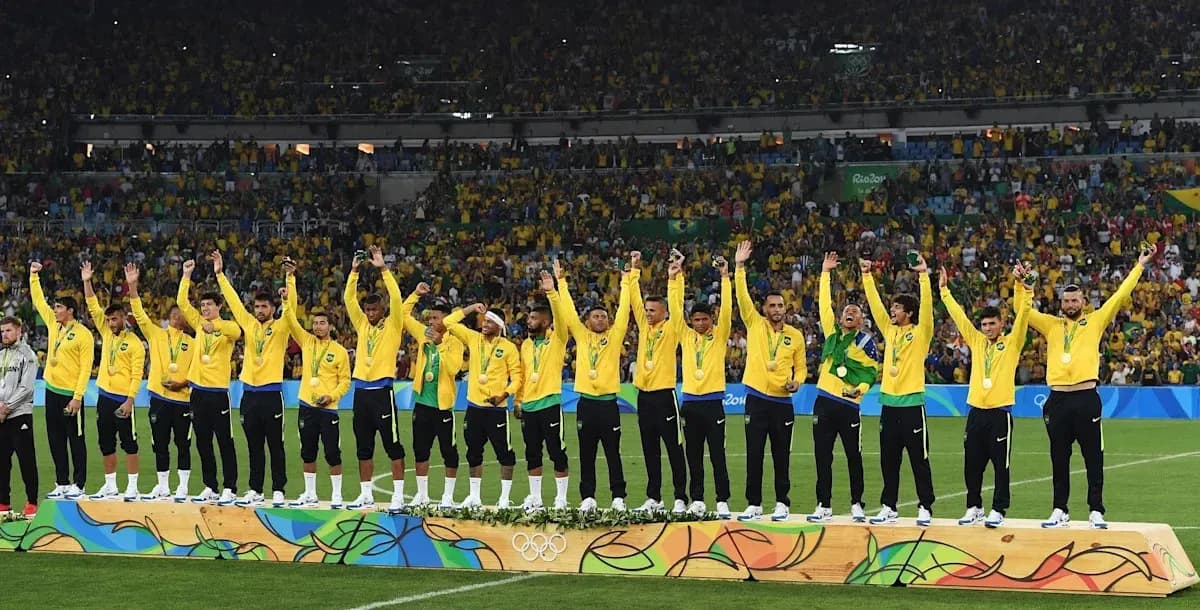
He walked to the spot with the stadium on edge, placed the ball, and struck. The net bulged. Gold, at last. Neymar tore away in celebration, collapsing to the turf as teammates swarmed him. The Maracanã shook with relief and joy. Brazilian football had its first Olympic title.
A Rocky Start, Then a Ruthless Response
That golden night almost never happened.
Brazil’s group-stage campaign began in Brasília with two goalless draws that felt like defeats. South Africa first, then Iraq. No goals, no rhythm, and a crowd already restless. The pressure ratcheted up with every mis-hit cross and blocked shot.
Qualification hung in the balance when the team travelled to Arena Fonte Nova in Salvador to face Denmark. This time, the response was brutal. Gabriel Barbosa scored twice, Gabriel Jesus added another, and Luan completed a 4-0 rout. The performance reset the mood and sent Brazil through as Group A winners.
From there, the knockout rounds told a very different story.
Colombia, Honduras, and a Team Finding Its Edge
In the quarterfinal at Arena Corinthians in São Paulo, Brazil met a Colombia side that had drawn 2-2 with Sweden and Japan and beaten Nigeria 2-0 in the group stage. It was a test of nerve as much as quality.
Brazil passed it. Neymar struck, Luan followed, and a 2-0 win booked at least a shot at the podium. The team looked sharper, more assured, finally playing with the authority expected of them.
Then came Honduras in the semifinal at the Maracanã. The Central Americans had already caused shocks of their own, advancing from a group with Argentina, Algeria and Portugal, then knocking out South Korea 1-0 in the quarters.
They were swept aside.
Brazil ran riot in a 6-0 demolition. Neymar scored twice, Gabriel Jesus matched him with two of his own, while Marquinhos and Luan also found the net. The result sent the Seleção into the final with momentum and a restored swagger, setting up that emotionally charged meeting with Germany.
The 18 Names Etched in History
Eighteen players left Rio as Olympic champions, the first men ever to do so in Brazilian colours. One more deserves a mention for a different reason.
Goalkeeper Fernando Prass had been called for the Games but never made it to the group stage. An elbow injury in the warm-up before a friendly against Japan at Serra Dourada in Goiânia ruled him out, denying him a place in the tournament but not his role in the journey.
The squad that finished the job was split across the pitch:
- Goalkeepers
Weverton (Athletico-PR)
Uilson (Atlético Mineiro) - Full-backs
William (Internacional)
Douglas Santos (Atlético Mineiro)
Zeca (Santos) - Center-backs
Rodrigo Caio (São Paulo)
Luan Garcia (Vasco da Gama)
Marquinhos (Paris Saint Germain – FRA) - Midfielders
Thiago Maia (Santos)
Rodrigo Dourado (Internacional)
Rafinha Alcântara (Barcelona – ESP)
Renato Augusto (Beijing Guoan – CHI)
Felipe Anderson (Lazio – ITA)
Walace (Grêmio) - Forwards
Neymar (Barcelona – ESP)
Luan (Grêmio)
Gabriel Barbosa (Santos)
Gabriel Jesus (Palmeiras)
Ten years on, the images remain vivid: Weverton’s dive, Neymar’s penalty, the Maracanã exploding in yellow and green. For a country that measures itself in football trophies, that night finally closed a chapter.
The question now is simple: when will a new generation write a moment to match it?