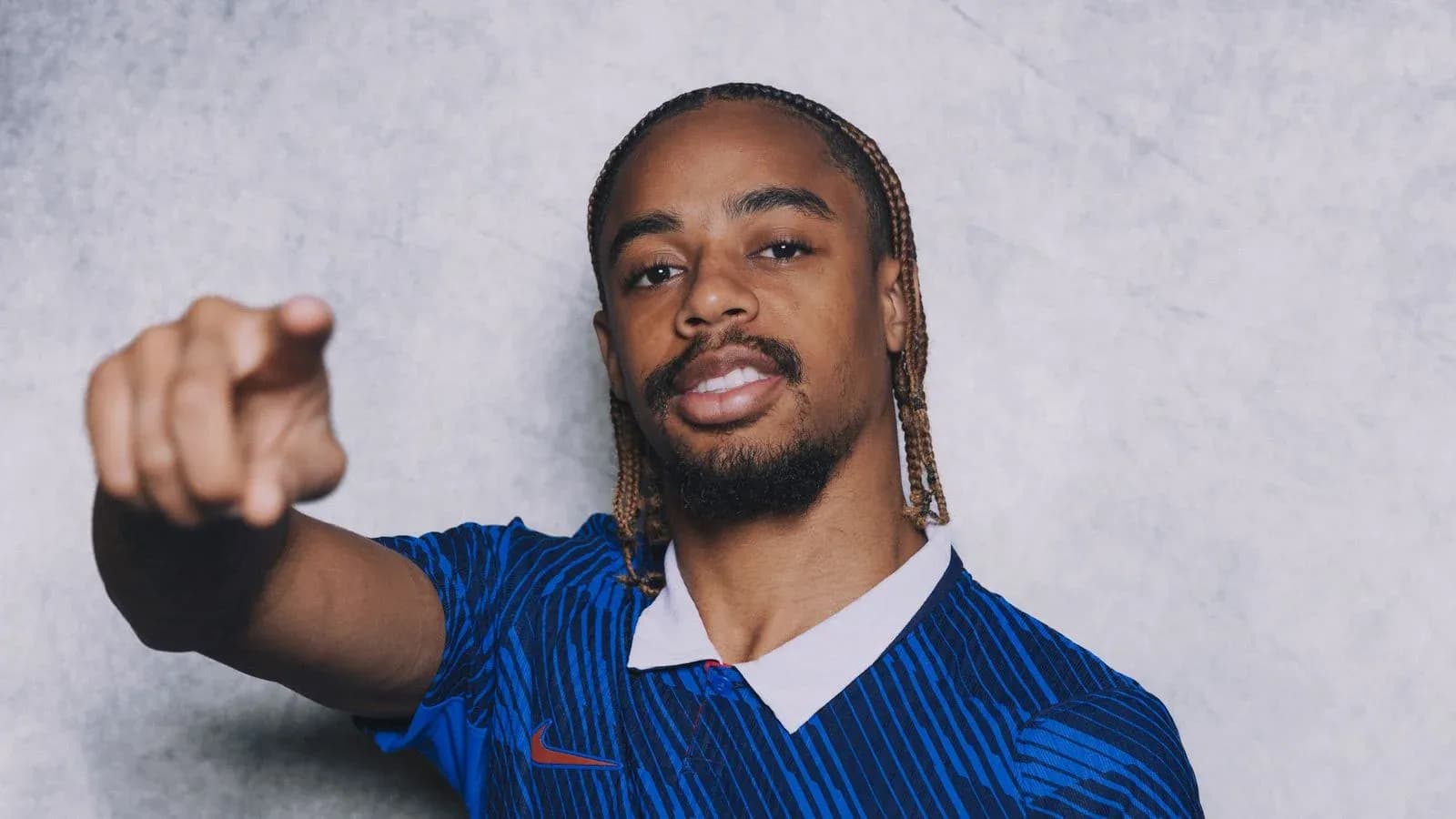
Bradley Barcola: The Rising Star of the Summer Transfer Window
Bradley Barcola is on the brink of becoming the headline act of this summer’s transfer window. Liverpool want him. Arsenal want him. Paris Saint-Germain know exactly why.
He is 23, a France international, and already a back-to-back Champions League winner with PSG. Yet in both finals, he started on the bench. Khvicha Kvaratskhelia’s arrival from Napoli in January 2025 pushed him down the pecking order on the left.
It has not pushed him out of the spotlight.
In Paris, he is not a guaranteed starter. Everywhere else, he is seen as a guaranteed star. Pace. Power. Intelligence. A forward sharpened under Luis Enrique, with a ceiling as high as the fee he is expected to command.
A turning point in Lyon
Barcola’s rise has not followed the usual script for a player now being chased by Europe’s elite. At Lyon, he hovered on the fringes of the first team under Laurent Blanc. Then, a single decision changed everything.
Karl Toko Ekambi wanted out.
“A club in Switzerland was interested because he was not playing for the first team,” recalled Jean-Francois Vulliez, who worked with Barcola at Lyon and now at PSG. “At that time, Blanc was the coach and we had Karl Toko Ekambi. But he decided he wanted to leave so the coach decided to stop the loan because we might need Bradley.”
That moment opened a door.
“It was a key moment because he realised that if Toko Ekambi left, Bradley could be a solution and there was an opportunity to use him. Toko Ekambi did leave. Bradley stayed. One match later, there was an injury and Laurent needed him.”
Barcola stepped in and never really stepped back.
The late bloomer nobody rushed
Vulliez knows Barcola as well as anyone. He saw him as a boy in Lyon’s academy, then followed him to PSG to work as a development coach for the French and European champions. He has seen plenty of prodigies. Barcola was not one of the obvious ones.
He was talented, yes, but not the kid who always played up an age group, not the one fast-tracked through every level.
“He was a normal kid, he never played above his age category, never jumped a stage. His maturation was a normal process,” Vulliez explained.
While Kylian Mbappe tore through youth football and France’s age-group sides, Barcola watched from the outside. He never represented France at youth level. The skill was there. The body was not ready.
“We were very patient with him at Lyon because we knew he had the skills, we just had to wait for that maturation process, that psychological maturation, that physical maturation. When that transformation eventually happens, they will improve quickly.”
When the chance finally came, he was ready. After Toko Ekambi’s exit, Barcola scored five goals in nine games in early 2023. He then impressed at the European Under-21 Championship that summer. By then, his future felt inevitable.
“His body was in Lyon but his head was in Paris.”
The move to PSG dragged but it happened. What followed has been relentless.
Trophies, transformation and Luis Enrique’s touch
Three seasons in Paris. Thirteen trophies. Over 150 appearances. Thirty-nine goals. Numbers that tell only part of the story.
Under Luis Enrique, Barcola has refined his game. The raw runner who always wanted to attack defenders has learned when to slow the tempo, when to recycle the ball, when to explode.
He now picks his moments.
The foundation for that evolution lies in his youth. As a late physical developer, he could not simply bulldoze his way through games as a teenager. He had to think.
“He developed his intelligence,” Vulliez pointed out. “He was able to scan the pitch, take good information and use the space. Very early, he had this and he had speed. Then, he progressed with his muscles, became powerful. It is a combination of these tactical abilities, technical abilities and physical abilities.”
That blend is what attracts the likes of Liverpool and Arsenal. It is not just what he is. It is what he can still become.
A winger who thinks like a No 9
At PSG, Barcola has been used primarily as a left-sided wide forward. On paper, a winger. In his head, and in his movements, very much a striker.
He played through the middle at Lyon until the age of 17. Those habits never left him. From the left, he drives inside, angles his body, and shapes shots towards the far corner with his stronger foot.
Those are instincts, not instructions. Clubs pay a premium for wide players who bring numbers, not just dribbles.
Barcola offers both. He scores. He creates. He gets into positions where defenders do not want to see him.
His shot volume for PSG last season ranked among the top 10 players in Ligue 1 per 90 minutes. Playing wide has not dulled his appetite for goal. “He is very clever with his runs inside.” The timing of those movements separates him.
“Because he played as a striker, he retains that ability to know when he needs to come inside and when he needs to run beyond. With Bradley in your team, you need to use this capacity to come between the lines or run from deep, because it is his strength.”
Coaches like players who solve problems on the pitch. Barcola does that.
“We never had a problem with him at the academy because he is intelligent and listens so when you are the coach that makes it easier to manage him because he can adapt to whatever strategy the coach wants to use. He understands because he is clever.
“I do not think you can transform a player after the age of 17 because if the player does not have the intelligence at that age then they will never have it. That is why it is vital to develop this intelligence early. Bradley has it. You can adapt his position later.”
Edges to sharpen, positions to explore
For all the excitement, there is still work to do. Barcola’s finishing can drift. Chances come, not all are taken. Luis Enrique has pushed him to become more ruthless in front of goal.
The encouraging part for any buying club: time is on his side.
“There are many very good players who improved their finishing when they became more mature,” said Vulliez. The belief inside PSG is that Barcola belongs in that category.
“As with every young player, sometimes they need that push but he has the mind to do it and that makes it easier. Maybe the left wing is the better position for him right now but I am curious to see how he develops because I believe he is able to become a No 9.”
That single line will have caught the attention of recruitment departments across Europe. A wide forward with elite pace who might yet become a central striker? That is the kind of flexibility that shapes squads and systems.
Barcola has already shown he can operate on the right as well, stretching defences, hitting the byline when required. His speed is not theoretical. He ranked among the top 10 fastest players in the Champions League last season. Give him grass to attack and he will simply knock it past you and run.
He is, quite simply, a better player than the one who left Lyon. A better player than the one who first walked into the PSG dressing room.
“Nobody could have imagined this,” Vulliez admitted.
That is the point for Liverpool, Arsenal and anyone else circling. If nobody imagined this version of Bradley Barcola a few years ago, how far can the next version go—and how much are they willing to pay to find out?