Bodo/Glimt's Tactical Mastery in Extra-Time Victory Over Union St. Gilloise
Bodo/Glimt’s 3-2 extra‑time win over Union St. Gilloise at Aspmyra Stadion was defined by territorial dominance against a compact, transitional opponent, and by how both coaches manipulated their structures once fatigue and game state began to bite.
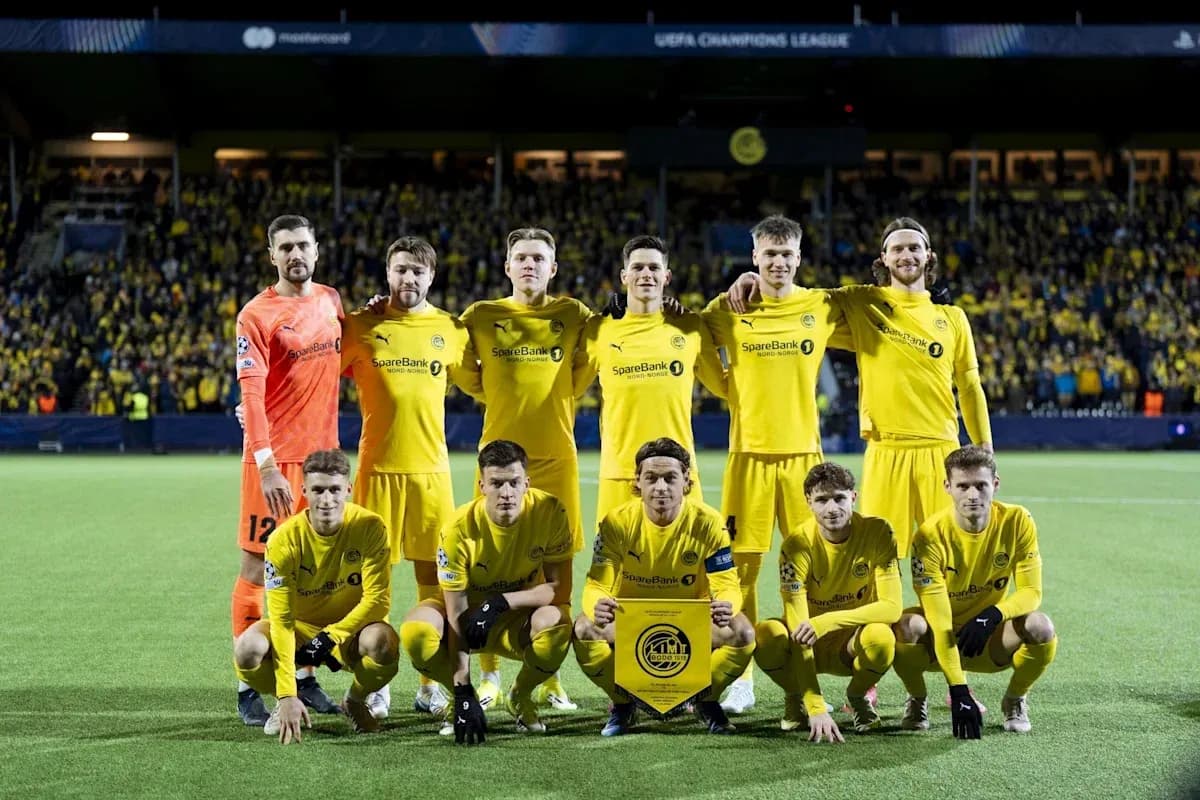
From the outset, Kjetil Knutsen’s 4‑3‑3 behaved like a classic positional-possession side. With 70% of the ball and an enormous 999 passes (889 accurate, 89%), Bodo/Glimt built patiently through the back four. The full-backs, F. Bjorkan on the left and F. Sjovold on the right, pushed high to pin Union’s wing‑backs, while the three-man midfield of Sondre Auklend, P. Berg and S. Fet created a triangle to progress centrally. Berg acted as the primary distributor, dropping close to the centre-backs to outnumber Union’s first pressing line of P. David and D. Olaru.
Union St. Gilloise’s 3‑5‑2 under David Hubert was clearly designed to absorb and counter. With only 30% possession and 427 passes (335 accurate, 78%), they accepted long spells without the ball, using the back three of N. Havenaar, M. Sylla and Kevin Mac Allister to defend the width of the box and protect the half‑spaces. The wing‑backs, L. Patris and Guilherme Smith, were forced deep for much of the contest, turning the shape into a 5‑3‑2 in sustained defence. Their plan was to spring quickly through central runners like A. Zorgane and K. Van De Perre once possession was recovered.
The shot profile underlines Bodo/Glimt’s territorial control: 23 total shots to Union’s 19, with a heavy emphasis on the penalty area (17 shots inside the box). The hosts’ ability to keep play in the final third also produced 10 corner kicks to Union’s single corner, an important indicator of repeated pressure. Yet Union still generated 15 shots inside the box themselves, showing that when they did break out, they reached dangerous zones quickly.
The opening goal at 51’ from O. Blomberg, assisted by J. Hauge, was a logical product of Bodo/Glimt’s wide overloads. The 4‑3‑3 stretched Union’s back five horizontally; with the wing‑backs pinned, half‑spaces opened for diagonal runs from the front three. Hauge’s role drifting inside from the flank created the angle to slide Blomberg into a finishing position, exploiting the space between centre-back and wing‑back.
Union’s immediate response at 61’ through Guilherme Smith, set up by D. Olaru, highlighted their counter-attacking threat. The substitution just before the goal — M. Fuseini (IN) for P. David (OUT) — freshened the front line and added more direct running against a Bodo/Glimt defence that was often positioned high. When Union broke, their midfield line surged forward in support, turning a low block into a fast five- or six-man attack. That pattern repeated for the 88’ equaliser from Fuseini, assisted by L. Patris, again born from a quick transition exploiting space behind an advanced back line.
Knutsen’s in-game adjustments were decisive. On 41’, H. Aleesami (IN) came on for J. Gundersen (OUT), adding a more experienced, physically robust presence to deal with Union’s direct counters and aerial duels. At 70’, a double attacking switch sharpened the hosts’ edge: J. Kitolano (IN) for S. Auklend (OUT) and A. Helmersen (IN) for O. Brynhildsen (OUT). Kitolano offered more verticality from midfield, while Helmersen became a penalty-box reference point. Within six minutes, Helmersen justified the move, assisting Hauge’s 76’ goal to restore the lead. His presence occupied central defenders, freeing Hauge to attack the channels and arrive onto cut-backs.
Union’s bench moves were more reactive. R. Schoofs (IN) for A. Zorgane (OUT) and M. Biondic (IN) for D. Olaru (OUT) at 70’ and 74’ respectively were aimed at injecting fresh legs and maintaining transition threat, but the red card sequence at 90+6’ for K. Van De Perre fundamentally altered their tactical possibilities. Reduced to 10 men, they had to protect the box even more narrowly and sacrifice counter-attacking ambition, which proved costly in extra time.
In extra time, Bodo/Glimt doubled down on control. The introduction of I. Maatta (IN) for F. Bjorkan (OUT) at 103’ and U. Saltnes (IN) for S. Fet (OUT) at 104’ refreshed both the left side and the midfield engine. Saltnes’ ability to arrive late in the box and combine in tight areas kept Union pinned. Later, at 120+1’, V. Nielsen (IN) for J. Hauge (OUT) helped lock down the lead with a more defensive profile.
The winning goal at 117’ from Helmersen, this time unassisted, was the culmination of accumulated pressure against a tiring, numerically reduced defence. By then, Union’s lines were compressed deep inside their own third, with limited capacity to contest second balls. Bodo/Glimt’s 6 blocked shots show how often Union had to throw bodies in front of efforts, but that desperation defending could not hold indefinitely.
Defensively, both goalkeepers were active within the context of their team’s approach. N. Haikin (Bodo/Glimt) made 3 saves behind a high line that often left space to defend in transition; his interventions were about managing isolated moments rather than sustained pressure. V. Chambaere (Union St. Gilloise) registered 5 saves and faced a constant stream of attacks, reflecting Bodo/Glimt’s volume of shots on goal (9). His work, combined with the back three’s blocking and clearances, kept Union in the tie far longer than the territorial balance suggested.
Discipline and game management also shaped the tactical narrative. Bodo/Glimt committed 11 fouls and collected 2 yellow cards, often using tactical fouls to halt counters. Union St. Gilloise, with 10 fouls but 4 yellows and 1 red, saw their midfield aggression, particularly from Van De Perre, tip over into destabilising indiscipline. That red card removed a key central runner and presser from their 3‑5‑2, forcing a late reconfiguration into a deeper, more passive block just as legs and concentration were fading.
Overall, Bodo/Glimt’s structured possession, width, and bench management gradually overcame Union St. Gilloise’s compact 3‑5‑2 and dangerous transitions. The statistical dominance in possession, passing and corners translated, after 120 minutes, into a deserved progression from the 3rd Qualifying Round, even if the scoreline remained tight due to Union’s efficiency on the break and resilience in their own box.