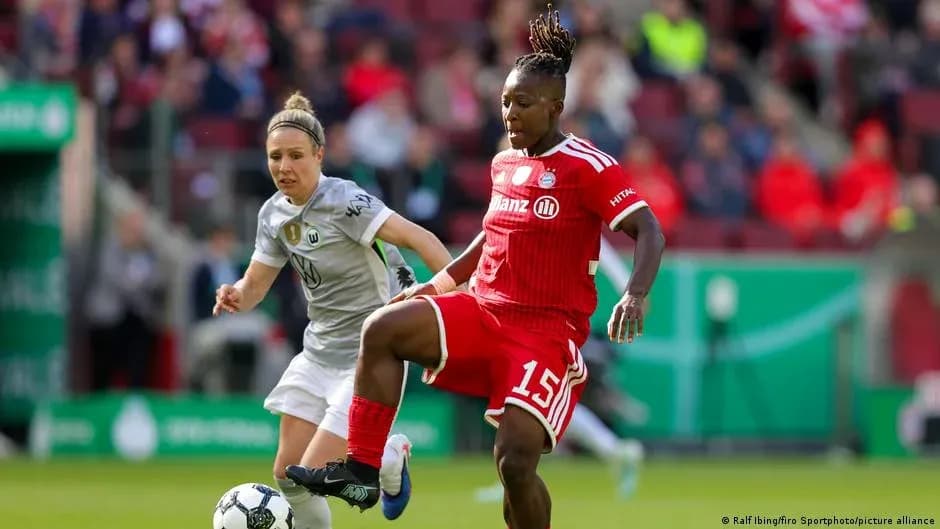
Bernadette Amani's Journey: From Ivorian Village to Bayern Munich
Seven months in Germany. Two trophies in the bag. And Bernadette Amani looks like a player who has landed exactly where she always believed she belonged.
The 28-year-old midfielder has barely had time to catch her breath since joining Bayern Munich midway through the season, yet she already has a Bundesliga title and a German Cup winners’ medal to show for it. For a player who once chased a ball around dusty pitches with boys in a small Ivorian village, the leap feels immense.
"It's a dream come true for me to be here, and I'm living my dream to the full," she said in an exclusive interview with DW before heading off to the Women’s Africa Cup of Nations in Morocco.
Bayern, she knows, is a different world.
"Munich is a very, very big club. Beyond just making me happy, it's a real achievement, a dream come true to be here, to play for such a prestigious club."
From village games to the German champions
Nothing about Amani’s route to Bavaria followed a neat academy-to-first-team script. Growing up in Dougbafla, she kicked around with the boys because there was no other option. There was certainly no talk of contracts, agents or European leagues.
Her parents wanted something more predictable: school, qualifications, stability. Football, to them, was a distraction, not a pathway. That insistence on education sent her away from the village to Abidjan, a move intended to shape her future in the classroom.
It ended up shaping her career on the pitch.
In the capital, she stumbled across something she had never truly seen before: a women’s league, with structure, intensity and ambition. She went to a match in 2019, expecting little. What she saw changed everything.
"I discovered the women's football league. I went to a match and, as luck would have it, it was the top team against the second-placed team," she recalled. The tempo, the duels, the technique — it all hit her at once.
Then came the detail that really opened her eyes. "I heard that so-and-so isn't here today because she's playing in Serbia, another isn't here today because she's playing in Turkey. And that was a real eye-opener for me; it made me realize that I could make a living from what I love."
One of the teams on the pitch that day, Onze Soeurs de Gagnoa, offered her a trial. She took it. She made it. Within a year, she had gone from watching Ivorian league games in the stands to playing in Spain’s third tier. From there, the climb continued: to Eibar, then to CD Tenerife Femenino in Liga F, Spain’s top division.
Tenerife became her launchpad. Bayern came calling. She calls it “the top.” She treats it like a starting point.
Life at Bayern: a new level of detail
Amani arrived in Munich already a professional, but she quickly discovered that professionalism has layers.
"I was already professional when I was in Spain, but let's just say it wasn't quite the same level of professionalism," she explained.
In Spain or Ivory Coast, she was used to lean staffs, a handful of coaches trying to cover everything. At Bayern, the scale hit her.
"In Spain or the Ivory Coast, the coaching staff might have consisted of no more than five or six people. But here there are eight or 10 people. And that enables them (the players) to perform at that high level for a long time."
The difference is not just about numbers. It is about depth. Specialists for every detail. Video, conditioning, positioning, recovery. For a player hungry to grow, the environment leaves little room for stagnation.
"I've learned a great deal about aspects I wasn't already aware of; how to position myself, how to position my body, how to interact with the ball and how to think. Really understanding the game is something I'm gradually learning alongside (the players) and the coaching staff."
Surrounded by title-winners, she is forced to adapt or be left behind. That is exactly how she wants it.
"Someone on the outside will say to you: 'You've put in the effort, you've made it to Bayern, a club that wins titles, that's professional and renowned all over the world,'" she said.
The message from inside the game is very different.
"But someone who's involved in football will tell you that's where the hard part begins. Staying there is even better. And it's hard not to let your guard down."
From Munich to Morocco: captain of the Lady Elephants
For now, Bayern can wait. The medals will still be there when she returns. Over the next few weeks, Amani’s world is painted in orange.
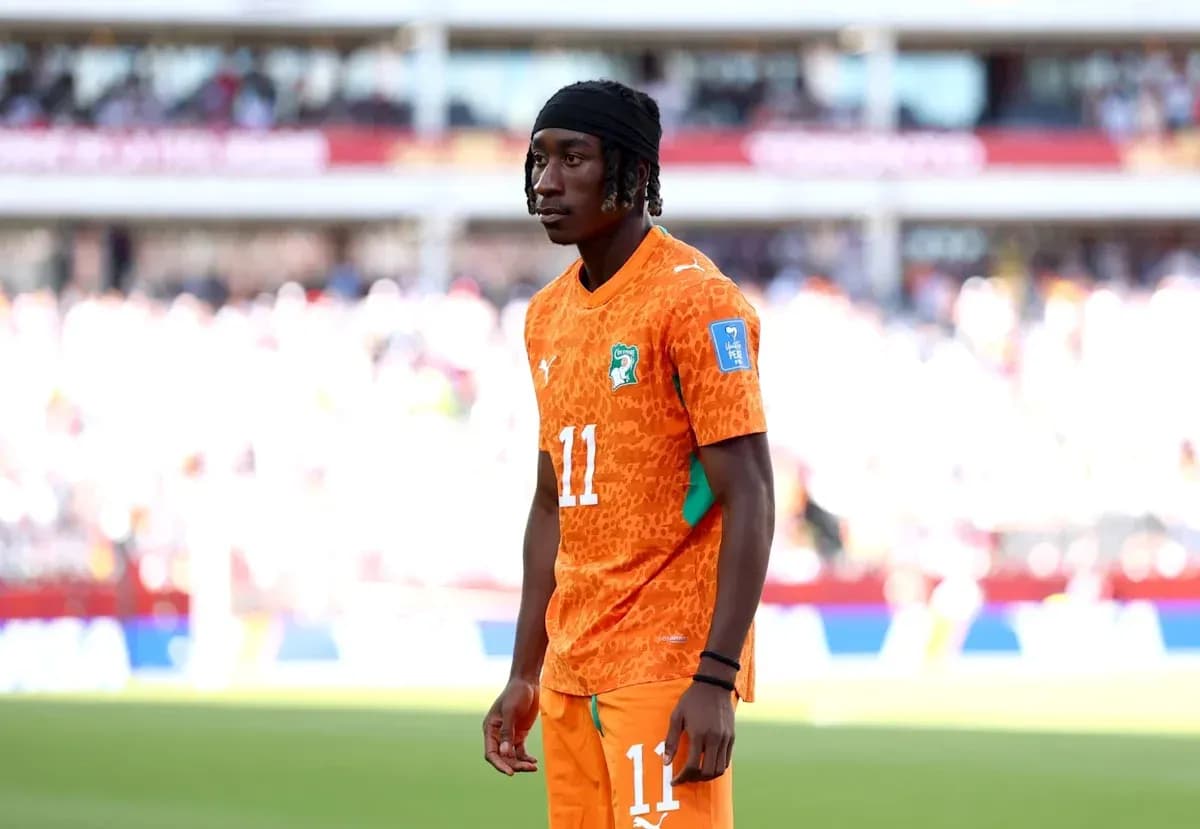
She leads Ivory Coast into WAFCON 2026, the country’s first appearance at the tournament in 12 years. They were late additions to the expanded 16-team field, one of four nations brought in after the competition grew from 12 participants. The opportunity is sudden, but the expectations are not modest.
"The target that has been set for us is, of course, to do no worse than we did at the last Africa Cup of Nations we took part in — that is, to finish third," she said.
That 2014 side reached the podium with a group largely based at home or in modest leagues abroad. This time, the profile is different. Ivory Coast now have more players spread across top European competitions, including their captain in Munich.
Yet there is a twist. Almost half the current squad will be making their first appearance at a WAFCON. Experience is thin in some areas. The stage will feel new. Amani knows this, but she doesn’t sound daunted.
"We're going to focus on our own game, and we know that we've got qualities that could give (our opponents) a run for their money," she said.
Statement start in Casablanca
On Monday in Casablanca, those words carried weight. The Lady Elephants did more than just compete. They dominated.
Ivory Coast brushed aside Burkina Faso 4-1 in their opening Group B match, a commanding performance that put them top of the group and sent a message across the tournament. The goals flowed, the confidence grew, and a team returning after a long absence looked like it had never been away.
Now comes the real measurement.
Their second match, on Friday, is against South Africa, a side ranked second on the continent and one of the established forces in African women’s football. On paper, it is the group’s heavyweight clash. In reality, it arrives with a twist of drama: South Africa opened their campaign with a shock 2-1 defeat to Tanzania.
That result tightens the screws on both sides. South Africa cannot afford another slip. Ivory Coast suddenly have a chance to seize control of the group, to turn a strong start into something more substantial.
For Amani, it is another step in a journey that has already taken her from Dougbafla to Abidjan, from Spain’s lower leagues to the Allianz Arena, from an anonymous spectator in the stands to captain of her country.
She has reached the top at club level, and she knows the challenge now is to stay there. With Ivory Coast back on the continental stage, the question is whether she can drag her national team towards that same standard — and keep rewriting what is possible for the next girl kicking a ball around a village pitch, wondering if this sport can really be a life.