
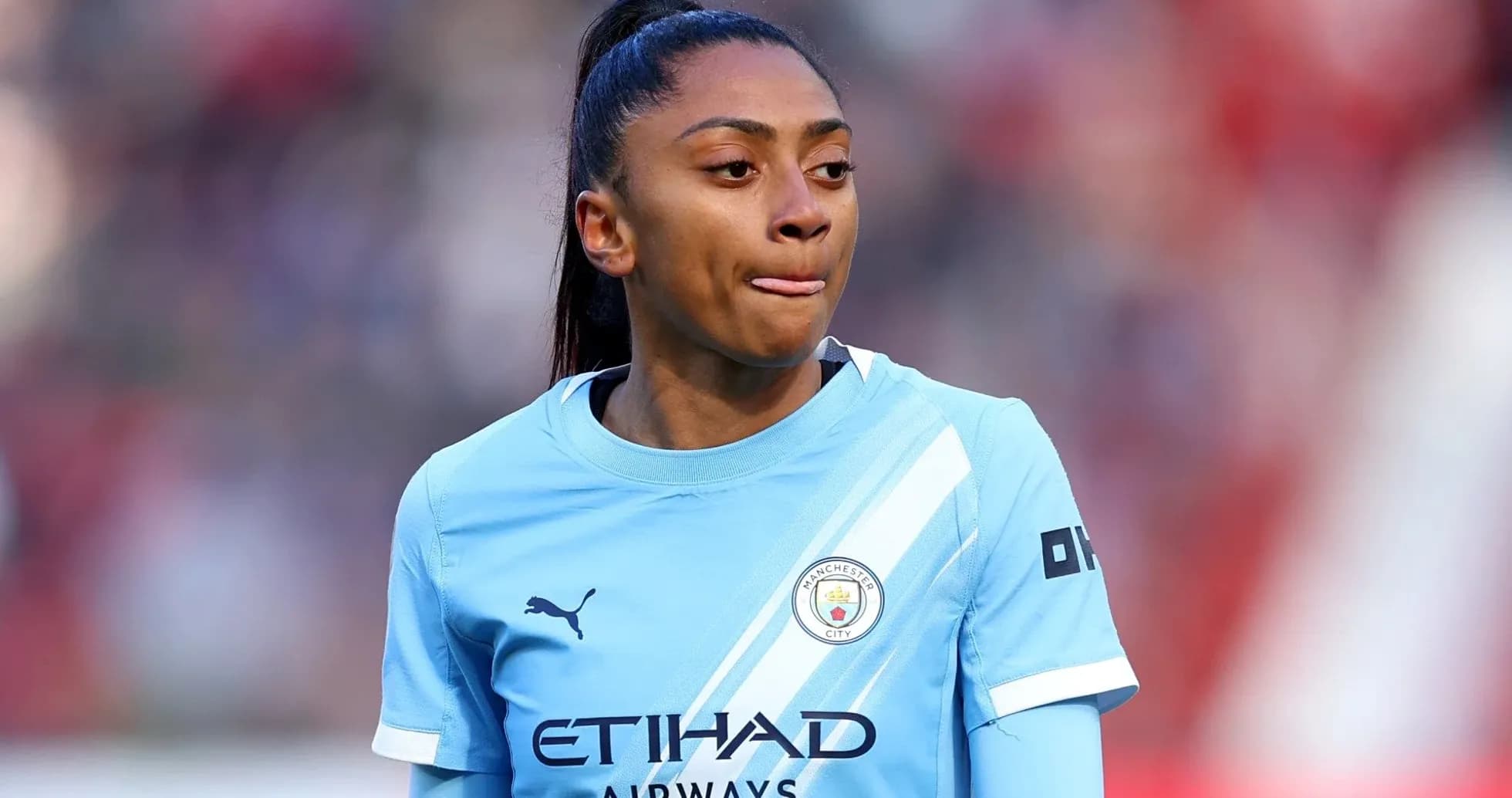
Barcelona signs Kerolin for €1.5m – reshaping the transfer market
Barcelona have gone back to the top shelf of the women’s transfer market – and this time they’ve smashed through their own ceiling to get there.
The European champions have reached an agreement to sign Brazil star Kerolin from Manchester City for a fee of around €1.5m (£1.28m/$1.7m), according to journalist Victoria Leite, a figure that will make the forward one of the most expensive players in the history of the women’s game. Only Grace Geyoro’s move to London City Lionesses, and potentially Alyssa Thompson’s switch to Chelsea, sit above it.
Kerolin is expected to sign a four-year deal in Catalunya this week, the end point of a chase that started with rejection after rejection. Barcelona initially saw two bids knocked back, the second of which would already have broken the club’s own women’s transfer record – the fee paid for Keira Walsh in 2022, believed to be over £400,000.
The roadblock was clear. Kerolin’s contract at City contained a release clause of more than €1m, a number Barcelona initially balked at. For a while, it looked like a classic stand-off: a club unwilling to lose a star, another unwilling to be strong-armed by a clause.
Then the tone shifted. As the two clubs worked to “find common ground and finalise the transfer”, as reported locally, the price climbed past that release figure. In the end, City’s resistance met Barcelona’s need – and the market moved with it.
City cash in on a rising star
From Manchester City’s point of view, this is a sale that makes sense on the balance sheet, if not in the dressing room.
Kerolin arrives in Spain off the back of a superb campaign. In her first full season in England, she delivered 14 direct goal contributions in the Women’s Super League, a tally bettered only by Khadija Shaw, Alessia Russo and Vivianne Miedema as City ended a decade-long wait for the title. She had only joined from North Carolina Courage in January 2025, yet quickly became one of the most incisive attackers in the division.
She is 26, under contract until 2028 and entering her peak. Clubs do not normally plan to sell players like that. They build around them.
But the numbers change the conversation. A fee in the region of €1.5m for a player signed less than two years ago is the kind of offer that forces even ambitious clubs to listen, especially when the squad is already overflowing with attacking options.
City’s forward line remains stacked: Shaw, Miedema, Mary Fowler, Lauren Hemp, Aoba Fujino and Iman Beney are already in the building. Beth Mead has arrived this summer to add yet another proven international to the mix. If City decide they need a direct replacement for Kerolin, the window is still open and the funds will be there.
So City bank a huge profit, keep a fearsome front line, and gain room to manoeuvre later in the summer. Sporting loss, financial win.
Barcelona buy a game-changer – at a cost
For Barcelona, this is not a luxury signing. It is a necessity.
The European champions have seen their attack ripped apart over the past few months. Alexia Putellas, twice a Ballon d’Or winner and the face of the project for a decade, has left for London City Lionesses. Salma Paralluelo, match-winner in the Champions League final with two goals, walked away on a free transfer despite being offered a new contract.
Those are not just departures; they are seismic exits. Goals, creativity, personality – gone.
There is still plenty of talent in Catalunya. Claudia Pina, Ewa Pajor, Kika Nazareth and Caroline Graham Hansen form a forward unit most clubs would envy. Graham Hansen has just committed her future to the club, while youngsters Sydney Schertenleib and Vicky Lopez continue to push from underneath.
Yet the balance has shifted. With Putellas and Paralluelo out, Barcelona needed someone who can tilt big games on her own, someone with proven output at the highest level, not just another promising teenager.
Kerolin fits that brief. She carries the ball with aggression, breaks lines, and has already shown she can produce consistently in a title race. Her arrival gives Barcelona a different profile in the final third, a forward who can both score and create in equal measure.
The price, though, drags another question into the room.
Big fee, tight margins
Barcelona’s decision to go so high for Kerolin lands in a delicate financial context.
Transfer fees in the women’s game have risen sharply in the last few years. That Barcelona must pay such a sum for a Brazil international under contract for two more seasons is no surprise in that sense. This is what the top end of the market looks like now.
But this is also a club that has lived with strict financial limits. Only last summer, several first-team regulars were forced out to help the club comply with Financial Fair Play rules. A wave of elite academy talent also departed, sacrificed to balance the books.
Against that backdrop, committing around €1.5m to a single signing is a statement – and a risk. It underlines how strongly Barcelona feel they must reinforce now to stay at the summit of Europe, yet it also tightens the margins for what comes next.
And what comes next is crucial.
Renewal storms on the horizon
Kerolin’s signing does not end Barcelona’s work. It sharpens it.
Patri Guijarro, widely regarded as one of the best holding midfielders in the world, is only tied down until 2027 and is already drawing interest from Lyon and top English clubs. Pajor, the spearhead of the attack, is entering the final year of her deal. So is Esmee Brugts, a rising star with the potential to anchor the next era.
Barcelona have just watched Alexia Putellas, Paralluelo, Mapi Leon and Ona Batlle all leave for free. Four pillars of a generation, gone without bringing in a transfer fee. They cannot afford a repeat next summer.
So the club now walks a tightrope. On one side, the need to keep refreshing a squad that expects to win every trophy it enters. On the other, the obligation to ring-fence enough money to lock down the core of its future.
Kerolin’s arrival answers one urgent question in the here and now: who steps into the void left in attack? The next one is harder, and it will define whether this record outlay looks like a masterstroke or an indulgence.
Can Barcelona keep paying at the top of the market and still hold on to the stars they already have?




