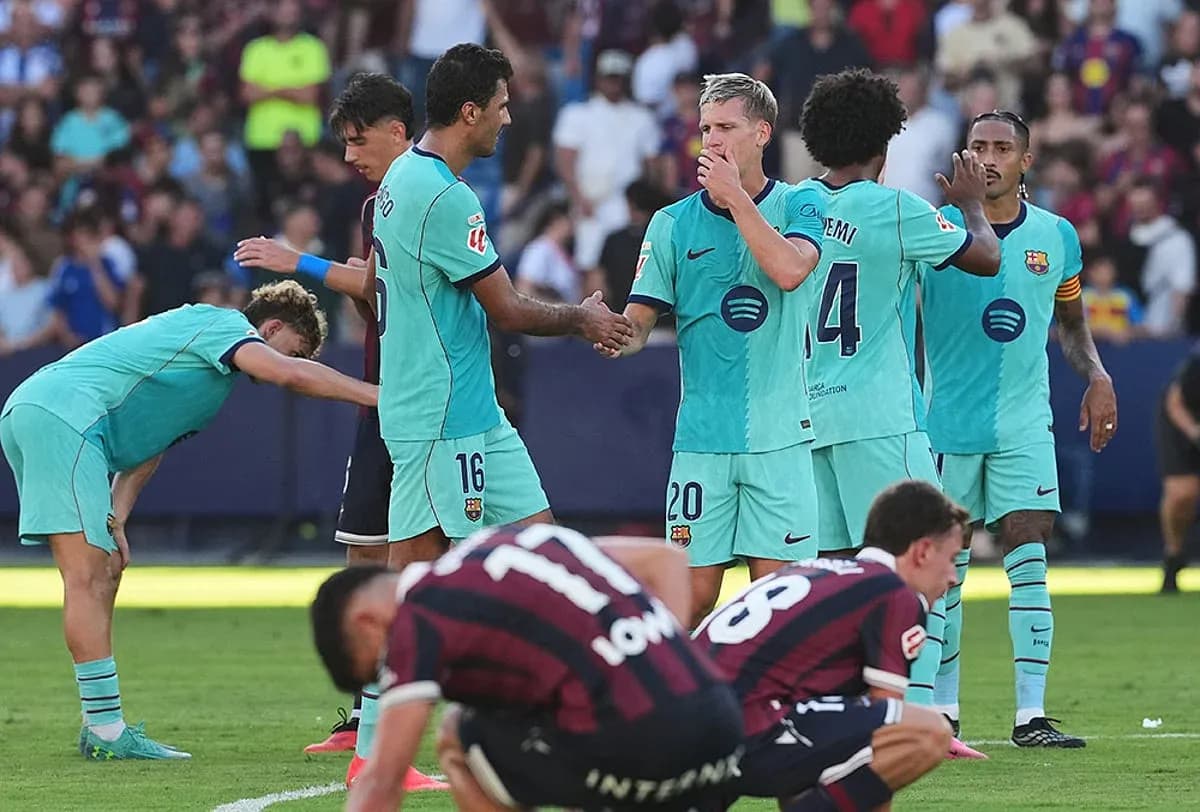
Barcelona Overwhelms Levante in La Liga Clash
The late-afternoon light over Estadio Ciudad de Valencia found two teams at very different points in their La Liga stories. Levante, 13th with 5 points from 5 matches, came into this Round 5 fixture with a goal difference of -2, still feeling their way back into the division’s rhythm. Barcelona arrived as the league’s early juggernaut: 1st place, 15 points from 5, 21 goals for and 4 against for a towering overall goal difference of +17. The final 4–2 scoreline in favour of Barcelona fit the broader arc of the season, but the way both squads set up – and bent the game to their strengths and weaknesses – told a more nuanced tale.
Levante's Formation
Luis Castro rolled out a 4-4-2 that leaned heavily into Levante’s home identity. At home this season, Levante had already scored 7 goals in just 2 matches, an average of 3.5 per game, but also conceded 6 at 3.0 per match. This is a side whose football at Estadio Ciudad de Valencia is expansive, volatile, and rarely dull. The back four of J. Toljan, Dela, A. Mandi, and M. Sanchez shielded M. Ryan, with a midfield line of V. Garcia, H. Sotelo, J. A. Olasagasti, and R. Brugue supporting the front pair of D. Requena and P. Ratkov.
Castro’s choice of 4-4-2, used only once before this season, was a clear attempt to stretch Barcelona horizontally and attack the spaces behind their advanced full-backs. Brugue, Levante’s standout attacker in this campaign with 3 league goals and a 7.07 average rating, operated as the key transitional outlet from the left. His 11 shots and 6 tackles so far underline his dual role as both runner and first presser. Alongside him, V. Garcia on the opposite flank and the central pairing of Sotelo and Olasagasti were tasked with compressing the middle when out of possession, then breaking quickly into the channels when the ball was turned over.
The tactical gamble, though, came with a defensive price. Heading into this game, Levante’s overall defensive record – 9 conceded in 5 matches, an average of 1.8 per game – and the lack of any home clean sheets spoke of a unit that struggles to absorb sustained pressure. Their card distribution, with 20.00% of yellow cards arriving in each of the 31–45, 46–60, 61–75, 76–90, and 91–105 minute windows, paints a picture of a team that is forced into last-ditch interventions across all phases rather than in one specific period.
Barcelona's Structure
Barcelona, by contrast, came in with the calm certainty of a side whose structure is already fully formed. Hansi Flick stayed loyal to his preferred 4-3-3, a shape that has underpinned 5 wins from 5. With J. Garcia in goal and a back four of E. Garcia, P. Cubarsi, G. Martin, and X. Espart, the visitors fielded a defensive unit that had conceded only 4 goals all season, 2 at home and 2 away. On their travels, Barcelona’s 14 goals scored and 2 conceded – 4.7 scored and 0.7 conceded per away match – framed this as an away machine built on territorial control and ruthless transitions.
The midfield triangle of Fermín, Rodri, and Pedri provided the game’s central choreography. Fermín has been one of the league’s most complete midfielders so far: 4 goals, 2 assists, 10 shots with 8 on target, 184 passes at 84% accuracy, and 6 successful tackles. His ability to arrive late in the box while still contributing defensively made him the hinge between Barcelona’s positional play and their counter-press. Pedri, with his usual metronomic passing, and Rodri as the connector, ensured that Barcelona could consistently overload Levante’s double pivot.
Ahead of them, the front three of Lamine Yamal, Raphinha, and A. Gordon represented the match’s decisive mismatch. Raphinha, with 6 goals and 3 assists from 5 appearances and an 8.5 rating, is the division’s most efficient wide finisher: 11 shots, 9 on target, plus 13 key passes. Opposite him, Lamine Yamal matched that 6-goal tally with 20 shots (11 on target), 19 key passes, and 33 dribble attempts, winning 28 of 57 duels. Between them, they offered both volume and precision, constantly testing Levante’s full-backs and centre-backs in one-on-one situations.
Gordon, leading La Liga in assists with 4, is the subtle glue in this frontline. His 90% pass accuracy, 7 key passes, and 13 dribbles attempted (8 successful) show a winger who can both retain the ball under pressure and deliver the final action. His presence on the left, dovetailing with Espart’s surges from full-back, repeatedly forced Levante’s right side – Toljan and V. Garcia – into two-versus-one scenarios.
Absences and Tactical Implications
The absences added another layer to the tactical story. Levante were without K. Etta Eyong and A. Primo, both listed as missing through injury. That reduced Castro’s options for midfield rotation and defensive reinforcement, pushing him towards a more front-foot, risk-accepting game plan. Barcelona, missing R. Bardghji and F. de Jong through knee injuries, were deprived of an additional creative winger and their most accomplished deep playmaker. Yet Flick’s depth – with Gavi, Marc Bernal, Dani Olmo, Gabriel Jesus, H. Abdelkarim, and K. Adeyemi all available from the bench – meant the overall structure and intensity could be maintained across 90 minutes.
In the “Hunter vs Shield” dynamic, Barcelona’s attack was always likely to overwhelm Levante’s fragile defensive numbers. Overall, Barcelona’s 4.2 goals scored per match versus Levante’s 1.8 conceded set the baseline. Conversely, Levante’s own attacking strength at home – 3.5 scored per game – suggested they would find ways through a Barcelona back line that, while solid, still allows 0.7 away goals per match.
The “Engine Room” battle between Fermín–Rodri–Pedri and Levante’s Sotelo–Olasagasti axis was where the contest’s tone was set. Barcelona’s midfielders, particularly Fermín, combined progressive passing with ball-winning; his 6 tackles and single blocked shot this season underscore his ability to disrupt as well as create. For Levante, Olasagasti and Sotelo were often forced deeper than ideal, spending more time screening spaces than launching Requena and Ratkov into the channels.
Disciplinary trends also framed the tactical risk. Barcelona’s yellow cards this season have clustered in the 46–60 minute window (60.00% of their cautions), reflecting a team that often ramps up intensity after half-time. Levante’s more evenly spread bookings speak to a side under pressure in every phase, which in turn increases the likelihood of defensive errors as fatigue sets in.
From a statistical prognosis standpoint, this match always tilted heavily towards Barcelona. An away side averaging 4.7 goals scored and 0.7 conceded on their travels faced a host whose home matches have averaged 6.5 total goals (3.5 for, 3.0 against). Layer on the individual form of Raphinha and Lamine Yamal, the creative weight of Gordon and Fermín, and the structural stability of Flick’s 4-3-3, and the 4–2 outcome felt like the logical intersection of form, structure, and talent.
Yet Levante’s ability to score twice, in line with their attacking home profile, also underlined why Estadio Ciudad de Valencia will remain a dangerous stop for visiting sides. For Castro, the task ahead is to preserve that attacking verve while tightening a back line that has yet to record a home clean sheet. For Barcelona, this was another confirmation that their blend of high-tempo pressing, wing-led creativity, and midfield control can carry them through even when key names like De Jong are absent.