Atletico Madrid Triumphs Over Real Madrid in La Liga Derby
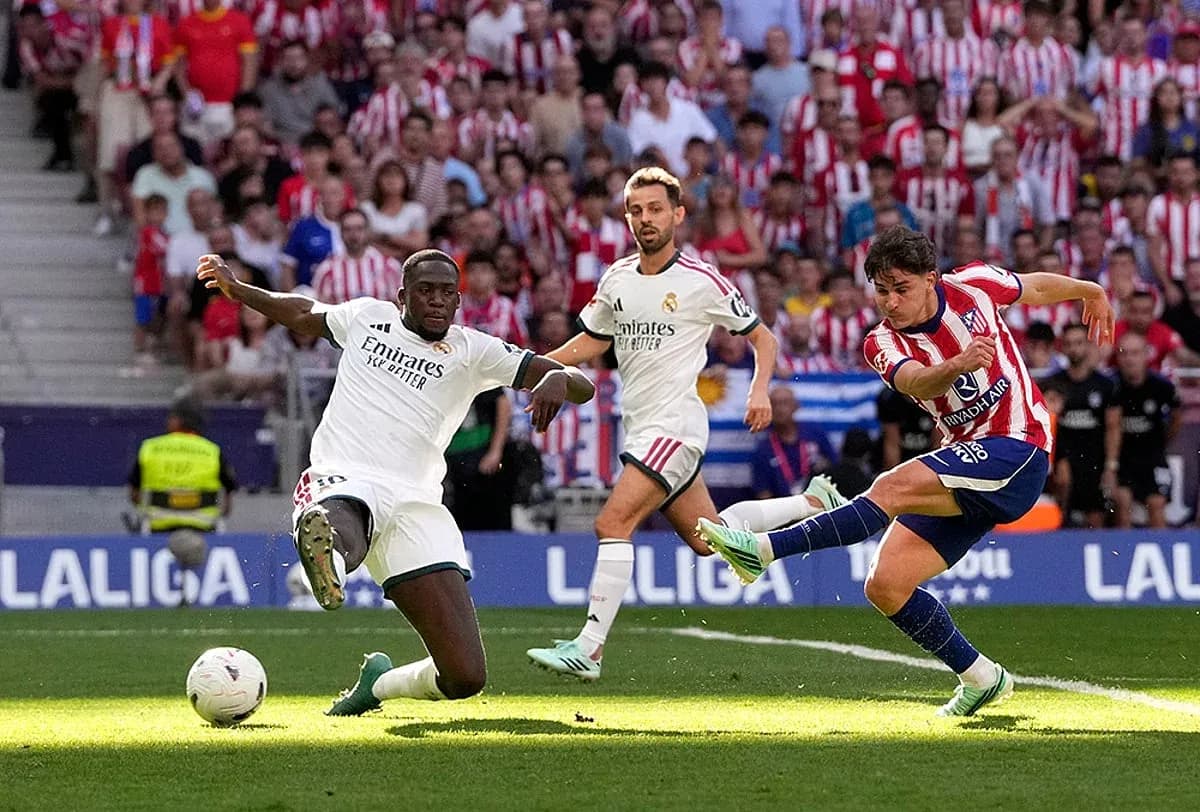
Under the bright Madrid sun at the Riyadh Air Metropolitano, this derby was more than a local feud; it was a collision of two fully formed identities near the top of La Liga. Atletico Madrid came into Round 7 second in the table on 16 points, with a total goal difference of +9 (16 scored, 7 conceded). Real Madrid arrived fourth on 15 points, their total goal difference an even more imposing +10 (18 scored, 8 conceded). By full time, the scoreboard read 2–1 to Atletico, and the story of how these squads were constructed – and how they collided tactically – was written clearly across the pitch.
I. The Big Picture – Structures and Seasonal DNA
Atletico’s season-long numbers already hinted at a side that has evolved without abandoning its steel. Overall this campaign, they average 2.3 goals scored per game and only 1.0 conceded. At home, that profile sharpens further: 2.5 goals scored and just 0.8 against. Diego Simeone has leaned heavily into a 4-4-2 – used in 5 of their 7 league matches – and he rolled it out again here.
Jan Oblak anchored a back four of Marc Pubill, C. Romero, Dávid Hancko and Álex Grimaldo. Ahead of them, a midfield line of G. Simeone, Marcos Llorente, J. Cardoso and Álex Baena supported a front two of Lee Kang-In floating off Jonathan David. It is a blend of classic Simeone traits – defensive discipline and vertical threat – with more technical craft between the lines.
Real Madrid’s season has been defined by attacking excess and a more fragile away underbelly. Overall they score 2.6 goals per game and concede 1.1. At home they are devastating – 4.0 scored and 0.7 conceded – but on their travels the balance tilts: 1.5 goals scored, 1.5 conceded. José Mourinho has gone all-in on a 4-2-3-1, used in all 7 league fixtures.
In this derby, Thibaut Courtois stood behind a back four of Denzel Dumfries, Ibrahima Konaté, Dean Huijsen and Marc Cucurella. Aurélien Tchouaméni and Fede Valverde formed the double pivot, with Arda Güler, Jude Bellingham and Vinícius Júnior supporting Kylian Mbappé as the lone striker. It is a star-studded spine built to dominate territory and transitions, but one that remains vulnerable when stretched wide and attacked with numbers.
II. Tactical Voids – Absences and Discipline
Both managers had to navigate key absences that subtly reshaped their plans.
Atletico were without P. Barrios and A. Sorloth, both ruled out with muscle injuries. Barrios’ absence removed a combative midfield option who could have offered extra legs in central pressing phases, pushing more responsibility onto J. Cardoso as the primary stabiliser. Sorloth’s injury meant Simeone had to lean on Jonathan David as his penalty-box reference, with Lee Kang-In tasked to drop off and connect play rather than working off a more traditional target man.
Real Madrid’s absences were more structural. Eder Militao (hamstring), Ferland Mendy (hip) and Rodrygo (knee) were all missing. Without Militao, Mourinho trusted the young Huijsen alongside Konaté, a pairing high on passing quality but still learning the dark arts of derby defending. Mendy’s absence forced Cucurella into the left-back role, a more aggressive, front-foot defender who can be pulled out of the line. Without Rodrygo, the right flank lost some of its directness, placing even greater creative and scoring burden on Mbappé, Bellingham and Vinícius.
Season-long disciplinary trends framed the risk profile. Atletico’s yellow-card distribution shows a spike between 31–45 minutes, where 30.77% of their bookings arrive, and another cluster early in the second half (23.08% between 46–60). They also have a single late red card this campaign between 76–90 minutes. Real Madrid, by contrast, concentrate 25.00% of their yellows between 46–60 and another 25.00% between 61–75, with a solitary red card already shown in the 46–60 window. In a derby where emotional control is a tactical resource, both sides came in with a clear tendency to boil over around the hour mark.
III. Key Matchups – Hunter vs Shield, Engine Room Battles
The headline duel was always going to be Mbappé against Atletico’s defensive block. Heading into this game, Mbappé had 7 league goals and 2 assists in 7 appearances, underpinned by 32 shots (22 on target) and a 7.96 average rating. He had also won and taken penalties, scoring 1 but missing 1 – an important detail against an Atletico side that has been perfect from the spot this season, converting both of their penalties with no misses.
Simeone’s plan was to deny Mbappé the spaces he thrives in between full-back and centre-back. Romero and Hancko stayed compact, while Pubill and Grimaldo rarely advanced together. The presence of J. Cardoso as a screening midfielder allowed Atletico to collapse the central lanes where Bellingham likes to combine with Mbappé.
Bellingham himself arrived as one of La Liga’s most complete midfielders: 3 goals, 2 assists, 17 key passes and a 90% passing accuracy. His duel with Cardoso and Llorente was the engine-room hinge of the derby. Atletico’s aim was to turn Bellingham’s touches backwards or sideways, preventing him from driving through the half-spaces.
On the other side, Atletico’s creative axis revolved around Álex Baena and G. Simeone. Baena, with 4 goals and 1 assist, is not just a set-piece threat but also a volume passer (232 total passes, 14 key passes) who can switch play quickly to isolate full-backs. G. Simeone’s work rate – 71 duels contested, 34 won – and 2 assists this season made him the hybrid presser and secondary playmaker on the right.
Their primary target was Real Madrid’s centre-back pairing. Konaté, already on 3 yellow cards this season, is an aggressive front-foot defender, while Huijsen, though technically superb, has already seen red once. That combination of aggression and inexperience was precisely what Jonathan David and Lee Kang-In looked to exploit. David’s efficiency – 3 goals and 1 assist in just 160 league minutes – made him the “hunter” lurking on the blind side, while Lee’s movement into pockets dragged markers out of line.
Out wide, Vinícius Júnior – with 3 assists, 23 fouls drawn and 29 dribble attempts – tested Pubill and Romero’s channel. But Atletico’s compact 4-4-2, with Baena tucking in, often turned that flank into a cul-de-sac, forcing Vinícius to receive deeper and reducing his presence in the box.
IV. Statistical Verdict – Why Atletico’s Plan Prevailed
From a statistical and structural standpoint, this was a clash between Atletico’s home defensive solidity and Real Madrid’s away volatility. On their travels, Madrid concede 1.5 goals per game and have yet to keep an away clean sheet this season. Atletico, at home, average 2.5 goals scored and have yet to lose, with 2 clean sheets in 4 matches.
Layer onto that the penalty narrative – Real Madrid’s 50.00% conversion rate from the spot this season, with 1 miss out of 2, versus Atletico’s flawless record – and the margins in high-pressure moments tilted towards the hosts.
The 2–1 scoreline ultimately mirrored the underlying profiles: Atletico’s balanced, resilient squad bending but not breaking against the league’s most explosive attack, and Real Madrid’s star-studded front line unable to fully overcome the structural frailties of an away defence still learning to live without its injured leaders. In a derby decided by details, Atletico’s collective cohesion and home-ground identity gave them just enough edge to turn a tactical arm-wrestle into a statement win.