AS Roma Dominates Fiorentina 4-0 in Serie A Showdown
Under the lights of the Stadio Olimpico, this was billed as a crossroads in the Serie A season: fifth‑placed AS Roma, chasing Europa League certainty, against a Fiorentina side still glancing nervously over their shoulder in 16th. Heading into this game, Roma’s overall goal difference stood at +23 (52 scored, 29 conceded) from 35 matches, while Fiorentina’s was -11 (38 for, 49 against). It felt like a clash between a hardened, top‑six machine and a side still trying to remember what it means to be secure.
By full time, the scoreboard read 4‑0 to Roma, a ruthless confirmation of what the season’s numbers had been hinting at.
I. The Big Picture – Roma’s structure, Fiorentina’s fragility
Roma lined up in their now-familiar 3‑4‑2‑1, a shape that has underpinned 27 league outings this season. M. Svilar sat behind a back three of G. Mancini, E. Ndicka and M. Hermoso, with Z. Celik and Wesley Franca providing width from the “4” line and N. Pisilli plus M. Kone patrolling the centre. Ahead of them, M. Soule and B. Cristante floated behind lone striker D. Malen.
The system fits Roma’s seasonal DNA. Heading into this game, they had scored 31 goals at home, an average of 1.7 per match at the Olimpico, while conceding just 10 at home – a stingy 0.6 per game. Ten home clean sheets underlined how comfortable they are defending higher up with three centre‑backs and aggressive wing‑backs.
Fiorentina, by contrast, arrived with a 4‑3‑3 that has been their most-used attacking base (12 league matches in that shape). D. de Gea was protected by a line of Dodo, M. Pongracic, L. Ranieri and R. Gosens, with a midfield trio of M. Brescianini, N. Fagioli and C. Ndour behind a front three of J. Harrison, A. Gudmundsson and M. Solomon.
On their travels this season, Fiorentina had averaged 1.0 goals scored and 1.6 conceded per match, with only 3 away clean sheets. The structure is designed to be front‑footed, but the numbers show a side that often leaves its back four exposed once the press is broken.
II. Tactical Voids – Absences and discipline
Roma came into this fixture missing a spine of attacking and creative options. A. Dovbyk (groin injury), E. Ferguson (ankle injury), L. Pellegrini (thigh injury) and B. Zaragoza (knee injury) were all ruled out, while N. El Aynaoui was suspended due to yellow cards. On paper, that is a serious depletion of central thrust and final‑third ingenuity.
Yet the depth of the bench – with P. Dybala, S. El Shaarawy and Angelino among the substitutes – allowed Piero Gasperini Gian to maintain his attacking principles without overloading the injured. The 3‑4‑2‑1 remained intact, but more responsibility fell on Soule between the lines and Malen as the reference point.
Fiorentina were also shorn of attacking alternatives. M. Kean, their leading scorer in the league with 8 goals, missed out through a calf injury, while R. Piccoli (muscle injury), L. Balbo (injury), N. Fortini (back injury) and T. Lamptey (knee injury) further thinned Paolo Vanoli’s options. Without Kean’s vertical running and physicality, the 4‑3‑3 relied heavily on Gudmundsson’s movement and Solomon’s dribbling to stretch Roma.
Disciplinary trends hinted at where this might tilt. Roma’s season card map shows yellow cards clustering between 46‑60', 61‑75' and 76‑90' (each 23.08% of their yellows), a sign of a side that plays on the edge in the second half. Fiorentina, however, carry a more combustible profile: 25.00% of their yellows arrive between 76‑90', and both of their reds this season have come in that same late window. In a match where Roma could dictate tempo, the risk of Fiorentina unravelling late was always present.
III. Key Matchups – Hunter vs Shield, Engine Room battles
The headline duel was always going to be D. Malen against the Fiorentina back line. Malen entered this round with 11 league goals and 2 assists in 15 appearances, converting from 40 shots (24 on target) and scoring 2 penalties from 2. He is not just a finisher; his 7 key passes and willingness to run the channels make him a constant reference point.
Standing in his way was M. Pongracic, the league’s leading yellow-card collector with 11 bookings. Pongracic is an aggressive defender: 29 tackles, 23 successful blocks and 34 interceptions this season, winning 110 of his 225 duels. But that front‑foot style comes with risk. Against a striker like Malen, who thrives on quick movements across the line and sharp changes of direction, every step forward can be punished.
Alongside Pongracic, L. Ranieri brought his own blend of timing and bite – 34 tackles, 10 blocked shots and 21 interceptions, but also 8 yellow cards. The Fiorentina centre‑backs are used to operating under stress, yet Roma’s 3‑4‑2‑1, with Soule and Cristante attacking half‑spaces, forced them into constant three‑way decisions: step to the ball, cover the channel, or protect the box.
In midfield, the “Engine Room” clash pitted Roma’s young core against Fiorentina’s technical trio. Soule, one of the league’s top assist providers with 5, is far more than a classic No.10. With 918 passes at 83% accuracy and 43 key passes, plus 89 dribble attempts (32 successful), he acts as Roma’s chief conductor. His ability to drift into pockets behind Fagioli and Ndour made him the game’s tactical fulcrum.
For Fiorentina, N. Fagioli and M. Brescianini were tasked with both building play and screening transitions. But their team’s season‑long pattern – conceding 49 overall, including 29 on their travels – shows that once the first line is beaten, the back four are often left exposed without enough protection from midfield.
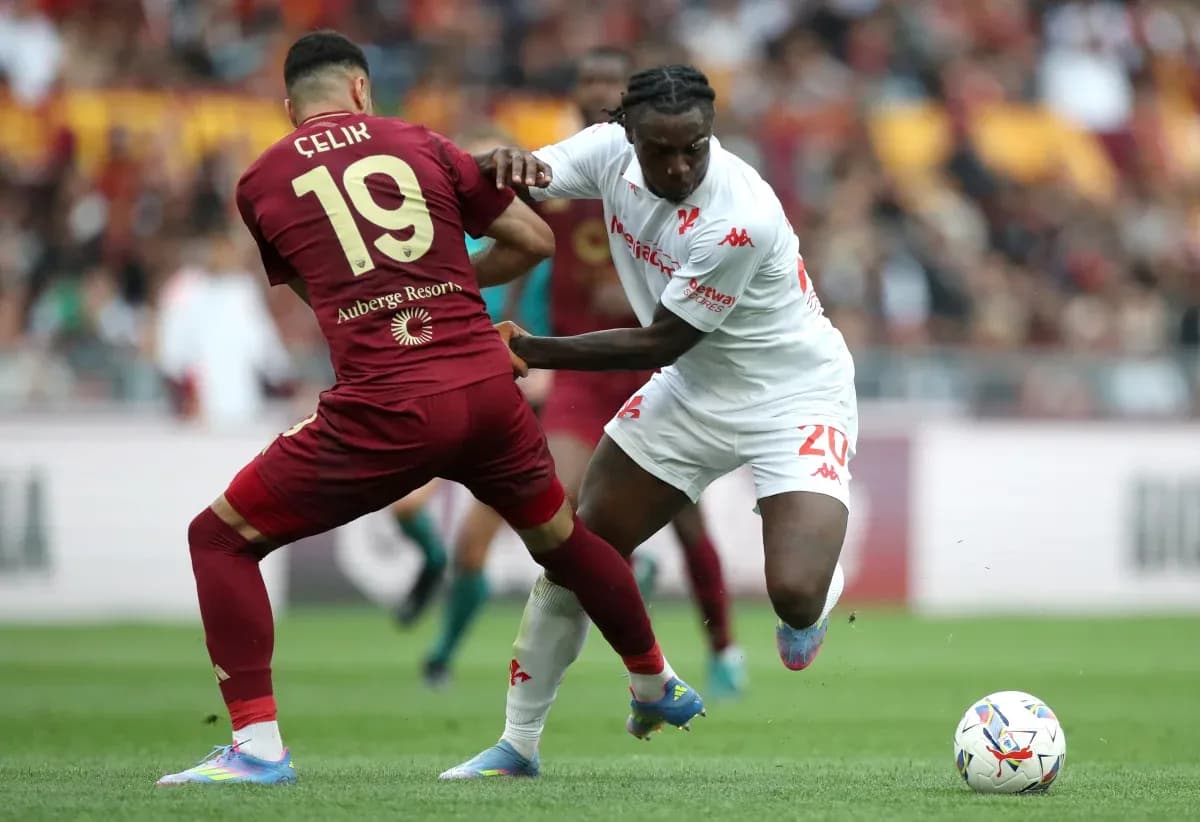
On the flanks, Z. Celik’s duel with R. Gosens offered another decisive channel. Celik’s season numbers – 57 tackles, 6 blocked shots and 17 interceptions, plus 2 assists – underline his two‑way value. In Roma’s 3‑4‑2‑1, his forward surges pin the opposing full‑back deep, limiting Gosens’ ability to overlap and support Solomon. That territorial squeeze helped Roma lock Fiorentina in their own half for long spells.
IV. Statistical Prognosis – Why 4‑0 felt logical
Heading into this game, Roma’s overall scoring average sat at 1.5 goals per match, with just 0.8 conceded. At home, that profile sharpened: 1.7 scored, 0.6 conceded, and 10 clean sheets in 18 fixtures. Fiorentina’s away record, by contrast, read 1.0 scored and 1.6 conceded per game, with 7 away matches where they failed to score.
Overlay those trends and the Expected Goals landscape clearly tilted Roma’s way. A side that consistently limits chances against, at home, facing a team that struggles to create and protect on their travels, was always likely to generate the higher xG and suffocate the contest.
The 4‑0 full‑time scoreline, with Roma already 3‑0 up by half time, reflected not just a one‑off storm but the season’s structural truths: Roma’s 3‑4‑2‑1 is a settled, efficient machine built on defensive control and sharp transitions, while Fiorentina’s 4‑3‑3 remains an open, often overstretched framework.
Following this result, the narrative is clear. Roma look every inch a Europa League side, their squad depth absorbing injuries and suspensions without diluting their identity. Fiorentina, meanwhile, are left to confront a familiar question: can a team this porous on their travels truly feel safe until the season’s final whistle?