AI Revolutionizing Soccer Recruitment and Player Health
AI has crept into soccer in the way most things do in elite sport: quietly at first, then all at once.
Clubs are rich, the margins are thin, and any edge – no matter how small – gets chased. The sport has always been ruthless like that.
From Arsenal blog to global data shop
For Nadav Bracha, the journey into this new world started in a very old one: as an obsessive Arsenal blogger tapping away from home.
He watched, he wrote, he scouted from his sofa. Using a mix of the eye test and basic tech, he highlighted players he thought big clubs were missing. The work built a following. When his day job in tech became too demanding, he did what tech people do: he built a tool.
Bracha trained an AI model to spit out the skeletons of his blog posts. Then he fused that with his own scouting instincts. Suddenly, the hobbyist was spotting players that made professionals pause.
“I started to get inbox requests from professional scouts and at clubs asking me, 'How do I know about that on a player?’” he recalled. His answer was blunt: it was just ChatGPT. If that was enough to impress people inside the game, he wondered, what exactly were they using?
The answer, he discovered, was chaos.
Clubs had data. Mountains of it. But it was scattered across platforms and providers. Wyscout had helped drag the sport into the numbers age in the early 2010s. Rival firms quickly followed. The problem flipped almost overnight.
“In the past 10 years, this industry has moved from complete scarcity to data overload,” Bracha said. “There are so many different data providers.”
Out of that mess came Marquee, Bracha’s company. Its pitch is simple: cut through the noise.
If a club’s recruitment department lives in “glorified spreadsheets,” as he puts it, Marquee tries to automate the grind. It pulls disparate platforms into one place, cleans the data, and acts like an outsourced analytics department. The tool doesn’t pretend to be Football Manager or EAFC Career Mode. It goes deeper.
For a fee, Marquee builds tailored profiles of potential signings, not just rating their quality but mapping how they might fit into a specific system. Clubs can ignore the recommendations. Many do. But some of the biggest don’t.
Marquee already works with several Premier League sides and has been publicly backed by Barcelona and MLS outfit Chicago Fire. Whether it has unearthed the next superstar is another matter. What’s clear is that this type of AI is now embedded in the recruitment landscape.
When the machine spots fatigue before the player
The influence of AI isn’t limited to transfers. It’s creeping into the most fragile area of all: player health.
Take FC Cincinnati’s MLS clash with Nashville SC last year. As the game wore on, the club’s tech flagged something off with Matt Miazga. An “irregular movement pattern” flashed up. Five minutes later, the defender asked to come off.
The system didn’t prevent the problem. The data wasn’t live, and no one forced him to play through pain. But the machine still saw something before anyone else did.
That, in essence, is the promise of Springbok Analytics.
Ask them for their favourite challenge and the answer is always the same: “Send us your most complicated injury.” More often than not, that means the hamstring – the scourge modern football still hasn’t solved.
A 2020 NIH study found hamstrings made up 12 percent of all professional soccer injuries. The re-injury rate sat anywhere between four and 68 percent. It’s the classic fatigue issue, flaring up late in halves, refusing to be tamed despite better sports science, GPS tracking, and gym work.
“We’ve got all the new technology that exists every which way,” said Matt Brown, Springbok’s Analytics Director. “Hamstring injuries have not gone down. They've gone up.”
Brown believes part of the problem is how poorly the game actually measures what’s going on inside the muscle. Strength, balance, atrophy – the numbers are hard to capture, and even harder to track over time.
“You want to scan a player at the time of injury, two months later, six months later, to track atrophy and see if you're getting the stimulus and the changes that you're going after with muscle,” he said.
Springbok’s answer is to attack the scan itself.
Born out of the University of Virginia, the company’s technology was first used on children with cerebral palsy. Hyper-detailed MRI processing created 3D graphics so surgeons could plan tendon-lengthening procedures with precision. When it worked in medicine, sport came calling.
The NBA signed on in 2023. MLS added Springbok to its Innovation Lab this year.
Traditional MRIs, Brown pointed out, are “thousands and thousands of slices of [two-dimensional gray images].” Doctors have to stack them, interpret them, and mentally build a 3D picture. Springbok uses AI to do the heavy lifting.
“We can now pre-process those images using AI,” Brown said. The system chews through the raw MRI data, carves out muscle boundaries, and spits out a clean, 3D “digital twin” of the player. What used to take a week can now be turned around in hours.
They don’t treat injuries. They don’t promise miracle prevention. They hand over sharper, faster measurements and leave the decisions to the medical staff who, as Brown put it, “have done 10 years of this” and already have their own theories.
Springbok is a support act, not the star. But in an environment where a week’s delay can mean missing a key run of games, that time saved matters.
Scanning the future of a 14-year-old
If Springbok looks inside the body, Fit:Match tries to look ahead.
At the Philadelphia Union academy, coaches wrestle with the same questions every day: what level can a kid handle? How much first-team exposure is safe? Can a teenage body cope with the demands that talent demands?
Traditionally, the answers are part science, part guesswork. Strength tests, growth charts, projected height, physical profiling – and then a coach’s gut feel.
Fit:Match wants to strip out the guess.
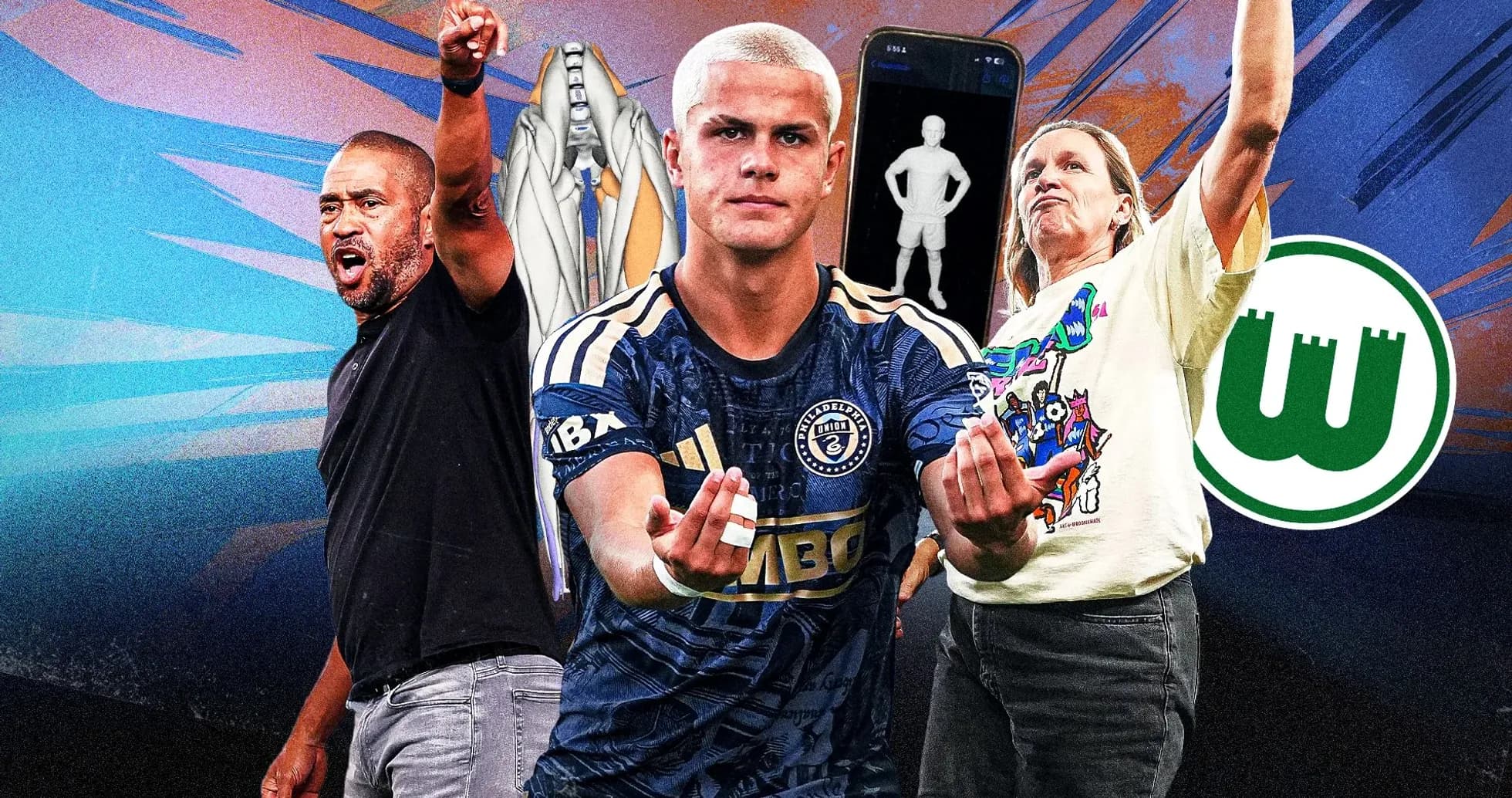
All it needs is a phone and 10 seconds. Four photos, from four angles. The system calculates height, body mass, wingspan and a long list of other measurements. Then it projects: likely height, growth maturation, a basic sketch of what full physical development might look like.
Founder Haniff Brown half-jokingly calls it “ChatGPT for soccer.” A process that would normally involve tape measures, forms, and manual data entry is compressed into a 30-second interaction.
Brown didn’t start in sport. His first move was in fashion, using instant body scans to stop people ordering four shirts and sending three back.
“How can we allow [a user] to upload a body profile of himself so that he doesn't have to buy four shirts and return the three that don't fit?” he asked. “You'll just buy one and boom.”
Hospitals and healthcare companies soon came calling. Then, in 2024, an unnamed European club asked him to scan their academy players. The scope changed overnight.
Brown set a hard limit: the scan had to take no more than 15 seconds. Anything longer, he knew, and coaches would simply ignore it. They want kids on the pitch, not in assessment queues.
The club bought in. Others followed. One problem quickly emerged: human inconsistency. Two coaches could measure the same player and produce different numbers.
“What we saw was one coach would, for the same player, measure and get one result, and from the same team, another coach would measure that same player and come up with a different result,” Brown said.
Fit:Match standardizes the whole thing. Four photos. Auto-generated digital twin. Detailed profile. The system is now used by clubs and by families.
“When parents register their children to go into an academy, they can actually upload their photos,” Brown explained. The platform builds the digital twin and feeds the data to MLS in the background.
That helps clubs decide which age groups to place players in and which pathways to build. In youth soccer, physical size still warps opportunity. A 14-year-old who matures early can dominate and be fast-tracked. A late developer can vanish.
“A player who is a 14-year-old but an early developer is far different from a player who's 14 and a late developer,” Brown said. MLS, he argues, can now “scientifically” distinguish between the two and protect those who might otherwise fall out of the system.
Ethics, jobs and the build-or-buy dilemma
All of this sounds powerful. It is. It’s also uncomfortable.
These tools don’t just streamline processes; they reshape them. They make projections about teenagers. They sit between medical staff and players. They intrude on the work of scouts and analysts who’ve built careers on their judgment.
Brown’s first hurdle with Fit:Match wasn’t the tech. It was trust. “The first step was getting people comfortable,” he said.
Bracha learned the same lesson with Marquee. The company had to position itself as a partner, not a replacement.
“It's more about them, to be fair, to kind of feel comfortable with everything that we do together,” he said. Only once they build a bank of “successful stories” will they shout about them.
There’s also the cold financial question. AI can look like a threat to jobs. Bracha doesn’t sugarcoat the calculation clubs face.
“From an ROI perspective, it will always be faster, quicker, righter to go to us because we've already built something, and we're investing a lot to improve it,” he argued. Salaries are one of a club’s biggest costs. Do they want to hire a full data team and build tools from scratch, or “just buy externally”?
“It’s like the AI’s most common question nowadays: build or buy? In this case, I think buy,” he said.
Even then, there are no guarantees. Wolfsburg were early adopters, loudly proclaiming that AI had saved them €1 million a year in admin and injury prevention. On the pitch, they struggled and became a punchline: a club trumpeting tech while the team faltered.
They’ve doubled down since. Sevilla have gone down a similar route, using IBM WatsonX to manage data. Others are more experimental, testing the limits of what public tools can offer.
Some coaches, like Fraser, have dabbled with ChatGPT to probe matchups and formations. Others have leaned harder.
Seattle Reign head coach Laura Harvey caused a stir in October 2025 when she admitted on the Soccerish podcast that she’d asked ChatGPT a simple question: “What formation should you play to beat NWSL teams?”
For two of the league’s then-14 sides, the answer came back the same: play a back five. Harvey didn’t blindly obey. She took the idea to her staff, weighed it, then implemented a system with five defenders.
The Reign finished fifth – eight places higher than the season before.
Did an AI chatbot transform Seattle? Of course not. But it did throw out an idea that survived the scrutiny of a professional coaching staff and ended up on the pitch. For those pushing AI in soccer, that’s proof enough that the technology can contribute.
There are plenty of failures too, data models binned, outputs ignored. Maybe that’s the point. These tools are becoming part of the background noise of elite football, another source of information in a sport already drowning in it.
In the end, the game remains brutally simple at the top level. As Fraser put it: “We’re all looking for any advantage we can get.”
If AI offers even one more, no matter how small, who in this business is really going to walk away from it?