2026 FIFA World Cup: Seven Nations Chase Glory
Seven nations remain. One trophy waits.
The 2026 FIFA World Cup has reached the stage where every touch feels heavier, every mistake unforgivable. Six European heavyweights and one South American giant are still standing in the United States, all of them chasing history, legacy, and, in some cases, redemption.
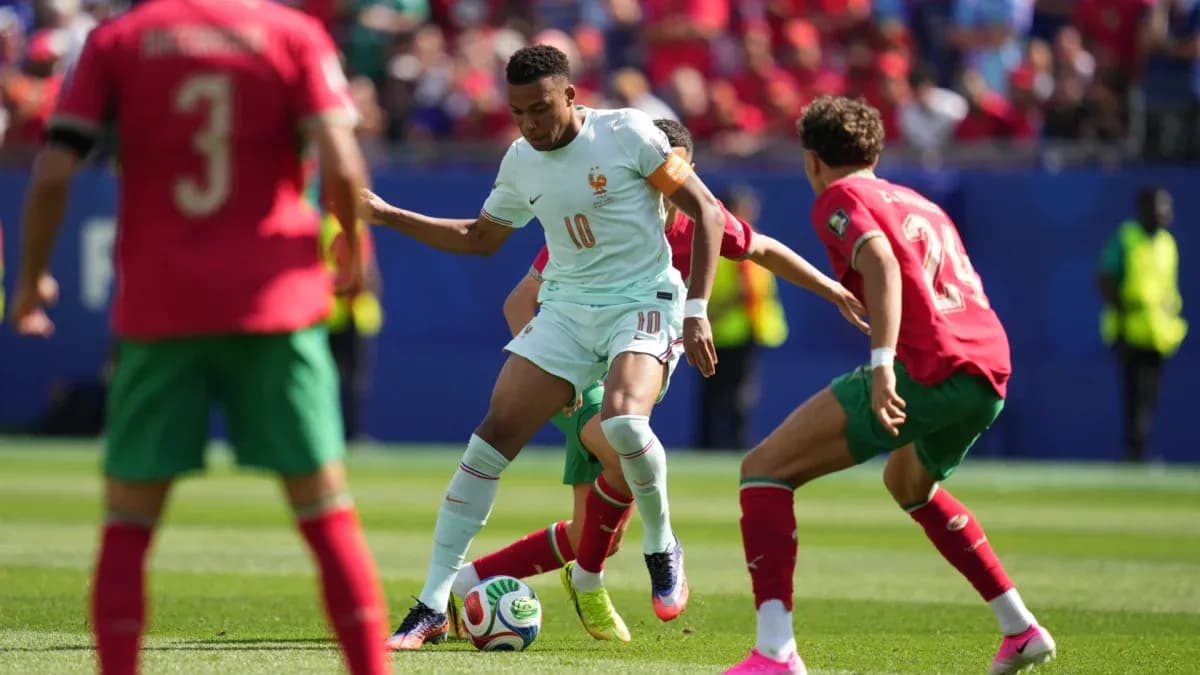
France: Mbappé chasing a dynasty
France are already in the semi-finals, and they have done it with the cold efficiency of a team that expects to be here. Senegal beaten 3-1. Iraq swept aside 3-0. Norway brushed off 4-1. Then Sweden 3-0, Paraguay 1-0, and Morocco 2-0 in the knockouts. Six wins, no defeats. Les Bleus are hunting a third straight world title.
Their semi-final at AT&T Stadium in Dallas on July 14 is booked; only the opponent is missing. Spain or Belgium will emerge from Friday’s quarter-final to face them. Whoever it is will have to solve the same problem the rest of the field has failed to crack: Kylian Mbappé.
France’s captain is no longer the precocious kid of 2018. He is the reference point of the tournament. Already the country’s all-time top scorer, he leads the charts again at this World Cup and has drawn level with Lionel Messi on 17 non-penalty goals across all World Cup appearances. That is rarefied air.
He rolled his ankle against Morocco, a jolt of panic for French fans and tournament organizers alike, but he has already declared himself “completely fine.” If that holds, France will walk into Dallas with their talisman fit, firing, and chasing a hat-trick of titles that would redraw the map of international football.
Spain: La Roja’s new conductor
Spain arrive at their quarter-final with Belgium in Los Angeles looking like a team that has quietly rearmed for another tilt at the trophy. Group H brought a cautious start with a 0-0 against Cabo Verde, then a 4-0 dismantling of Saudi Arabia and a controlled 1-0 win over Uruguay. Austria fell 3-0. Portugal were edged 1-0. This is a side that knows how to manage a game, then kill it.
At the heart of the excitement is Lamine Yamal. Just 18 and already the focus of a nation’s hopes, the right winger came into the tournament still nursing a hamstring injury, admitting he was not yet ready for 90 minutes every match. His ceiling is obvious, though. Previous tournaments have shown his talent; this one feels like the stage on which he fully steps into the spotlight.
Spain last lifted the World Cup in 2010. Ranked just behind Argentina in the current FIFA standings, they look as close as they have been since then to reclaiming that status. Get past Belgium, and a semi-final with France looms — a clash of generations, styles, and philosophies.
Belgium: Lukaku against the doubters
Belgium’s World Cup looked like it might drift into anonymity after opening draws with Egypt (1-1) and Iran (0-0). Then came the 5-1 demolition of New Zealand, and suddenly the old swagger returned. The knockout rounds have only fed it: Senegal edged 3-2, then the 4-1 dismantling of the United States in front of a stunned home crowd.
That last win carried extra noise. Folarin Balogun’s red card suspension was lifted so he could play, a decision Donald Trump publicly claimed a role in. Betting markets swung toward the Americans. Belgium ignored the storyline and tore through them.
Even after that, coach Rudi Garcia suggested “everyone thinks [they] are going home.” The mood around this team has been one of skepticism, as if the so-called golden generation’s window has already slammed shut. Romelu Lukaku has other ideas.
Belgium’s all-time top scorer has come off the bench in each of their last three games and scored in all of them, becoming the first player in World Cup history to find the net as a substitute in four separate matches. He is bullying defenders again, living in the penalty area, and chasing more records. Spain will try to stop him on Friday at SoFi Stadium. If they fail, France will be next on his list.
Norway: Haaland drags a nation into new territory
For Norway, every step now is uncharted ground. Their quarter-final against England at Hard Rock Stadium in Miami on July 11 is already the furthest they have ever gone in a World Cup. It does not feel like enough.
Drawn with France in Group I, they took a 4-1 beating from the champions-in-waiting but refused to fold. Iraq were dispatched 4-1, Senegal beaten 3-2. In the knockouts, they took out Côte d’Ivoire 2-1, then stunned Brazil by the same scoreline. This is no fluke run; this is a team that has learned to live on the edge and enjoy it.
At the centre of everything stands Erling Haaland. His name now sits alongside Messi and Cristiano Ronaldo in global conversations, even if he himself shies away from those comparisons. The numbers don’t. Norway’s all-time top scorer has 60 goals in 53 senior internationals, hitting his 60th against Côte d’Ivoire in this tournament. Messi and Ronaldo needed more than twice as many games to reach the same mark.
Haaland has given Norway belief. England will test its limits.
England: Kane’s ruthless pursuit
England, the Three Lions, have done what they usually do in the early stages: qualify with a mix of authority and anxiety. Group L brought a 4-2 win over Croatia, a goalless stalemate with Ghana, then a 2-0 victory against Panama. In the knockouts, they squeezed past the Democratic Republic of Congo 2-1 and edged Mexico 3-2. Not always pretty, but effective enough.
Now comes Norway, and the sense that the margin for error has vanished. Win in Miami, and a semi-final against either Argentina or Switzerland awaits.
Harry Kane remains the axis around which this England team turns. The captain is already his country’s all-time top scorer and has six goals at this World Cup, trailing only Mbappé, Messi, and Haaland. He knows this terrain: he took the Golden Boot in 2018 and has carried that same single-mindedness into 2026.
His club season tells its own story — 73 goals in the 2025-26 campaign so far, second only to Messi’s legendary 2011-12 haul. Kane is in the form of his life, and England are three wins from ending decades of hurt. They will need every ounce of his ruthlessness.
Argentina: Messi’s last great push?
Argentina stand alone as the only non-European side left. They also stand on top of the FIFA Men’s World Ranking, and nothing in this tournament has suggested that status is exaggerated.
La Albiceleste cruised through Group J: 3-0 over Algeria, 2-0 against Austria, 3-1 versus Jordan. The knockout stage brought more drama but the same result — Cabo Verde beaten 3-2, Egypt also 3-2. They have bent, briefly, without breaking.
Lionel Messi remains their heartbeat, their captain, and their guiding mind on the pitch. He has long since passed the point where statistics can fully explain his impact, yet the numbers keep coming. Argentina’s all-time top scorer has already extended his own records in this World Cup: most goals in tournament history, now up to 21, and the first player ever to score in eight consecutive World Cup matches.
He was the first to win the Golden Ball twice. He is chasing a second World Cup title as player-coach figurehead, leading the No. 1 ranked team into a quarter-final against Switzerland at Arrowhead Stadium in Kansas City on July 11. The Swiss know his name. So does the rest of the planet.
Switzerland: Xhaka and the art of resistance
Switzerland arrive at that quarter-final as clear underdogs on paper, ranked 19th in the world and staring up at the tournament favourites. That has not bothered them yet.
Group B saw a 1-1 draw with Qatar, then a 4-1 win over Bosnia and Herzegovina and a 2-1 victory against Canada. In the knockouts, they shut out Algeria 2-0, then outlasted Colombia in a goalless grind that ended with a 4-3 win on penalties. This is a side that can suffer, and still find a way through.
Their captain, Granit Xhaka, embodies that mentality. A defensive midfielder by trade, he is not the man expected to score the winning goal, but he is the one who dictates the temperature of a match. Breaking lines, snapping into tackles, starting attacks from deep — he has led Switzerland to their first World Cup quarter-final since 1954.
They respect Messi. They also want to beat him. If Xhaka can bend Argentina’s rhythm, just for 90 minutes, the World Cup could yet serve up another seismic shock.
Seven teams, one month of football behind them, and now only three matches from immortality. The margins are shrinking. The stars are rising. Who blinks first?